Trading success rarely comes from a single strategy, indicator, or system. Successful trading is a composition of different skills applied in a way that is almost always unique to the individual. Market knowledge, technical analysis, risk management, discipline, and psychology must work together. That is why the best trading books remain one of the most powerful tools for traders at every level.
Within the first years of your trading journey, books can save you thousands in losses by teaching you how markets really work. For advanced and professional traders, the best books for traders sharpen decision-making, refine execution, and strengthen mental discipline. In 2026, with faster markets, AI-driven tools, and evolving market mechanics, reading remains essential because the core drivers of financial markets are still human behavior, risk, and psychology.
This guide brings together the must-read trading books that stand the test of time while remaining highly relevant today. From beginner guides to advanced technical analysis, trading psychology, forex, crypto, and day trading, these are the best investing and trading books every trader should own.
Key Takeaways
Successful trading in 2026 is not about one perfect strategy, but about mastering the mental game, risk control, and consistent execution across day trading online, swing trading, and long-term approaches.
The best trading books help traders become more self-aware, revealing how beliefs, emotions, and discipline directly impact results.
From classic psychology texts to data-driven market studies, these books put forward both timeless principles and advanced techniques suited for modern, fast-moving markets.
Tackling complex topics like probabilistic thinking, position sizing, and market structure becomes easier when learned through real-world trader experiences and proven frameworks.
Best Trading Books That Every Trader Should Read in 2026
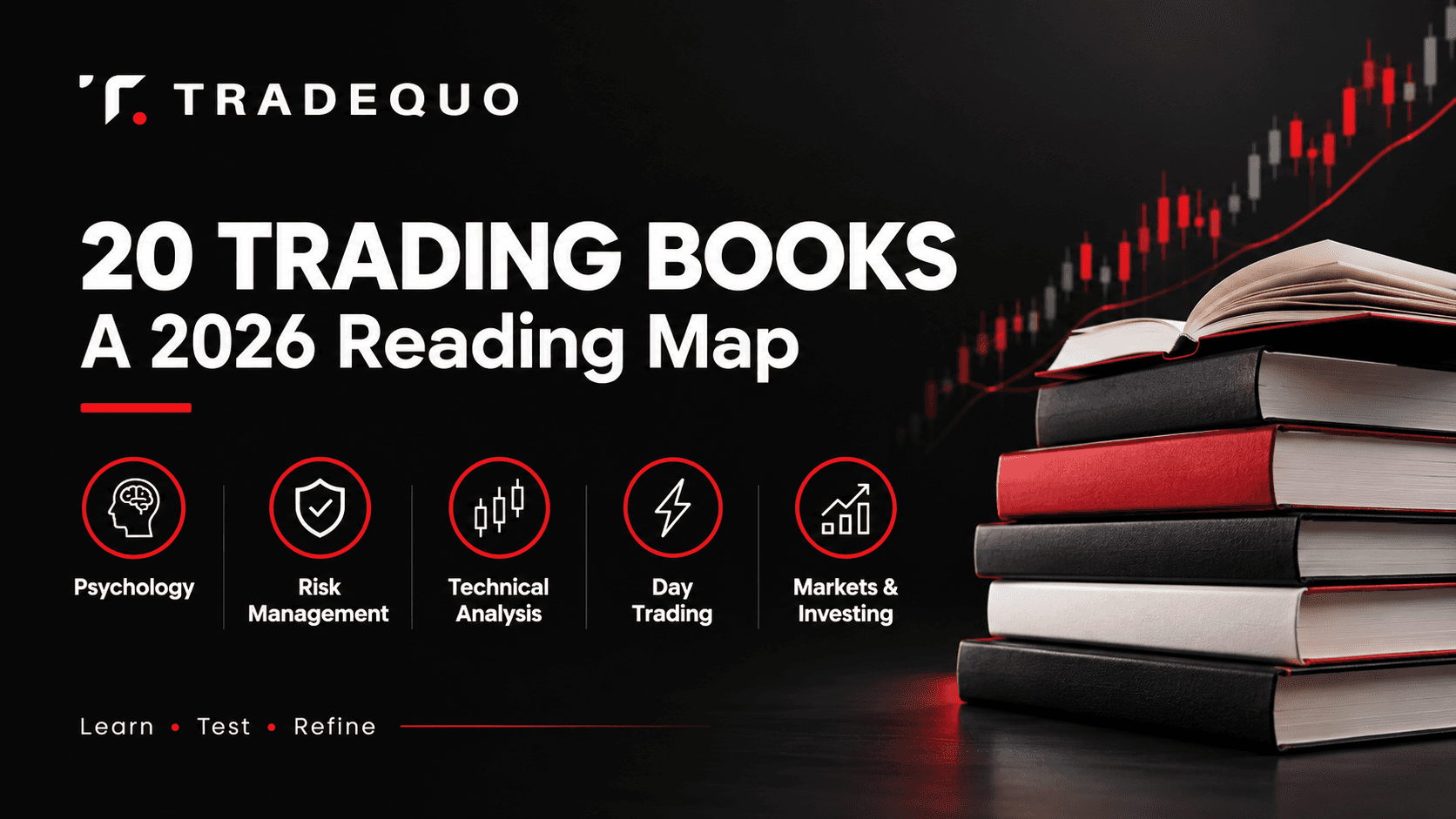
The books below are grouped conceptually, but each offers lessons that apply across markets, including stocks, forex, and crypto. Together, they form a solid foundation for beginners and a refinement toolkit for advanced traders.
1. Trading in the Zone by Mark Douglas
First published: 2000
Few books on trading psychology have influenced more traders than this one. Mark Douglas explains why most traders fail despite having good strategies.
Douglas argues that the market is neutral, random, and indifferent. Your suffering comes from expecting certainty in an environment that guarantees none. He introduces the idea of probabilistic thinking, where losses are not mistakes but statistical outcomes.
What makes this book powerful is that Douglas doesn’t motivate; you’ll almost feel uncomfortable reading it. He strips away the illusion of control and replaces it with responsibility.
Key Takeaways
Your trading performance is a mirror of your internal beliefs. You do not control outcomes. You control execution. Emotional discipline is crucial for trading success.
Why It Matters in 2026
As markets move faster, mental stability is the edge. This is one of the best books on trading psychology ever written and remains essential for every successful trader.
🔗Find it here: https://www.amazon.com/Trading-Zone-Confident-Discipline-Attitude/dp/0735201447
2. The Disciplined Trader by Mark Douglas
First published: 1990
This is the foundation on which Trading in the Zone was built. Douglas focuses on belief systems: how traders unconsciously sabotage themselves by needing to be right, avoid pain, or chase validation.
He introduces the idea that discipline is not willpower, but alignment between beliefs and behavior.
Key Takeaways
Mindset is not optional. It is the first system you build. Consistency comes from thinking in probabilities rather than certainty.
Why It Matters in 2026
For novice traders and intermediate traders, this book helps build the right mindset before capital is put at risk.
🔗 Find it here: https://www.amazon.com/Disciplined-Trader-Developing-Winning-Attitude/dp/0132157578
3. Market Wizards by Jack Schwager
First published: 1989
Schwager interviews elite traders across futures, equities, and macro markets. What’s shocking isn’t their strategies - it’s how different they all are.
Some rely on fundamentals. Others on charts. Some hold for years. Others for minutes.
The common thread? Risk control, self-awareness, and emotional discipline.
Key Takeaways
Market Wizards shows that money can be made in a variety of ways by a variety of people. There is no single correct trading system.
Why It Matters in 2026
The Market Wizards books prove that adaptability and self-awareness are more important than copying strategies.
🔗 Find it here: https://www.amazon.com/Market-Wizards-Interviews-Top-Traders-ebook/dp/B006X50OPW
4. Reminiscences of a Stock Operator by Edwin Lefevre
First published: 1923
Based on Jesse Livermore’s life, this book reads like a novel, but it’s a case study in human behavior.
Livermore’s cycles of massive success and devastating failure show how ego, overconfidence, and lack of risk control can destroy even the most talented traders.
Key Takeaways
Markets change, but human behavior does not. Overconfidence, discipline, and risk management define long-term success.
Why It Matters in 2026
It remains one of the most important trading books ever written because it focuses on market psychology and decision-making.
🔗 Find it here: https://www.amazon.com/Reminiscences-Stock-Operator-Edwin-Lefèvre/dp/0471770884
5. The Intelligent Investor by Benjamin Graham
First published: 1949
This is not a trading book - it’s a risk philosophy.
Graham introduces “Mr. Market,” the margin of safety, and the difference between investing and speculation. Even if you never buy a stock for the long term, this book teaches you how professionals think about risk.
Key Takeaways
Risk comes from not knowing what you are doing. Focus on the margin of safety and long-term thinking.
Why It Matters in 2026
Even active traders benefit from understanding fundamentals. This is one of the best books on fundamental analysis ever written.
🔗 Find it here: https://www.amazon.com/Intelligent-Investor-Definitive-Value-Investing/dp/0060555661
6. One Up on Wall Street by Peter Lynch
First published: 1989
Lynch demystifies investing. He shows how ordinary people often spot trends before institutions do, if they pay attention and do the work.
This book teaches classification (stalwarts, growers, turnarounds) and reinforces the importance of understanding what you own.
Key Takeaways
Invest in what you understand. Do your own research. Growth opportunities exist before Wall Street notices.
Why It Matters in 2026
This book remains relevant to traders who blend investing and trading strategies in the stock market.
🔗 Find it here: https://www.amazon.com/One-Up-Wall-Street-Already/dp/0743200403
7. A Random Walk Down Wall Street by Burton Malkiel
First published: 1973
This book introduces Efficient Market Theory and argues that beating the market consistently is extremely difficult. Even traders benefit from this perspective, as it resets expectations and highlights the importance of diversification and discipline.
Key Takeaways
Markets are difficult to beat consistently. Diversification and discipline matter.
Why It Matters in 2026
Understanding efficient market theory helps traders set realistic expectations and manage risk tolerance.
🔗 Find it here: https://www.amazon.com/Random-Walk-Down-Wall-Street/dp/0393358380
8. The Stock Trader’s Almanac by Jeffrey Hirsch
An annual resource focused on seasonal trends and historical market data.
This isn’t theory - it’s historical behavior. Seasonal tendencies, election cycles, and recurring patterns are analyzed with data, not opinions.
Key Takeaways
Markets exhibit seasonal patterns. Historical data can inform better timing decisions.
Why It Matters in 2026
For active traders, this book is crucial for understanding recurring market behavior.
🔗 Find it here: https://stocktradersalmanac.com
9. How to Day Trade for a Living by Andrew Aziz
First published: 2016
One of the most practical best day trading books available. Aziz focuses on process, not promises: setups, risk rules, journaling, and psychology.
Key Takeaways
Day trading requires structure, discipline, and proper risk management. Execution speed matters.
Why It Matters in 2026
This book provides an approachable introduction for beginners who want to start trading actively.
🔗 Find it here: https://www.amazon.com/How-Day-Trade-Living-Management/dp/1535585951
10. The Playbook by Mike Bellafiore
First Published: 2013
Written by the co-founder of a professional trading firm, this book explains how professional traders think. It reveals how professional trading desks actually operate: preparation, review, metrics, and constant improvement.
Key Takeaways
Preparation and review matter more than prediction. Trading is a performance business.
Why It Matters in 2026
It offers insight into professional trading systems and disciplined execution.
🔗 Find it here: https://www.amazon.com/Playbook-Inside-Think-Professional-Trader/dp/B08S2VSZPR
11. Trade Your Way to Financial Freedom by Van K. Tharp
First published: 1998
Van Tharp was a pioneer of trading psychology, but this book is his masterpiece on system architecture. He shatters the myth of the "Holy Grail" entry signal. Instead, he introduces the concept of R-multiples - viewing every trade not in dollars, but as a multiple of your initial risk.
Key Takeaways
Position sizing and exits are more important than entries. Proper risk management defines survival.
Why It Matters in 2026
This is one of the best trading books for beginners who want a structured approach. In 2026, as algorithmic trading reacts to every headline, Tharp’s focus on position sizing is what keeps you from "blowing up" your account during a flash crash.
🔗 Find it here: https://www.amazon.com/Trade-Your-Way-Financial-Freedom/dp/007147871X
12. Mastering the Trade by John Carter
First published: 2005
John Carter provides a rare look into the daily life of a professional trader. This book is famous for introducing the "TTM Squeeze" - a technical setup that identifies periods where market volatility is "compressing" before an explosive move. Carter balances this with "Internal Indicators," showing you how to read what the big institutional "smart money" is doing behind the scenes.
Key Takeaways
Market structure and timing matter. Discipline separates a good trader from a losing one.
Why It Matters in 2026
Useful for intermediate and advanced traders refining technical strategies.
🔗 Find it here: https://www.amazon.com/Mastering-Trade-Third-Techniques-Profiting/dp/1260121593
13. The Art and Science of Technical Analysis by Adam Grimes
First published: 2012
If you want a book that tells you "this pattern works 100% of the time," look elsewhere. Grimes brings a skeptical, data-driven lens to the world of charts. He argues that most of the market is "noise" (random movement) and that a trader’s job is to find the rare moments where price action is non-random. It’s a dense, academic, yet deeply rewarding read for the serious student.
Key Takeaways
Patterns must be tested statistically. Context matters more than indicators.
Why It Matters in 2026
This is one of the best books on technical analysis for traders seeking evidence-based methods.
14. Technical Analysis of the Financial Markets by John Murphy
First published: 1986
Often referred to as the "Bible of Technical Analysis," Murphy’s work is the foundational text for the Chartered Market Technician (CMT) exams. It covers everything: from the Dow Theory and basic support/resistance to intermarket analysis (how gold affects the dollar, which affects stocks).
Key Takeaways
Technical analysis applies across asset classes. Trends, support, and resistance drive price.
Why It Matters in 2026
Price moves in trends, and history repeats itself because human psychology never changes.
🔗 Find it here: https://www.amazon.com/Technical-Analysis-Financial-Markets-Comprehensive/dp/0735200661
15. Japanese Candlestick Charting Techniques by Steve Nison
First published: 1991
Before Steve Nison, the Western world used boring bar charts. Nison traveled to Japan to uncover the secrets of Munehisa Homma - the 18th-century rice trader who became one of the most successful traders of his era. This book teaches you how to read the "heartbeat" of the market through Dojis, Hammers, and Engulfing patterns.
Key Takeaways
Candlesticks reveal market psychology. Patterns reflect shifts in supply and demand.
Why It Matters in 2026
Still the gold standard for understanding candlestick charting techniques. Even the most advanced AI bots are programmed to recognize these specific visual psychological triggers.
🔗 Find it here: https://www.amazon.com/Japanese-Candlestick-Charting-Techniques/dp/0735201811
16. Encyclopedia of Chart Patterns by Thomas Bulkowski
First published: 2000
Bulkowski is the "Moneyball" scout of the trading world. He analyzed thousands of charts to provide success rates for every pattern imaginable. Want to know the "failure rate" of a Head and Shoulders Top? Bulkowski has the percentage.
Key Takeaways
Not all patterns are equal. Probability matters.
Why It Matters in 2026
Advanced traders benefit from understanding which patterns actually work.
🔗 Find it here: https://www.wiley.com/en-us/Encyclopedia+of+Chart+Patterns%2C+3rd+Edition-p-9781119739685
17. Naked Forex by Alex Nekritin and Walter Peters
First published: 2012
A price action-focused guide to the forex market.
In an era where people clutter their screens with twenty different colorful indicators, Naked Forex is a breath of fresh air. The authors advocate for "clean" charts. They teach you to read raw price action - speed, momentum, and rejection - without the lag of indicators like MACD or RSI.
Key Takeaways
Simple price-based strategies can outperform complex systems. Indicators are optional. It's best for Forex traders who feel overwhelmed by "analysis paralysis."
Why It Matters in 2026
One of the best Forex trading books for traders seeking clarity and discipline.
🔗 Find it here: https://www.amazon.com/Naked-Forex-High-Probability-Techniques/dp/1118114019
18. The Best Loser Wins by Tom Hougaard
First published: 2022
This is perhaps the most important psychological book of the decade. Hougaard, a high-stakes day trader, argues that we are biologically "wired" to fail at trading. Our brains want us to cut profits short (to feel a "win") and hold onto losses (hoping to avoid "pain"). Success is the art of doing the exact opposite.
Key Takeaways
The ability to accept losses defines long-term success. Risk tolerance must be trained.
Why It Matters in 2026
Essential reading for traders struggling with emotional control: "The goal of a trader is not to be right, but to make money when they are right and lose little when they are wrong."
🔗 Find it here: https://www.amazon.com/Best-Loser-Wins-Thinking-high-stake/dp/085719822X
19. The Psychology of Money by Morgan Housel
First published: 2020
While not a "trading" book per se, Housel’s work is essential for anyone managing capital. He explores why brilliant people make terrible financial decisions. He teaches that wealth is what you don't see - it's the cars not bought and the ego kept in check. In 2026, this remains the gold standard for long-term financial sanity.
Key Takeaways
Success with money is more about behavior than intelligence.
Why It Matters in 2026
This book connects trading psychology with long-term financial success. It's best for investors who need to bridge the gap between "earning" and "keeping."
🔗 Find it here: https://www.amazon.com/Psychology-Money-Timeless-lessons-happiness/dp/0857197681
20. The Man Who Solved the Market by Gregory Zuckerman
First published: 2019
This is the thrilling narrative of Jim Simons and his firm, Renaissance Technologies. Simons, a mathematician, built a "Medallion Fund" that averaged ~66% gross annual returns for decades by using quantitative models. It’s a cautionary and inspiring tale of how data, when used correctly, can systematically beat the "gut feeling" of every human on Wall Street.
Key Takeaways
Data, discipline, and adaptation can outperform intuition.
Why It Matters in 2026
It provides the historical context for the AI and machine-learning revolution we are living through today.
🔗 Find it here: https://www.amazon.com/Man-Who-Solved-Market-Revolution/dp/073521798X
Bonus Recommendations for Personal Development
Atomic Habits by James Clear - Essential for building consistent trading routines.
The One Thing by Gary Keller - Helps traders focus on mastering execution rather than collecting endless strategies.
The Power of Habit by Charles Duhigg - Understand how to reprogram impulsive trading behaviors.
How To Apply These Books To Become A Better Trader

Reading these must-read trading books is just the beginning. Successful traders extract principles from multiple sources and synthesize them into a personalized approach. Start by identifying your biggest weakness, whether technical knowledge, risk management, or psychology, then focus on books addressing that specific area.
Many traders make the mistake of reading dozens of books without implementing anything. Instead, read one book thoroughly, identify three actionable concepts, and practice them for at least a month before moving to the next resource. This focused approach builds competence faster than superficial exposure to many ideas.
Consider keeping a trading journal where you document insights from your reading and how they apply to your actual trades. When Mark Douglas explains how beliefs shape performance, test his ideas by tracking your emotional state before each trade. When John Murphy outlines technical patterns, practice identifying them in real-time before risking capital.
Building a comprehensive trading education means reading across categories. Study technical analysis to understand chart patterns and market structure. Read about trading psychology to develop emotional discipline. Explore books on successful traders to see how diverse approaches can all work. Add perspectives on fundamental analysis and market mechanics to round out your knowledge.
Final Remarks
Remember that knowledge without execution means nothing in trading. The disciplined trader takes insights from books and tests them systematically, adapts what works, and discards what doesn't. Your investment strategy should evolve as you gain experience, but the foundation these books provide will serve you throughout your trading career.
The difference between most traders and successful traders often comes down to continuous learning and self-improvement. These 20 books provide the knowledge base, but your commitment to applying these lessons determines your results. Start with the books most relevant to your current challenges, implement their teachings methodically, and watch your trading performance improve over time.
FAQs
What Are The Best Trading Books For Beginners?
The best trading books for beginners include Trading in the Zone, How to Day Trade for a Living, and Trade Your Way to Financial Freedom because they cover mindset, structure, and risk management.
Are Trading Books Still Relevant In 2026?
Yes. Markets evolve, but human behavior, risk, and psychology remain constant. That is why classic trading books continue to provide value.
Which Books Focus Most On Trading Psychology?
Trading in the Zone, The Disciplined Trader, and The Best Loser Wins are considered the best books on trading psychology.
What Are The Best Books On Technical Analysis?
Technical Analysis of the Financial Markets, Japanese Candlestick Charting Techniques, and The Art and Science of Technical Analysis are essential technical analysis books.
Can Reading Trading Books Improve Performance?
Yes. Books help traders avoid common mistakes, understand market mechanics, and develop the discipline needed for consistent execution.