Introducción
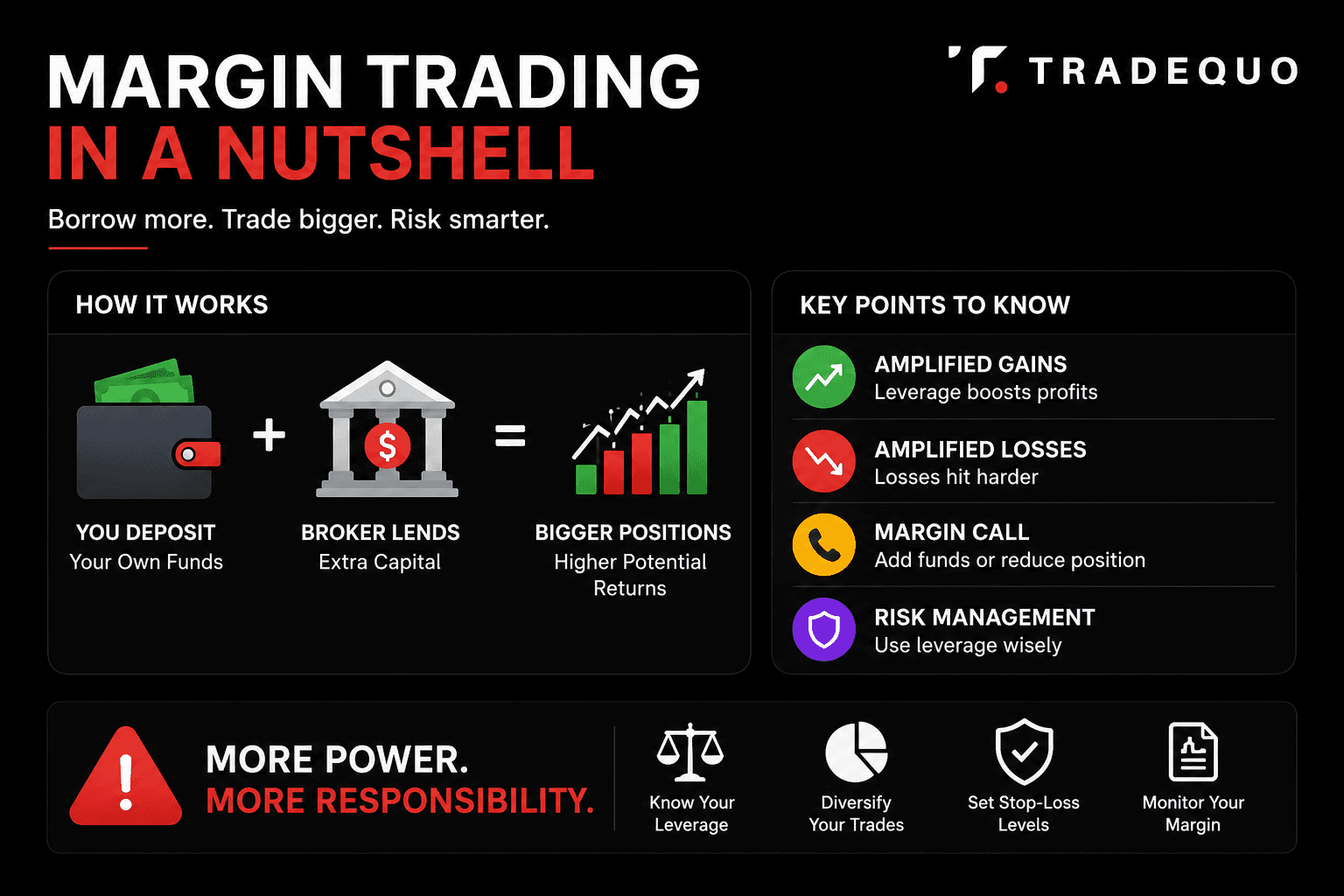
El margen trading da a los operadores acceso a capital que aún no tienen. En esencia, consiste en tomar prestado dinero de un bróker para comprar instrumentos financieros, ya sean acciones o pares de divisas (forex). Su atractivo es evidente: con más poder adquisitivo, incluso los movimientos de precios más modestos pueden traducirse en retornos significativos. Sin embargo, esa misma amplificación funciona en ambas direcciones. Antes de que un operador abra su primera posición apalancada, es fundamental que comprenda a fondo el margen trading.
Exploremos cómo funcionan las cuentas de margen, cuáles son los riesgos reales en la práctica y cómo abordar todo esto sin que se convierta en una lección costosa.
Cómo funcionan las cuentas de margen
Para empezar a hacer margen trading, necesita una cuenta de margen, que es diferente de una cuenta de efectivo estándar. Una cuenta de efectivo le limita a operar únicamente con los fondos que deposite. Por el contrario, una cuenta de margen le permite a su bróker prestarle capital adicional, utilizando sus fondos depositados y sus activos existentes como garantía.
Requisitos de margen inicial
Cuando abre una posición utilizando fondos prestados, su bróker le exige que realice un depósito de margen inicial. En los Estados Unidos, la Regulación T (establecida por la Reserva Federal) generalmente limita el margen inicial al 50% para la mayoría de los valores, lo que significa que puede pedir prestado hasta el 50% del precio de compra de una acción. Si desea comprar acciones por valor de $10.000, necesitará al menos $5.000 en su cuenta.
Margen de mantenimiento
Una vez abierta la posición, se activa un límite diferente: el margen de mantenimiento. Este es el capital mínimo de la cuenta que debe mantener en relación con el valor total de sus posiciones. La mayoría de los brókers lo fijan entre el 25% y el 40%, aunque puede ser mayor según el tipo de activo o las políticas propias del bróker.
Un ejemplo sencillo: Supongamos que deposita $5.000 y pide prestados otros $5.000 para comprar acciones por valor de $10.000. Su capital es de $5.000, lo que representa el 50% del valor total de la posición. Si la acción cae a $7.000, el monto prestado sigue siendo de $5.000, pero su capital ahora es de solo $2,000, lo que equivale aproximadamente al 28.5% del valor de la posición. Si el margen de mantenimiento de su bróker es del 30%, usted ya está en incumplimiento y se aproxima una llamada de margen.
Esta dinámica es lo que hace que operar con cuentas de margen sea fundamentalmente diferente de operar solo con su propio capital. Las matemáticas avanzan rápido y no siempre a su favor.
Beneficios y riesgos del margen trading
La ventaja: retornos amplificados
El principal atractivo del margen trading es el apalancamiento. Cuando controla una posición mayor de la que su propio capital permitiría normalmente, un movimiento de precio que genera un retorno del 5% sobre la posición total podría representar una ganancia del 10% o incluso del 20% sobre su capital real invertido, dependiendo de cuánto haya pedido prestado.
Para operadores experimentados con una perspectiva muy sólida sobre un activo en particular, este apalancamiento puede marcar una diferencia significativa en los retornos absolutos. También es útil para estrategias a corto plazo donde los márgenes de beneficio ajustados se benefician de posiciones de mayor tamaño.
El margen trading también permite a los operadores diversificar en más posiciones de forma simultánea, en lugar de concentrar todo su propio capital en una sola operación.
La desventaja: las pérdidas se amplifican de la misma manera
Todo lo que funciona a su favor en las ganancias, funciona en su contra en las pérdidas. Una caída del 10% en un activo que mantiene con un apalancamiento de 1:2 se traduce en una pérdida del 20% de su capital invertido, sin incluir los cargos por intereses de los fondos prestados.
Los riesgos del margen trading aquí no son meramente teóricos. Las posiciones apalancadas en mercados volátiles, especialmente en activos como acciones de beta alta, pueden moverse en contra de un operador con muy poco aviso. Y a diferencia de una posición en efectivo, donde su pérdida se limita a lo que depositó, una posición de margen puede, en teoría, generar pérdidas que superen su depósito original si el mercado sufre una caída abrupta antes de que el bróker pueda actuar.
También hay que considerar el costo del préstamo. Los brókers cobran intereses sobre los préstamos de margen, y esos cargos se acumulan diariamente. Una operación que parece rentable en el papel puede verse afectada de manera significativa por los costos de financiación si se mantiene durante un período prolongado.
Llamadas de margen y liquidación
Qué desencadena una llamada de margen
Una llamada de margen ocurre cuando el capital de su cuenta cae por debajo del requisito de margen de mantenimiento. En ese momento, su bróker se pondrá en contacto con usted y le exigirá que deposite fondos adicionales o cierre algunas de sus posiciones para que la cuenta vuelva a cumplir con los requisitos.
El plazo para responder a una llamada de margen varía según el bróker. Algunos le dan un día o más para responder; otros, en especial en mercados que se mueven con rapidez, pueden actuar casi de inmediato. Este es un detalle importante que debe aclarar antes de abrir una cuenta de margen.
Qué sucede si no responde
Si no cumple a tiempo con una llamada de margen o si la cuenta continúa deteriorándose, el bróker puede y por lo general comenzará a liquidar sus posiciones sin su consentimiento. No necesitan su permiso. El derecho del bróker a liquidar es una cláusula estándar en los contratos de cuentas de margen, y existe para protegerlos de pérdidas sobre el capital que le han prestado.
Aquí es donde se vuelve doloroso: la liquidación forzosa no siempre ocurre a precios favorables. Si mantiene posiciones en un mercado a la baja y su bróker empieza a vender para cubrir la insuficiencia de margen, es posible que venda al precio que el mercado ofrezca en ese instante. Podría terminar asumiendo pérdidas en el peor momento posible.
Esta es también la razón por la que mantener grandes posiciones apalancadas durante períodos de alta volatilidad es especialmente peligroso. Un movimiento intradía brusco puede desencadenar una llamada de margen y una liquidación forzosa antes de que el operador tenga la oportunidad de responder.
Ejemplo de margen trading: Un escenario de llamada de margen
Supongamos que un operador deposita $3,000 y pide prestados $3,000 a su bróker, lo que le da un total de $6,000 para invertir en una acción que cotiza a $60 por acción. Eso equivale a 100 acciones. El margen de mantenimiento del bróker es del 30%.
Si la acción cae a $42 por acción, la posición ahora vale $4,200. Después de restar el préstamo de $3,000, el capital del operador es de $1,200, lo que representa aproximadamente el 28.6% del valor de la posición, por debajo del límite del 30%. Se activa una llamada de margen. El operador debe depositar más fondos o vender acciones para volver a cumplir con los requisitos.
Si la acción cae aún más antes de que actúe, la situación se complica rápidamente.
Fórmula de margen trading

Los operadores suelen calcular el capital de la cuenta utilizando una fórmula sencilla:
Capital = Valor total de la posición − Fondos prestados
Ejemplo:
Valor de la posición = $7,000
Fondos prestados = $5,000
Capital = $2,000
El porcentaje de capital determina si se produce una llamada de margen:
Ratio de capital = Capital ÷ Valor de la posición
En este ejemplo:
2,000 ÷ 7,000 = 28.6%
Si el bróker exige un margen de mantenimiento del 30%, el operador recibe una llamada de margen.
Consideraciones regulatorias
El margen trading no funciona en el vacío. En los Estados Unidos, está regulado por un conjunto de normas estructuradas por niveles y diseñadas para proteger tanto a los inversores individuales como al sistema financiero en general.
Organismos reguladores clave
La Autoridad Reguladora de la Industria Financiera (FINRA) y la Comisión de Bolsa y Valores (SEC) establecen las reglas básicas para las cuentas de margen en los EE. UU. La Regulación T, establecida por la Reserva Federal, rige la cantidad de crédito que los brókers pueden otorgar para la compra de valores.
Bajo la Regla 4210 de FINRA, los brókers deben mantener requisitos mínimos de margen para las cuentas de los clientes. Para la mayoría de los valores de renta variable, el margen inicial es del 50% y el margen de mantenimiento es de un mínimo del 25%, aunque muchos brókers imponen requisitos más altos, especialmente para acciones volátiles o ETF apalancados.
Cómo varían los requisitos de margen
Los requisitos de margen no son uniformes en todas las clases de activos. Los requisitos de margen en forex funcionan de manera diferente a las reglas de margen de acciones, y a menudo se expresan como un porcentaje del valor nominal de la operación en lugar de un margen inicial fijo del 50%.
Las opciones, los futuros y los CFD también tienen sus propios marcos de margen. La metodología de cálculo, los límites de mantenimiento y las reglas en torno a las llamadas de margen difieren entre sí. Es precisamente por esto que comprender la política de margen de su bróker es la base de todo lo demás.
Por qué importan las políticas del bróker
Dos brókers pueden cumplir con los mismos mínimos regulatorios y, aun así, tener políticas significativamente diferentes sobre los márgenes de mantenimiento, los procedimientos de llamadas de margen y los plazos de liquidación. Un bróker puede darle 24 horas para responder a una llamada de margen; otro puede liquidar posiciones en cuestión de una hora en un mercado rápido. Leer la letra pequeña antes de fondear una cuenta de margen es una medida de higiene financiera básica, no solo una precaución excesiva.
Estrategias de gestión de riesgos
El margen trading se puede utilizar de manera responsable, pero requiere disciplina y un conjunto claro de controles de riesgo. Aquí se presentan enfoques prácticos que los operadores experimentados utilizan para evitar que el apalancamiento se convierta en un inconveniente.
Monitoree su nivel de margen con regularidad. La mayoría de las plataformas de negociación muestran su utilización de margen actual en tiempo real. Mantener una estrecha vigilancia sobre este número, especialmente durante períodos de volatilidad elevada, le da tiempo para actuar antes de que una llamada de margen le obligue a tomar medidas.
Utilice órdenes de stop-loss. Un stop-loss cierra automáticamente una posición si alcanza un precio predeterminado, limitando sus pérdidas antes de que puedan acumularse hasta el punto de desencadenar una llamada de margen. Esta es una de las herramientas de gestión de riesgos más sencillas disponibles y resulta especialmente valiosa en el comercio apalancado, donde los movimientos ocurren rápidamente.
Evite el apalancamiento máximo. El hecho de que su bróker ofrezca un apalancamiento de 1:4 o 1:10 no significa que deba utilizarlo. Muchos operadores experimentados utilizan mucho menos del máximo disponible, tratando el apalancamiento como una herramienta para una amplificación moderada en lugar de una exposición máxima.
Empiece poco a poco. Para quienes son nuevos en el trading apalancado, utilizar un margen mínimo mientras aprenden la mecánica es mucho más sensato que descubrir los riesgos a través de una gran pérdida.
Mantenga un colchón de efectivo. Mantener capital en reserva en lugar de emplearlo todo en posiciones apalancadas le ofrece flexibilidad para cumplir con los requisitos de margen sin verse obligado a vender en el peor momento posible.
Conclusión
El margen trading es un mecanismo poderoso, pero premia la preparación y castiga la complacencia. Tomar prestado para comprar amplifica tanto las ganancias como las pérdidas, y la mecánica de los márgenes de mantenimiento, las llamadas de margen y la liquidación forzosa hacen que las cosas puedan escalar rápidamente cuando los mercados se mueven en contra de una posición apalancada. Los reguladores han establecido límites de protección, pero estos no sustituyen la gestión de riesgos personales. Que el margen trading se adapte a su enfoque de inversión depende enteramente de su tolerancia al riesgo, su conocimiento de los instrumentos con los que opera y su capacidad para monitorear y gestionar las posiciones de forma activa. Utilizado con prudencia, puede mejorar significativamente los retornos. Utilizado sin cuidado, los costos llegan rápido y de manera contundente.
FAQs
¿Qué es el margen trading en términos sencillos?
El margen trading consiste en tomar prestado dinero de su bróker para comprar instrumentos financieros más allá de lo que su propio capital le permitiría. Los fondos prestados están garantizados con el saldo y los activos existentes en su cuenta, que actúan como colateral.
¿Qué sucede durante una llamada de margen?
Una llamada de margen ocurre cuando el capital de su cuenta cae por debajo del requisito de margen de mantenimiento del bróker. Su bróker le pedirá que deposite fondos adicionales o cierre posiciones para restablecer el nivel de capital requerido. Si no actúa a tiempo, el bróker puede liquidar sus posiciones automáticamente.
¿Es el margen trading adecuado para principiantes?
El margen trading conlleva un riesgo significativo y, por lo general, es más adecuado para operadores experimentados que comprenden el apalancamiento y cuentan con una gestión de riesgos sólida. Los principiantes interesados en el margen trading deberían comenzar con un apalancamiento muy bajo, informarse sobre las políticas específicas de su bróker y utilizar herramientas como las órdenes de stop-loss desde el principio.
¿Cómo difieren los requisitos de margen entre los distintos activos?
Los requisitos varían considerablemente según el tipo de activo y el bróker. Las acciones estadounidenses suelen seguir la regla de margen inicial del 50% de la Regulación T, mientras que los márgenes de forex se calculan de manera diferente y pueden ser mucho más bajos, lo que significa que se dispone de un mayor apalancamiento. Confirme siempre los requisitos específicos con su bróker antes de operar.
¿Cuál es la diferencia entre apalancamiento y margen en el trading?
El margen es el depósito que usted realiza como garantía para abrir una posición apalancada. El apalancamiento es la relación que describe qué tan grande es la posición que puede controlar en comparación con ese depósito. Por ejemplo, una relación de apalancamiento de 1:2 significa que con $5,000 en margen, puede controlar una posición de $10,000. Ambos conceptos están estrechamente vinculados, pero el margen se refiere al requisito de capital, mientras que el apalancamiento describe el efecto multiplicador en su exposición.
¿Qué es un nivel de margen seguro?
Un nivel de margen seguro depende de la estrategia del operador, pero muchos operadores experimentados intentan mantener la utilización del margen por debajo del 50% de su garantía disponible para reducir el riesgo de llamadas de margen durante la volatilidad normal del mercado.