差價合約(CFD)是複雜的金融工具,並因槓桿作用而具有迅速虧損的高風險。您在投資前應考慮自己是否了解差價合約如何運作。

Oil Price Today: What Moves WTI and Brent

If you have ever wondered why gas prices seem to swing from one month to the next, the answer usually traces back to a handful of forces that shape crude oil markets every single day. Understanding what drives oil prices isn't just useful for economists or policymakers. For anyone trading CFDs on crude, it is the foundation everything else is built on.

Let's explore the key drivers behind oil prices, the difference between WTI and Brent, and how traders can position themselves around these movements.

What Determines Global Oil Prices?

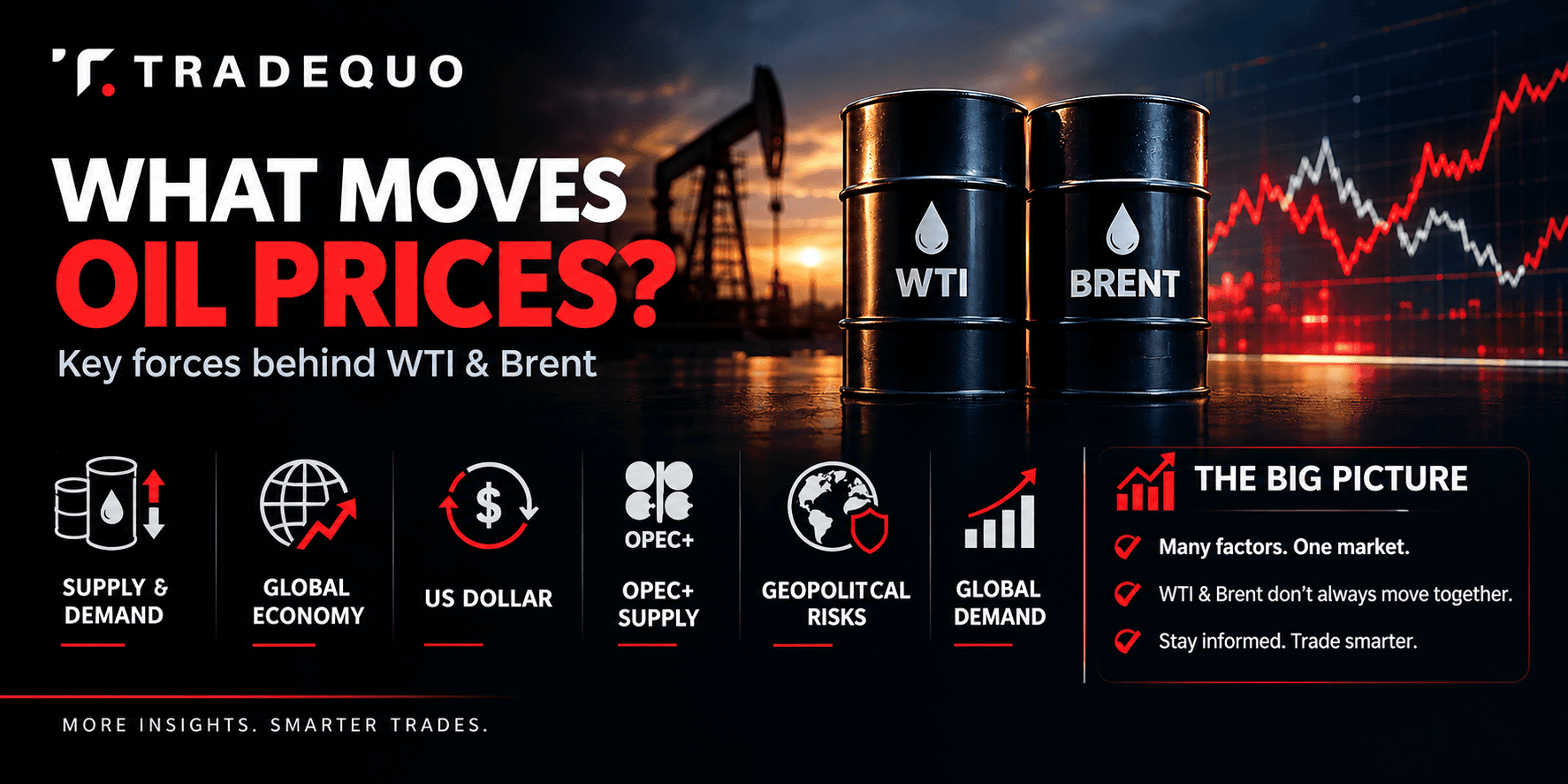
what determines oil prices

At its core, the price of oil comes down to supply and demand, but the story is rarely that simple. Global supply and demand for oil sit at the center of nearly every price swing, and when production outpaces consumption, an oversupply builds up that tends to push prices lower. The opposite is also true. When supply tightens relative to demand, prices climb.

Beyond the basic balance sheet, oil prices reflect expectations. Traders and analysts are constantly pricing in what they believe will happen to global economic growth, industrial activity, and demand for transportation fuel months down the line. This is why oil can move sharply on a single piece of news, even before any barrels have physically changed hands. Perceptions about where supply and demand are headed often matter as much as where they currently stand.

Another factor that affects oil prices in a way that is easy to overlook is currency. Oil is priced globally in US dollars, which means the strength of the dollar has a direct effect on demand. When the dollar strengthens, oil becomes more expensive for buyers using other currencies, which can soften demand and put downward pressure on prices. A weaker dollar tends to do the reverse, making crude more affordable abroad and supporting higher prices.

WTI vs Brent Crude Oil: What's the Difference?


WTI vs Brent Crude Oil

Ask most retail traders what determines the price of oil, and you will quickly run into two names: West Texas Intermediate and Brent Crude. Both are considered light, sweet crude oil grades, but where they come from and how they get to market make a meaningful difference in price.

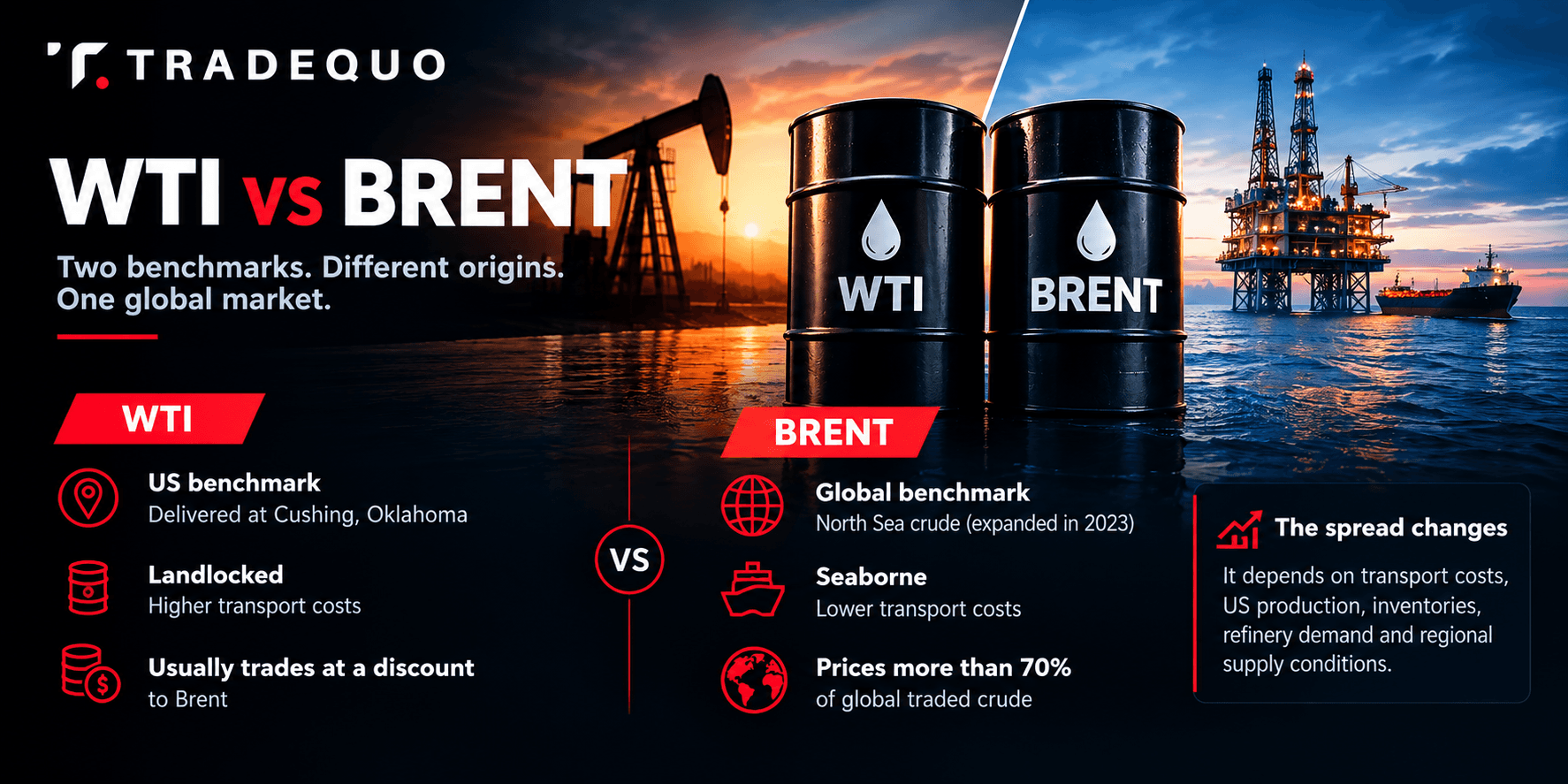
WTI is the main US crude oil benchmark, with futures contracts tied to physical delivery at Cushing, Oklahoma. Its pricing is influenced by US production, pipeline flows, inventories, and conditions at the Cushing hub. Brent is the leading global crude oil benchmark, historically based on North Sea crude streams. Its benchmark basket was expanded in 2023 to include WTI Midland from the US Permian Basin. It is widely used as a reference price for roughly two-thirds of the world's internationally traded crude oil.

Brent often trades at a premium to WTI, but the spread changes with transportation costs, US production and exports, inventories, refinery demand, and regional supply-and-demand conditions. Export costs and transport logistics both play a role, and the Brent-WTI spread widens or narrows depending on regional supply conditions and how easily crude can move to where it is needed. In mid-2018, for example, that spread widened to more than 6 dollars a barrel as US production surged faster than pipeline capacity could keep up.

Inventory data also plays into this comparison. Falling crude inventories often signal tighter supply, which tends to support higher prices, while rising stockpiles suggest the market is better supplied than demand requires. Regular data releases on crude inventories act as a barometer that traders watch closely, and WTI in particular is closely influenced by US crude inventory reports and domestic production statistics.

OPEC+ and Global Oil Supply

No conversation about oil-producing countries is complete without OPEC. The Organization of the Petroleum Exporting Countries, working alongside allied producers under the OPEC+ banner, has long played an outsized role in global crude oil prices. In 2018, OPEC members produced roughly 32–33 million barrels of crude oil per day, making the group one of the world's most important sources of supply. At the end of 2018, OPEC members held about 79.4% of the world's proven crude oil reserves.

OPEC+ production targets directly influence how tight or loose the market feels at any given time. Production quotas and output adjustments made by the group dictate a significant portion of global oil supply, which means a decision to cut output can tighten supply and lift prices, while an agreement to raise production can ease prices by adding more barrels to the market.

That said, OPEC's grip on the market is not what it once was. Its influence peaked during the 1973 oil crisis, when the group's actions could move prices dramatically on their own. Since then, the rise of US shale oil production has diluted that dominance. The US averaged about 9.3 million barrels of crude oil production per day in 2017, with output rising rapidly as shale production expanded.

Geopolitical Risk and Supply Shocks

Oil does not trade in a vacuum, and geopolitical tensions in energy-producing regions can shift market sentiment almost overnight. Conflict, sanctions, or instability near major supply routes create uncertainty about whether oil will keep flowing at expected volumes, and that uncertainty alone can move prices even before any actual supply disruption occurs.

This is often described as a risk premium. Fears of supply disruptions build a cushion into the price that reflects the possibility of trouble ahead, not necessarily trouble that has already happened. Tensions in the Middle East are a recurring example of this dynamic, frequently acting as bullish support for oil prices even in periods when demand forecasts are softening.

Economic sanctions on major producing nations fit into this picture too, restricting the flow of crude from a given country and forcing buyers to seek alternative sources, which can tighten global supply. The pricing of both WTI and Brent is shaped by this mix of global macroeconomics and geopolitical developments layered on top of the more mechanical supply and demand fundamentals.

The US Dollar and Crude Oil Prices

The link between currency markets and crude oil deserves its own spotlight, because it is one of the more consistent relationships in commodity trading. Since oil is priced in US dollars worldwide, movements in the dollar's value ripple through to oil demand almost automatically. A stronger dollar raises the effective cost of oil for buyers holding other currencies, which can dampen demand and weigh on prices.

This relationship means traders watching oil prices today often keep one eye on the currency markets, since dollar strength or weakness can amplify or offset moves driven by supply and demand fundamentals elsewhere in the market.

Global Demand and Economic Growth

Global oil demand is highly dependent on how major economies are performing. When industrial output, manufacturing activity, and consumer spending are strong, demand for transportation fuel and energy climbs alongside them. When growth slows, or a recession takes hold, that demand can fall quickly, often faster than producers can adjust supply.

History offers some clear examples of how macroeconomic shocks feed through to oil prices. The 2008 financial crash caused Brent Crude prices to drop by more than 100 dollars a barrel as demand collapsed alongside the broader global economy. More recently, in 2020, oil prices fell to 20 year lows as the COVID-19 pandemic brought travel and industrial activity to a near standstill. Just two years later, in 2022, oil prices peaked above 120 dollars per barrel as geopolitical tensions layered on top of a demand recovery, showing how quickly sentiment can swing in the opposite direction.

Longer-term shifts in energy use also factor into demand forecasts. Renewable energy adoption and the growth of electric vehicles are gradually reducing global reliance on oil in some markets, and in 2020 renewable sources generated nearly a third of global electricity. Should demand for oil dwindle meaningfully over time, OPEC may respond with further supply cuts to help stabilize prices, adding another layer to an already complex picture.

It is also worth noting that market speculation shapes prices independently of physical supply and demand. Oil futures contracts allow traders to speculate on where prices are headed, and this speculative activity can amplify price swings. In the lead-up to the 2008 financial crisis, speculation was seen as a contributing factor to rising oil prices before the eventual collapse.

How to Trade Oil Price Movements

For traders, crude oil offers exposure to some of the clearest macro narratives in financial markets, from OPEC+ meetings to inventory reports to shifting geopolitical headlines. Oil futures and spread betting are two of the most common ways to gain exposure to price moves without holding physical barrels, and CFD trading has become a popular route for retail traders who want to speculate on both rising and falling prices without needing storage facilities or refinery access.

Because crude oil trading carries high risk, especially around scheduled data releases and geopolitical headlines, many traders build their strategy around key recurring events. Weekly inventory data from sources like the Energy Information Administration, OPEC+ meeting outcomes, and major economic releases tend to be the moments when oil moving sharply is most likely, so keeping a calendar of these dates is a practical habit for anyone active in this market.

Conclusion

Oil prices sit at the crossroads of global supply decisions, geopolitical developments, currency movements, and shifting demand from major economies. None of these forces work in isolation, which is exactly what makes crude oil such a closely watched and heavily traded market. For traders who want to stay active even when the standard trading week winds down, Tradequo offers the ability to trade oil on weekends, so headline risk from geopolitical events does not have to wait until Monday to be addressed.

FAQs

What is the difference between WTI and Brent crude oil?

WTI is the US benchmark, delivered at Cushing, Oklahoma, while Brent is the global benchmark historically sourced from the North Sea, expanded in 2023 to include Permian Basin crude, and used to price more than 70% of oil traded internationally. Both are light, sweet grades, but WTI usually trades at a discount to Brent because landlocked delivery adds transport costs that seaborne Brent avoids.

Why does Brent crude usually cost more than WTI?

Brent is produced close to shipping routes, which keeps transport costs down, while WTI has to move from an inland delivery point, adding expense along the way. This gap has kept Brent priced above WTI in most years since 2016, with the spread stretching past 6 dollars a barrel by the middle of 2018.

What causes oil prices to change from day to day?

The short answer is the balance between supply and demand. OPEC+ decisions on production, which controlled roughly 47 percent of global crude output in 2024, supply disruptions from conflict or extreme weather, weekly inventory figures, and the broader pace of global economic growth all feed into daily price moves.

Does the value of the US dollar affect oil prices?

Yes. Since oil is priced in US dollars everywhere, a stronger dollar makes crude more expensive for buyers using other currencies, which can soften demand and pull prices lower. A weaker dollar tends to have the opposite effect, supporting demand and prices.

Has WTI crude ever traded at a negative price?

It has, and it remains one of the most extraordinary moments in oil market history. On April 20, 2020, WTI futures fell to negative 37.63 dollars a barrel, the first negative settlement ever recorded, as collapsing pandemic-era demand left storage at Cushing nearly full. Brent oil price dropped sharply as well but held above zero, closing that day at 19.33 dollars, largely because offshore storage gave it more flexibility.

Disclaimer: Trading CFDs, including oil and other commodities, involves a high level of risk and may not be suitable for all investors. Leverage can work both for and against you, magnifying both profits and losses. Past performance is not a reliable indicator of future results. Please ensure you understand the risks involved and seek independent financial advice if necessary before trading.

深受大家喜愛

深受市場信賴

2025 年獎項
2025 年獎項
2025 年獎項

© 2026 Trade Quo. All rights reserved.

This website provides content by group of companies, which include:

Tradequomarkets Financial Services L.L.C is a registered, authorised and regulated company by the Securities and Commodities Authority (SCA) of the United Arab Emirates, with License No. 20200000320 Category 5, to carry out regulated activities of Financial Consultations and Introduction. Its registered office is located at Business Tower, Main Business Village 114499 Dubai, UAE.

Tradequomarkets LTD (2023/C0024). Located at #8 Jepson Lane, St. George, Goodwill, Commonwealth of Dominica

Trade Quo Global Ltd, a securities dealer firm that is authorized and regulated by the Seychelles Financial Services Authority (FSA) with license number SD140.

Tradequo (PTY) Ltd is licensed in South Africa by the Financial Sector Conduct Authority with FSP license number 54827. The registered office: 33rd Floor – 34 Whiteley Road, 2196, Johannesburg, South Africa.

Quo Markets LLC, registered with Financial Services Authority FSA: 3171 LLC 2024. Registered address: Suite 305, Griffith Corporate Centre, Beachmont, Kingstown, SVG.

Tqbg Ltd, registered in Cyprus with registration number HE438084, registered address Archiespiskopou Makariou III 160 1st floor, 3026, Limassol, Cyprus. Is apointed payment agent, and does not engage in any regulated activities.

Risk Warning: CFDs are complex instruments and come with a high risk of losing money rapidly due to leverage. 72.6% of retail investor accounts lose money when trading CFDs with this provider. You should consider whether you understand how CFDs work and whether you can afford to take the high risk of losing your money.

Regional Restrictions: This website including the information and materials contained in it, is not directed at, or intended for distribution to or use by, any person or entity who is a citizen or resident of the following countries: USA, Israel, Iran, Iraq, Russia, Afghanistan, Cuba, Cyprus, Eritrea, Liberia, Libya, Somalia and Syria or any jurisdiction where such distribution, publication, availability or use would be contrary to applicable law or regulation.

TradeQuo and its affiliates do not target EEA clients.

深受大家喜愛

深受市場信賴

2025 年獎項
2025 年獎項
2025 年獎項

© 2026 Trade Quo. All rights reserved.

This website provides content by group of companies, which include:

Tradequomarkets Financial Services L.L.C is a registered, authorised and regulated company by the Securities and Commodities Authority (SCA) of the United Arab Emirates, with License No. 20200000320 Category 5, to carry out regulated activities of Financial Consultations and Introduction. Its registered office is located at Business Tower, Main Business Village 114499 Dubai, UAE.

Tradequomarkets LTD (2023/C0024). Located at #8 Jepson Lane, St. George, Goodwill, Commonwealth of Dominica

Trade Quo Global Ltd, a securities dealer firm that is authorized and regulated by the Seychelles Financial Services Authority (FSA) with license number SD140.

Tradequo (PTY) Ltd is licensed in South Africa by the Financial Sector Conduct Authority with FSP license number 54827. The registered office: 33rd Floor – 34 Whiteley Road, 2196, Johannesburg, South Africa.

Quo Markets LLC, registered with Financial Services Authority FSA: 3171 LLC 2024. Registered address: Suite 305, Griffith Corporate Centre, Beachmont, Kingstown, SVG.

Tqbg Ltd, registered in Cyprus with registration number HE438084, registered address Archiespiskopou Makariou III 160 1st floor, 3026, Limassol, Cyprus. Is apointed payment agent, and does not engage in any regulated activities.

Risk Warning: CFDs are complex instruments and come with a high risk of losing money rapidly due to leverage. 72.6% of retail investor accounts lose money when trading CFDs with this provider. You should consider whether you understand how CFDs work and whether you can afford to take the high risk of losing your money.

Regional Restrictions: This website including the information and materials contained in it, is not directed at, or intended for distribution to or use by, any person or entity who is a citizen or resident of the following countries: USA, Israel, Iran, Iraq, Russia, Afghanistan, Cuba, Cyprus, Eritrea, Liberia, Libya, Somalia and Syria or any jurisdiction where such distribution, publication, availability or use would be contrary to applicable law or regulation.

TradeQuo and its affiliates do not target EEA clients.

深受大家喜愛

深受市場信賴

2025 年獎項
2025 年獎項
2025 年獎項

© 2026 Trade Quo. All rights reserved.

This website provides content by group of companies, which include:

Tradequomarkets Financial Services L.L.C is a registered, authorised and regulated company by the Securities and Commodities Authority (SCA) of the United Arab Emirates, with License No. 20200000320 Category 5, to carry out regulated activities of Financial Consultations and Introduction. Its registered office is located at Business Tower, Main Business Village 114499 Dubai, UAE.

Tradequomarkets LTD (2023/C0024). Located at #8 Jepson Lane, St. George, Goodwill, Commonwealth of Dominica

Trade Quo Global Ltd, a securities dealer firm that is authorized and regulated by the Seychelles Financial Services Authority (FSA) with license number SD140.

Tradequo (PTY) Ltd is licensed in South Africa by the Financial Sector Conduct Authority with FSP license number 54827. The registered office: 33rd Floor – 34 Whiteley Road, 2196, Johannesburg, South Africa.

Quo Markets LLC, registered with Financial Services Authority FSA: 3171 LLC 2024. Registered address: Suite 305, Griffith Corporate Centre, Beachmont, Kingstown, SVG.

Tqbg Ltd, registered in Cyprus with registration number HE438084, registered address Archiespiskopou Makariou III 160 1st floor, 3026, Limassol, Cyprus. Is apointed payment agent, and does not engage in any regulated activities.

Risk Warning: CFDs are complex instruments and come with a high risk of losing money rapidly due to leverage. 72.6% of retail investor accounts lose money when trading CFDs with this provider. You should consider whether you understand how CFDs work and whether you can afford to take the high risk of losing your money.

Regional Restrictions: This website including the information and materials contained in it, is not directed at, or intended for distribution to or use by, any person or entity who is a citizen or resident of the following countries: USA, Israel, Iran, Iraq, Russia, Afghanistan, Cuba, Cyprus, Eritrea, Liberia, Libya, Somalia and Syria or any jurisdiction where such distribution, publication, availability or use would be contrary to applicable law or regulation.

TradeQuo and its affiliates do not target EEA clients.