差價合約(CFD)是複雜的金融工具,並因槓桿作用而具有迅速虧損的高風險。您在投資前應考慮自己是否了解差價合約如何運作。

What is USDT? The Digital Dollar Behind TradeQuo's New Card?

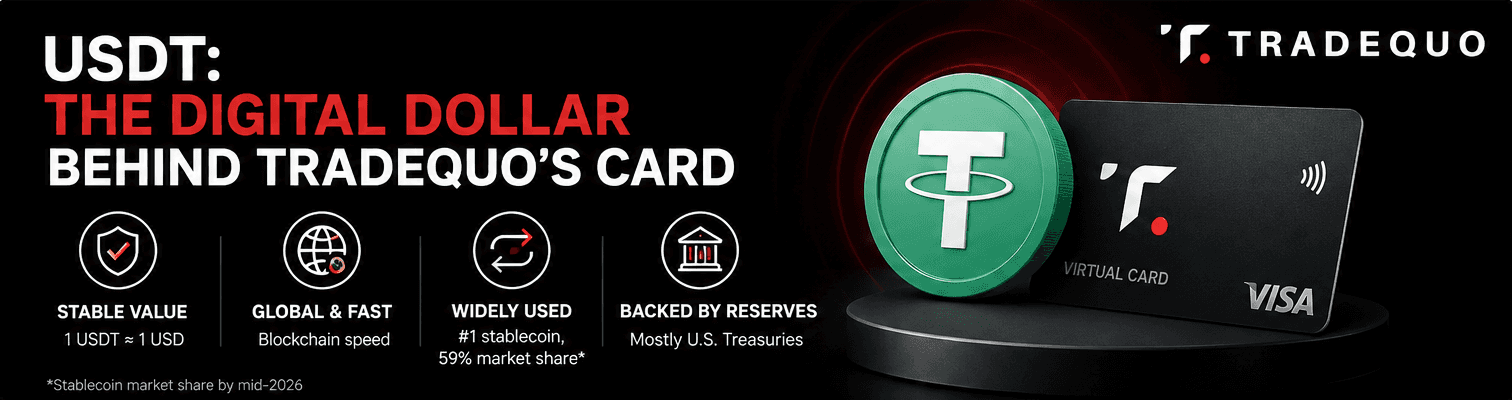
Bitcoin can drop 10% before lunch and recover by dinner. USDT doesn't do that. It's designed to sit quietly at roughly one dollar per token, no matter what the rest of the crypto market is doing, which is exactly why people call it a "digital dollar."

That stability is also what makes TradeQuo's new card worth paying attention to. Fund it from any of your wallets, and your balance is automatically converted into USDT, so no matter what you deposit, you're left holding a steady, dollar-pegged balance you can spend online, without the delays of traditional banking.

USDT itself works as a bridge between everyday money and the crypto world: it moves at blockchain speed, trades on nearly every exchange, and gives traders a stable place to hold value between positions. It's that same stability, translated into a spendable balance, that powers the card.


What Is USDT?

USDT Meaning in Simple Terms

USDT is a "stablecoin" created by Tether Limited. Tether (USDT) was launched in July 2014 as RealCoin before being rebranded. Its purpose is straightforward: each Tether token aims to track the value of one US dollar, matching fiat currency in a blockchain environment. The USD itself is a fiat currency issued by the US government, and USDT mirrors its value digitally.

Stablecoins are cryptocurrencies designed to reduce market volatility. They are typically pegged to fiat currencies like the US dollar, providing a low-volatility solution compared to other digital currencies. Tether (USDT) is the most widely used stablecoin globally - its market cap was nearly $99 billion by March 2024, and by mid - 2026 that figure has grown past $186 billion, representing roughly 59% of the total stablecoin market.

Key facts about how Tether USDT works:

  • USDT is pegged to the US dollar at 1:1, meaning each token targets a stable value of $1.

  • USDT exists on several blockchains - Tether operates on multiple blockchains, including Ethereum and Tron, plus Solana, the Liquid Network, and others. It originally launched on Bitcoin's Omni Layer, which used a transport protocol built on the Bitcoin blockchain.

  • Tether tokens work as digital tokens built on these chains, letting users choose between faster or cheaper networks when sending USDT.

  • USDT has become one of the most traded crypto assets in the entire cryptocurrency market, often ranking third by market cap after Bitcoin and Ethereum.

How Does USDT Maintain Its Price Stability?

Tether works through a "mint-and-burn" system. When institutional clients deposit funds, Tether Holdings Limited issues new Tether tokens. When clients redeem, those tokens are destroyed. This keeps supply aligned with demand and anchors the Tether price near $1.

What backs those Tether coins? Tether claims to back USDT tokens with reserves including cash and cash equivalents, US Treasury bills, secured loans, precious metals like gold, and even some Bitcoin. The composition has shifted over time: Tether reported holding $63 billion in U.S. Treasuries as of 2023, and by Q2 2025, that figure climbed past $127 billion in US government debt. Treasury bills now dominate Tether's reserves, reinforcing price stability.

This is a centralized model. Stability depends on Tether Holdings' reserve management and on users' confidence that they can redeem at or near $1-not on algorithmic smart contracts. Tether publishes quarterly attestations on its transparency page to show reserves exceeding USDT liabilities, and quarterly reports on its reserve holdings to support that claim.

The Tether price can briefly slip below $1 during stress. USDT briefly dipped to $0.95 during market panics, though deep liquidity and arbitrage trading on exchanges typically pull it back within hours. USDT can fluctuate in value based on market conditions, but it avoids major price shifts unlike Bitcoin or Ethereum under normal circumstances.

Think of it this way: 1 USDT ≈ 1 USD, backed by reserves plus market trust. That trust is the mechanism that keeps the peg alive.

Why USDT Matters for Traders


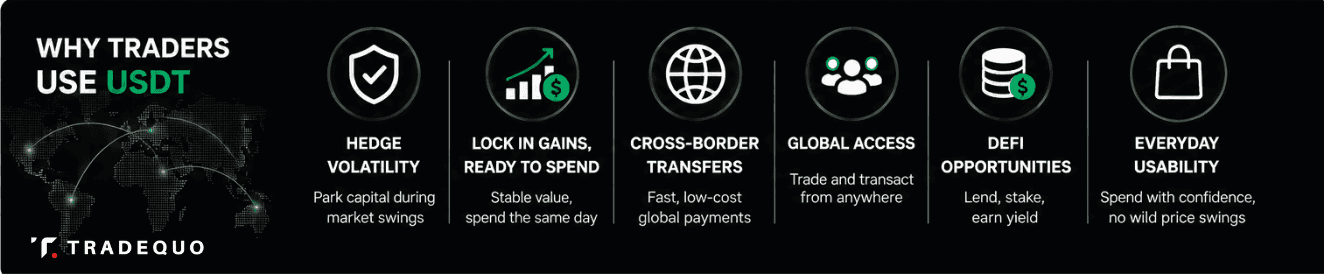
Why traders use USDT

USDT functions as a convenient "parking space" during market volatility. When the crypto market turns sharply, traders can exit Bitcoin or altcoins into USDT-a stable asset-to avoid drawdowns while staying inside the crypto ecosystem.

Because USDT provides liquidity across virtually all centralized and decentralized exchanges, it serves as a base currency for most crypto trading pairs. USDT is extensively used as a trading pair and to denominate crypto positions, and stablecoins are used in decentralized finance (DeFi) for lending and staking, expanding its role beyond simple trading.

  • Hedging volatility. USDT allows traders to park capital in a stable asset during volatile market swings, then deploy into new positions when opportunities arise.

  • Locking in gains, ready to spend. When a trade pays off, converting to USDT lets you hold that value at a stable $1, instead of watching it swing with the market. From there, moving funds into your TradeQuo card means you can spend those gains the same day - no multi-day bank withdrawal required. 

  • Cross-border transfers. Stablecoins can facilitate fast and low-cost international transfers. USDT provides fast and efficient fund transfers without relying on traditional banking methods, and transactions with USDT settle globally in minutes or seconds via blockchain networks.

  • Global access. USDT enables global participation for traders in regions with restrictive banking infrastructure, whether they are working with the Mexican peso, offshore Chinese yuan, or any other traditional currency. USDT is often used as a base currency in trading pairs on major exchanges worldwide.

  • DeFi participation. Between card spending, USDT can be deployed in lending protocols or liquidity pools to earn yield.

TradeQuo's USDT Card


TradeQuo's USDT Card

TradeQuo clients can activate a virtual card instantly inside the Client Portal - no waiting, beyond standard identity verification (KYC). This is a crypto card at its core: whichever wallet you fund it from, that balance is automatically exchanged into USDT. USDT is the actual asset sitting behind your card balance, which is exactly what keeps it dollar-stable and shielded from the swings of more volatile crypto holdings. The conversion to USDT happens automatically at top-up - there's no manual swap step for you to manage.

The flow in practice looks like this:

  1. Fund from any of your wallets. Your balance is automatically converted to USDT

  2. Spend online or in physical shops wherever the card network is accepted - Apple Pay and Google Pay are both supported. 

  3. Track everything inside the Client Portal. 

A few practical details worth knowing upfront: the card works both online and in physical shops, so your morning coffee run is covered, not just subscriptions and e-commerce. Virtual cardholders can also use contactless ATM withdrawals (PIN support is rolling out by the end of September 2026). A physical card is on the way too, expected in October 2026, which will bring standard ATM withdrawals. 

Note: you can only load your own card from your own wallet - there's no option to fund someone else's account.

There's a one-time $25 issuance fee when you first create the card, and a $20 minimum on that first load, so plan on $45 to get started. After that, top-ups have no added fee, with a $20 minimum per load. If you spend in a currency other than USD, your local bank may apply its own conversion rate at the point of sale - that's outside TradeQuo's fees. Identity verification (KYC) is required before activation, and availability depends on where you're based, so check your status with the support team. 

Benefits of Holding USDT for Card and Trading Activity

USDT allows users to hold dollar-denominated value in a blockchain environment while keeping funds immediately accessible. Here are the core advantages for TradeQuo clients:

Liquidity. With tens of billions of Tether coins in circulation and heavy trading volumes, USDT holders can enter or exit positions with minimal slippage. USDT provides liquidity across virtually every exchange, making it the backbone of most crypto trading pairs.

Flexibility. Holding USDT lets you rapidly switch between trading positions and a stable value. If a sudden market dip creates a buying opportunity, your USDT is ready to deploy. If you would rather spend, the card is loaded and waiting. USDT is digital money that moves at blockchain speed through the banking system's alternative rails.

Everyday usability. Unlike other crypto assets that swing wildly, USDT lets card users treat their balance like digital dollars-predictable, spendable, and not subject to the anxiety of watching a portfolio crash overnight. This psychological benefit helps traders make calmer decisions and avoid panic-selling during sharp downturns in market conditions.

Risks, Controversies, and Regulatory Scrutiny Around USDT

While USDT is useful, it carries real risks that every user should understand. Tether's history includes significant legal and regulatory actions.

In 2019, the New York Attorney General filed a lawsuit against Tether and Bitfinex, alleging they misrepresented reserves and covered up an $850 million shortfall. Tether faced legal scrutiny for covering up losses at Bitfinex. In 2021, Tether settled and agreed to pay an $18.5 million settlement, with no admission of wrongdoing, but the New York Attorney General's office barred Tether from serving New York residents. The New York Attorney General case remains a landmark in stablecoin oversight.

Separately, the Commodity Futures Trading Commission found that between 2016 and 2018, Tether's reserves were only 27.6% backed by fiat at times, far from the "100% backed" claim on the Tether platform. Tether was fined $41 million for misleading reserve claims in 2021. Tether was also investigated for potential Bitcoin price manipulation in 2018, adding further regulatory scrutiny to its record.

Today, Tether claims to hold reserves exceeding all outstanding USDT. In August 2026, Tether announced the completion of its first full financial audit by KPMG, which covered its 2025 financial statements. However, prior to that milestone, Tether had never published a full independent audit under the strictest international standards for the bulk of its operating history. Tether's reserves include other assets beyond Treasuries, such as Bitcoin, gold, and secured loans, whose liquidity in a crisis remains a concern for some analysts.

Additional risks to keep in mind:

  • Depeg risk. USDT can temporarily trade below $1 during extreme market stress, as it did when it briefly hit $0.95.

  • Centralization risk. Tether Holdings Limited is a single company that can freeze addresses or be targeted by regulators in multiple jurisdictions.

  • Counterparty risk. Users rely on Tether's solvency and governance. Unlike fiat money in an insured bank account, USDT has no government deposit guarantee.

How to Acquire, Store, and Sell USDT Safely

Common ways to acquire USDT include centralized exchanges, on-ramp services accepting bank transfers or cards, peer-to-peer markets, and swaps from other digital currencies. Payment processors and on-ramp providers in various countries make it accessible even to newcomers in the crypto world.

One critical safety rule: USDT exists as different technical tokens on different chains. Sending USDT on an ERC-20 address to a TRC-20 wallet, or vice versa, can permanently destroy your funds. Always verify the network before sending USDT.

Best practices for holding USDT:

  • Use reputable wallets and platforms with two-factor authentication.

  • Consider hardware wallets for larger balances not actively used for card spending.

  • Keep only the amount you plan to spend or trade on exchanges.

To sell USDT, transfer it to a supported exchange, trade into your local real-world currencies, and withdraw to a bank account. Alternatively, the TradeQuo card can often bypass the need for cash withdrawals entirely - spend directly without converting through the traditional banking system.

Tether also continues expanding its stablecoin product line. For example, Tether launched USAT and other tokens pegged to different currencies beyond the US dollar, and Tether announced plans for products targeting the Euro and other fiat currencies. Even USD Coin (USDC), the second-largest stablecoin, takes a different approach to reserves, so comparing across the digital currency ecosystem is worthwhile. The Bitcoin network itself does not natively support stablecoins, but layers built on top of it - like Bitcoin's Omni Layer and the Liquid Network - enabled early versions of these digital tokens.

Is USDT Right for You?

USDT is generally well-suited for short-to-medium-term needs: hedging market volatility, moving funds quickly between platforms, and powering tools like the TradeQuo card for everyday spending. It offers a low-volatility solution in a crypto market known for wild swings.

However, USDT is not the same as holding dollars in a regulated bank account with deposit insurance. It should not be treated as a risk-free, long-term savings option. Conservative users may wish to diversify between USDT, USD Coin, and traditional fiat holdings, particularly in jurisdictions where stablecoin regulation is still evolving.

Consider your own risk tolerance and stay informed about new developments. Nothing in this article constitutes financial advice. Before making large allocation decisions involving USDT or other Tether tokens, do your own research or consult a qualified professional.

FAQs

Is USDT a stablecoin? 

Yes. USDT (Tether) is the largest stablecoin in crypto, built to hold a steady $1 value instead of swinging like Bitcoin or Ethereum. It made up roughly 59% of the stablecoin market by mid-2026. 

How does USDT work? 

Tether mints new USDT when clients deposit funds, and burns tokens when clients redeem, keeping supply in line with demand. Reserves backing those tokens are mostly US Treasury bills, plus cash, secured loans, and small allocations to gold and Bitcoin. 

What is USDT used for? 

Traders use it as a stable place to park funds during volatility, and as the default base currency on most exchanges. It's also popular for fast cross-border transfers, DeFi lending, and everyday spending. 

What network is USDT on? 

USDT runs on multiple blockchains, including Ethereum, Tron, Solana, and the Liquid Network. Always confirm the network before sending; using the wrong one (e.g., ERC-20 vs. TRC-20) can permanently lose your funds. 

Is USDT the same as a US dollar? 

Not quite. USDT tracks the dollar's value, but it's a privately issued token backed by Tether's reserves - not government currency, and not deposit - insured. It usually trades near $1, though it briefly dipped to $0.95 during past market stress. 

What's the difference between USDT and USDC? 

Both are dollar-pegged stablecoins, but issued by different companies. USDT (Tether) is the larger of the two; USDC (Circle) is second, with its own reserve and reporting practices. The core 1:1 peg mechanic is similar - the difference comes down to issuer, audit history, and regulatory standing.

深受大家喜愛

深受市場信賴

2025 年獎項
2025 年獎項
2025 年獎項

© 2026 Trade Quo. All rights reserved.

This website provides content by group of companies, which include:

Tradequomarkets Financial Services L.L.C is a registered, authorised and regulated company by the Securities and Commodities Authority (SCA) of the United Arab Emirates, with License No. 20200000320 Category 5, to carry out regulated activities of Financial Consultations and Introduction. Its registered office is located at Business Tower, Main Business Village 114499 Dubai, UAE.

Tradequomarkets LTD (2023/C0024). Located at #8 Jepson Lane, St. George, Goodwill, Commonwealth of Dominica

Trade Quo Global Ltd, a securities dealer firm that is authorized and regulated by the Seychelles Financial Services Authority (FSA) with license number SD140.

Tradequo (PTY) Ltd is licensed in South Africa by the Financial Sector Conduct Authority with FSP license number 54827. The registered office: 33rd Floor – 34 Whiteley Road, 2196, Johannesburg, South Africa.

Quo Markets LLC, registered with Financial Services Authority FSA: 3171 LLC 2024. Registered address: Suite 305, Griffith Corporate Centre, Beachmont, Kingstown, SVG.

Tqbg Ltd, registered in Cyprus with registration number HE438084, registered address Archiespiskopou Makariou III 160 1st floor, 3026, Limassol, Cyprus. Is apointed payment agent, and does not engage in any regulated activities.

Risk Warning: CFDs are complex instruments and come with a high risk of losing money rapidly due to leverage. 72.6% of retail investor accounts lose money when trading CFDs with this provider. You should consider whether you understand how CFDs work and whether you can afford to take the high risk of losing your money.

Regional Restrictions: This website including the information and materials contained in it, is not directed at, or intended for distribution to or use by, any person or entity who is a citizen or resident of the following countries: USA, Israel, Iran, Iraq, Russia, Afghanistan, Cuba, Cyprus, Eritrea, Liberia, Libya, Somalia and Syria or any jurisdiction where such distribution, publication, availability or use would be contrary to applicable law or regulation.

TradeQuo and its affiliates do not target EU/EEA/UK clients.

深受大家喜愛

深受市場信賴

2025 年獎項
2025 年獎項
2025 年獎項

© 2026 Trade Quo. All rights reserved.

This website provides content by group of companies, which include:

Tradequomarkets Financial Services L.L.C is a registered, authorised and regulated company by the Securities and Commodities Authority (SCA) of the United Arab Emirates, with License No. 20200000320 Category 5, to carry out regulated activities of Financial Consultations and Introduction. Its registered office is located at Business Tower, Main Business Village 114499 Dubai, UAE.

Tradequomarkets LTD (2023/C0024). Located at #8 Jepson Lane, St. George, Goodwill, Commonwealth of Dominica

Trade Quo Global Ltd, a securities dealer firm that is authorized and regulated by the Seychelles Financial Services Authority (FSA) with license number SD140.

Tradequo (PTY) Ltd is licensed in South Africa by the Financial Sector Conduct Authority with FSP license number 54827. The registered office: 33rd Floor – 34 Whiteley Road, 2196, Johannesburg, South Africa.

Quo Markets LLC, registered with Financial Services Authority FSA: 3171 LLC 2024. Registered address: Suite 305, Griffith Corporate Centre, Beachmont, Kingstown, SVG.

Tqbg Ltd, registered in Cyprus with registration number HE438084, registered address Archiespiskopou Makariou III 160 1st floor, 3026, Limassol, Cyprus. Is apointed payment agent, and does not engage in any regulated activities.

Risk Warning: CFDs are complex instruments and come with a high risk of losing money rapidly due to leverage. 72.6% of retail investor accounts lose money when trading CFDs with this provider. You should consider whether you understand how CFDs work and whether you can afford to take the high risk of losing your money.

Regional Restrictions: This website including the information and materials contained in it, is not directed at, or intended for distribution to or use by, any person or entity who is a citizen or resident of the following countries: USA, Israel, Iran, Iraq, Russia, Afghanistan, Cuba, Cyprus, Eritrea, Liberia, Libya, Somalia and Syria or any jurisdiction where such distribution, publication, availability or use would be contrary to applicable law or regulation.

TradeQuo and its affiliates do not target EU/EEA/UK clients.

深受大家喜愛

深受市場信賴

2025 年獎項
2025 年獎項
2025 年獎項

© 2026 Trade Quo. All rights reserved.

This website provides content by group of companies, which include:

Tradequomarkets Financial Services L.L.C is a registered, authorised and regulated company by the Securities and Commodities Authority (SCA) of the United Arab Emirates, with License No. 20200000320 Category 5, to carry out regulated activities of Financial Consultations and Introduction. Its registered office is located at Business Tower, Main Business Village 114499 Dubai, UAE.

Tradequomarkets LTD (2023/C0024). Located at #8 Jepson Lane, St. George, Goodwill, Commonwealth of Dominica

Trade Quo Global Ltd, a securities dealer firm that is authorized and regulated by the Seychelles Financial Services Authority (FSA) with license number SD140.

Tradequo (PTY) Ltd is licensed in South Africa by the Financial Sector Conduct Authority with FSP license number 54827. The registered office: 33rd Floor – 34 Whiteley Road, 2196, Johannesburg, South Africa.

Quo Markets LLC, registered with Financial Services Authority FSA: 3171 LLC 2024. Registered address: Suite 305, Griffith Corporate Centre, Beachmont, Kingstown, SVG.

Tqbg Ltd, registered in Cyprus with registration number HE438084, registered address Archiespiskopou Makariou III 160 1st floor, 3026, Limassol, Cyprus. Is apointed payment agent, and does not engage in any regulated activities.

Risk Warning: CFDs are complex instruments and come with a high risk of losing money rapidly due to leverage. 72.6% of retail investor accounts lose money when trading CFDs with this provider. You should consider whether you understand how CFDs work and whether you can afford to take the high risk of losing your money.

Regional Restrictions: This website including the information and materials contained in it, is not directed at, or intended for distribution to or use by, any person or entity who is a citizen or resident of the following countries: USA, Israel, Iran, Iraq, Russia, Afghanistan, Cuba, Cyprus, Eritrea, Liberia, Libya, Somalia and Syria or any jurisdiction where such distribution, publication, availability or use would be contrary to applicable law or regulation.

TradeQuo and its affiliates do not target EU/EEA/UK clients.