Broker fees are rarely loud. They don’t shout; they whisper. And if you’re not listening closely, they quietly cut into your returns trade after trade, year after year.
In 2026, brokers advertise harder than ever. Zero spread. $0 commissions. Lowest fees in the industry. On the surface, broker pricing looks simpler than it did a decade ago. In reality, it’s more layered, more fragmented, and, if we’re honest, more confusing.
Let’s explore what a broker fee actually means, how brokerage fees are structured across markets, and how to compare platforms without falling for headline numbers that don’t tell the full story.
If you trade forex, stocks, ETFs, commodities, or even think about real estate transactions, this matters a lot.
Key Takeaways
Zero spread trading is a pricing model, not a promise of free trading; costs are simply structured differently.
Brokers offer different fee models depending on account type, trading volume, and the currency pair being traded.
Brokerage fees in forex trading go beyond commissions and include spreads, financing costs, and platform-related charges.
The lowest-spread forex brokers are only cost-effective if their average spreads remain stable during active forex market sessions.
What Is a Broker Fee Really?
At its core, a brokerage fee is what a broker charges for executing transactions or providing services on your behalf. That sounds straightforward. But the form that fee takes varies wildly depending on the market. Brokerage fees can be:
A percentage of a transaction
A flat fee
A commission per trade
A spread between buy and sell prices
Or a combination of all of the above
And that’s before we talk about other fees: platform subscriptions, inactivity fees, withdrawal charges, overnight financing costs, or premium features.
Understanding what a broker’s fee is means understanding how you’re paying, not just how much.
Spreads: The Most Invisible Broker Fee
For forex traders especially, the spread is often the main cost, even when brokers insist trading is “commission-free.”
The spread is the difference between the bid (what you can sell for) and ask (what you can buy for) price on a currency pair. Every time you enter a trade, you pay it.
Imagine you want to buy a stock. The market price says $100.00. But the broker’s "ask" price is $100.05. That five-cent difference is the broker spread. It might seem tiny, but if you’re trading thousands of shares, that "invisible" fee is a significant trading cost.
This is why broker spread comparison matters more than almost anything else in forex trading.
Spread Types
Spreads typically appear in three primary forms:
Variable Spreads: These fluctuate with market conditions, widening during volatile periods or low-liquidity sessions. They offer transparency but can create cost uncertainty for trades executed during news events.
Fixed Spreads: Providing predictable costs regardless of market movements, these are favored by traders who prioritize budgeting certainty over potential savings during calm markets.
Raw/ECN Spreads: Often combined with per-trade commissions, these reflect the true interbank market spread. They appeal to high-volume traders who benefit from direct market access despite the additional commission layer.
Minimum Spread vs Average Spread
Many brokers advertise a minimum spread. You’ll see headlines like:
From 0.0 pips
0 pip spread forex broker
Ultra-tight spreads
But minimum spreads only appear in perfect conditions - high liquidity, calm markets, ideal timing. What actually impacts your results are average spreads, which reflect real-world trading. If you want honest broker pricing, always compare:
Average spreads, not minimum
Spreads during volatile sessions
Spreads on the currency pairs you actually trade
This is where many low-spread brokers quietly stop being low-cost at all. A broker might offer 0.0 pips at 3:00 AM when the market is dead, but spike it to 2.0 pips during the New York open. Always check the broker metrics pricing for the times you actually plan to trade.
Zero Spread Brokers: Attractive, but Not Free
In 2026, zero spread brokers are everywhere. Or at least brokers who advertise them. A zero spread forex broker offers accounts where there’s no difference between bid and ask prices. Sounds perfect. And for some strategies, it can be.
But here’s the reality: 0-spread brokers almost always charge a fixed commission per trade, or apply markups to the underlying exchange rate, or both. This leads to the classic comparison: acknowledging raw spreads vs no commission.
Raw Spreads vs No Commission
Raw spread accounts: ultra-tight spreads + commission
No commission accounts: wider spreads, no explicit fee
Neither is inherently cheaper. The real cost depends on: trade size, frequency, trading hours, and volatility. This is why a proper broker's cost comparison table should always convert fees into cost per trade, not marketing slogans.
Commissions: Clear, Honest, and Often Misunderstood
A brokerage commission is a direct charge per trade. It’s common in:
Forex raw spread accounts
Stock and ETF trades
Commodity Futures Trading Commission structures
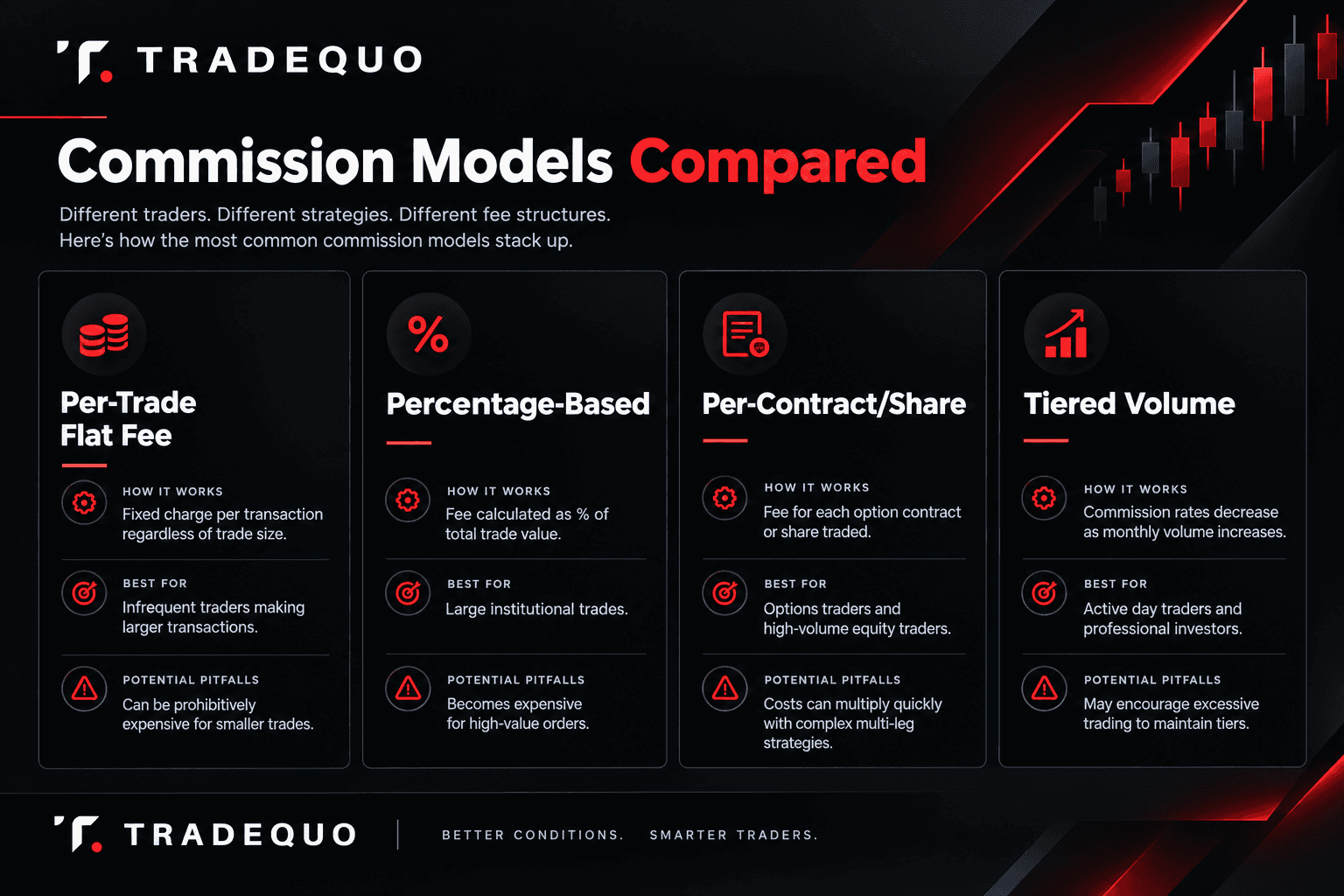
For active traders, commissions still matter, especially with options or futures. Look for:
Tiered pricing (lower rates with volume)
No contract fees
Transparent margin rates
The "Commission-Free" Reality
Many platforms now advertise zero-commission trading for stocks and ETFs, but with limitations. These offers typically:
Exclude certain asset classes like mutual funds or bonds
Apply only to specific account types or balance thresholds
May feature slower execution speeds compared to paid tiers
Often come with payment for order flow arrangements that can impact fill prices
For options traders, even "commission-free" platforms typically charge per-contract fees ranging from $0.50 to $0.65. These small amounts can accumulate significantly for traders employing multi-contract strategies.
Less Obvious Fees That Add Up
Beyond spreads and commissions, several ancillary charges frequently escape traders' attention:
Inactivity Fees: Charged when accounts don't meet minimum trade frequency or balance requirements. These can range from $10-$50 quarterly.
Withdrawal & Transfer Fees: Particularly common with international brokers, these can include wire transfer charges and account closure penalties.
Currency Conversion Margins: Forex and international stock traders often pay 1-2% markups on currency conversions beyond the spread.
Data & Platform Fees: Real-time data feeds, advanced charting tools, and API access often carry monthly subscription costs ranging from $10 to $200+.
Overnight Financing: For positions held beyond daily settlement, swap rates or financing charges apply, especially impactful for leveraged products.
The Fund Expense Trap
Even when broker commissions are low, investment products themselves carry costs. Mutual fund expense ratios (averaging 0.40% for equity funds) and ETF management fees represent ongoing drains. Some brokers also receive 12b-1 fees from fund companies, essentially kickbacks for fund placement, that create potential conflicts of interest.
Full-Service Brokers vs Discount Brokers
In investing, full-service brokers charge more because they offer personalized advice, portfolio management, and financial planning. Fees often range from 1% to 2% of assets under management.
Discount or online brokers, by contrast:
Offer $0 trades
Minimal advice
Self-directed platforms
Robo-advisors sit in between, usually charging 0.20% to 0.30% annually. The right choice depends on whether the service actually improves your investment returns.
Execution Quality: The Fee You Don’t See
Execution quality doesn’t show up on a fee schedule, but it matters. Poor execution leads to:
Slippage
Requotes
Missed entries
Worse fill prices
Two brokers can advertise the same spreads and commissions, but one consistently delivers worse outcomes. This is why experienced traders test platforms hands-on and care about: Execution speed, Liquidity providers, Market maker vs ECN models, and Regulation (NFA, FCA, ASIC, etc.)
Real-World Comparison Example (Hypothetical Figures)
Consider a trader executing 20 monthly EUR/USD trades of 1 standard lot each, with half held overnight:

This simplified comparison reveals how the "cheapest" option varies dramatically based on specific trading behaviors.
The Cost Comparison Framework That Actually Works
Here's a practical approach to comparing brokers without falling for marketing tricks:
Start with your trading profile. Are you a long-term investor making a handful of trades annually? An active day trader? Someone building a diversified portfolio of mutual funds and ETFs? Your answer determines which fees matter most.
Long-term investors should prioritize brokers with no account minimums, zero inactivity fees, and low expense ratios on funds. Even small differences in expense ratios - the annual fees charged by mutual funds and ETFs - compound dramatically over decades. Those 12b-1 fees buried in fund documentation can silently erode returns year after year.
Active traders need to focus elsewhere: low per-trade commissions or zero contract fees for options, competitive margin rates, and fast execution. For you, platform quality and advanced tools might justify paying slightly more in fees if they improve your trading performance.
Demand complete transparency. Insist on a detailed breakdown of all potential expenses in writing before committing to an account. Many brokers list some fees prominently while burying others in lengthy disclosure documents. Read the actual fee schedule, not just the marketing materials. Ask direct questions about every category: trading commissions, account maintenance, data feeds, withdrawal fees, currency conversion, and margin interest rates.
Review regulatory disclosures. The SEC requires brokers to provide Form CRS (Client Relationship Summary), a standardized document summarizing principal fees and potential conflicts of interest. This levels the playing field somewhat, giving you comparable information across different brokers. Actually read this document.
Calculate the total cost of ownership. This means adding up everything: trading costs, account fees, platform costs, and opportunity costs from features you might lose by choosing a cheaper broker. A broker charging slightly higher commissions but offering superior research tools might actually provide better value if those tools improve your returns by even a small percentage.
Practice on Demo
Making Your Decision
Comparing broker fee structures comes down to cutting through marketing language to identify actual costs, then matching those costs against your trading style and needs.
Don't accept vague answers. Don't trust minimum spread claims without seeing average spread data. Don't overlook the fine print on inactivity fees, withdrawal fees, or mandatory platform subscriptions. And definitely don't choose a broker based solely on a single attractive feature while ignoring everything else they'll charge you.
The brokers that survive long-term competition do so by providing genuine value, whether that's superior execution, better tools, educational resources, or truly transparent low-cost structures. Your job is to determine which value proposition aligns with your goals.
Disclaimer: This assessment is based on current brokerage industry practices, regulatory disclosures, and trading cost structures as of 2026. Fee structures evolve continuously, so regular review of your broker's pricing updates remains essential. For personalized advice regarding specific investment decisions, consult with a qualified financial advisor who can consider your complete financial situation.
FAQs
What brokerage fees should I expect when trading with forex brokers?
Brokerage fees in forex trading usually come through spreads, commissions, overnight financing, and other broker charges, depending on the account type and currency pair traded.
Are the lowest spread forex brokers always the cheapest option?
Not necessarily. While lower spreads reduce spread trading costs, many brokers offer tight pricing only during certain forex market conditions and compensate with commissions or other fees.
What is zero spread trading, and is it really free?
Zero spread trading means no visible bid–ask difference, but forex brokers typically offset this with fixed commissions or markups, so trading is never entirely cost-free.
How do brokers charge differently across the forex market?
All forex brokers structure costs differently. Some focus on spreads, others on commissions.
Does the trading platform affect overall forex trading costs?
Yes. An intuitive trading platform with fast execution can reduce slippage and hidden costs, even if broker charges appear slightly higher on paper.