Table of Contents
How Does Forex Trading Work In Practice?
How to Read a Forex Quote
What Is the Spread and Why Does It Matter?
What Is a Pip in Forex?
How Leverage and Margin Work
What Happens If a Trade Moves Against You? (Margin Calls)
Placing a Trade: A Full Step-by-Step Example
How a Trade Closes and Settles
Conclusion
Frequently Asked Questions
How Does Forex Trading Work In Practice?
If you have ever exchanged your home currency for the local money of your destination, you have participated in the foreign exchange market. But for most retail traders, forex trading is something more intentional: the act of buying one currency while simultaneously selling another, not to spend abroad, but to profit from fluctuations in their relative values. It is the world's largest financial market, with trillions of dollars changing hands daily, and it operates differently from stock or commodity trading. There is no central exchange, no single physical location where everything happens. Instead, it’s a vast, decentralized network where currencies are traded electronically by banks, hedge funds, corporations, and individual investors from around the world.
Let's explore how forex trading works based on real examples and how to get started with confidence.
So, How Does Forex Trading Work In Practice?
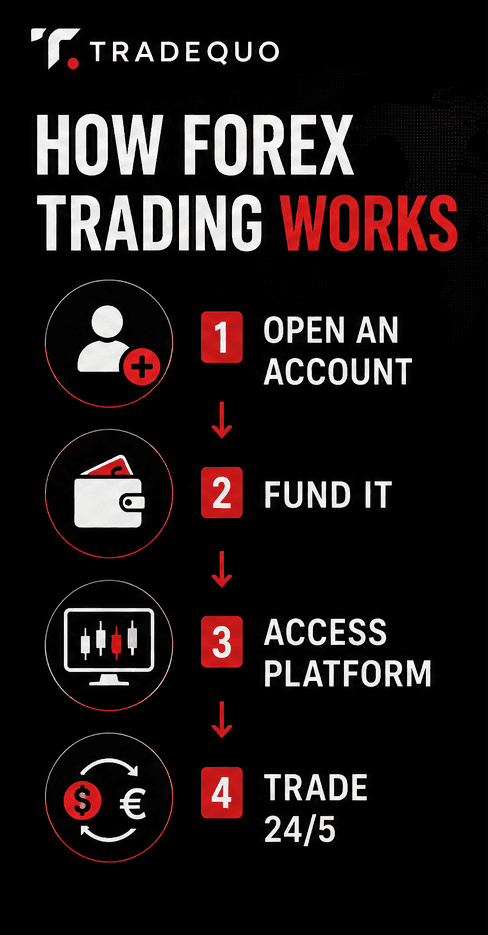
To start trading forex, you open a forex trading account with a broker, deposit funds, and access an electronic platform that connects you to global currency markets. From there, you can begin trading currencies in a fast-moving global marketplace shaped by interest rates, economic data, central banks, and market sentiment.
How to Read a Forex Quote
Forex pairs are always made up of two currencies. The one that comes first is called the base currency, and the one that comes second is the quote currency. Essentially, the exchange rate tells you the cost of the base currency - it shows how much of the quote currency you have to spend to buy one unit of the first.
For example, if EUR USD is quoted at 1.1000, it means one euro equals 1.1000 US dollars. Here, EUR is the base currency, and USD is the quote currency. Buying the pair means buying the base currency and selling the quote currency (expecting the base to rise), while selling the pair means the reverse (expecting it to fall) - a flexibility that lets traders profit whether markets are climbing or falling.
What Is the Spread and Why Does It Matter?
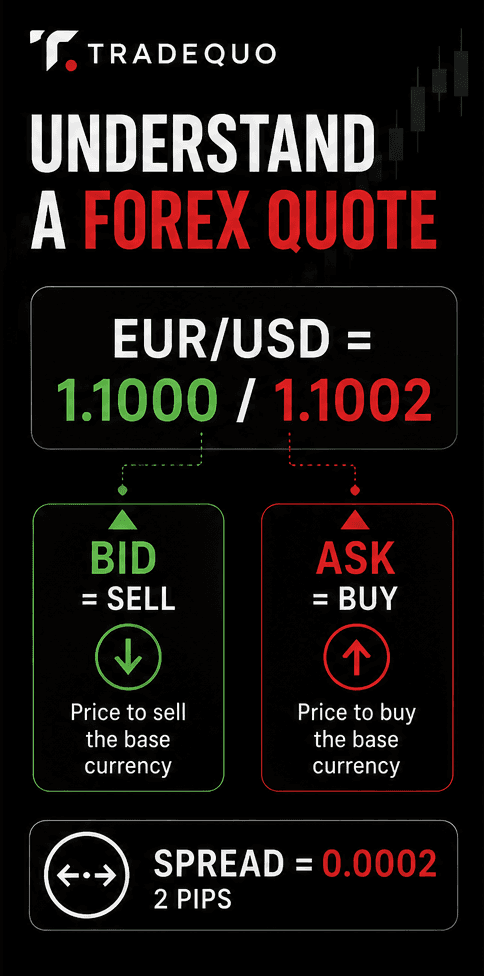
Forex prices are displayed with two numbers, the bid and the ask. For instance, EUR / USD = 1.1000 / 1.1002. The bid is the sell price. It is the price at which you can sell the base currency. The ask is the buy price. It is the price at which you can buy the base currency. The difference between these buy and sell prices is called the spread.
In this example, the spread is 0.0002, or two pips.
What Is a Pip in Forex?
A pip is the standard unit used to measure price movements in forex currency pairs, usually referring to the fourth decimal place. The spread represents the broker’s compensation for facilitating forex transactions.
Even small differences in currency prices matter. If you enter a trade, you begin slightly negative because of the spread. The market price must move in your favour by at least the size of the spread before you break even.
Spreads vary depending on market volatility, liquidity, and the specific forex pair. Major currency pairs such as EUR USD, GBP USD, and USD JPY typically have tighter spreads because they are heavily traded in global FX markets. Exotic currency pairs, which involve one major currency and one from an emerging economy, often have wider spreads and periods of little or no trading.
How Leverage and Margin Work
One reason forex trading is so popular among retail traders is leveraged trading.
Leverage allows you to control a larger position than your initial deposit would otherwise permit. Instead of paying the full value of a trade, you only need to provide margin, which is the initial deposit required to open and maintain a leveraged position.
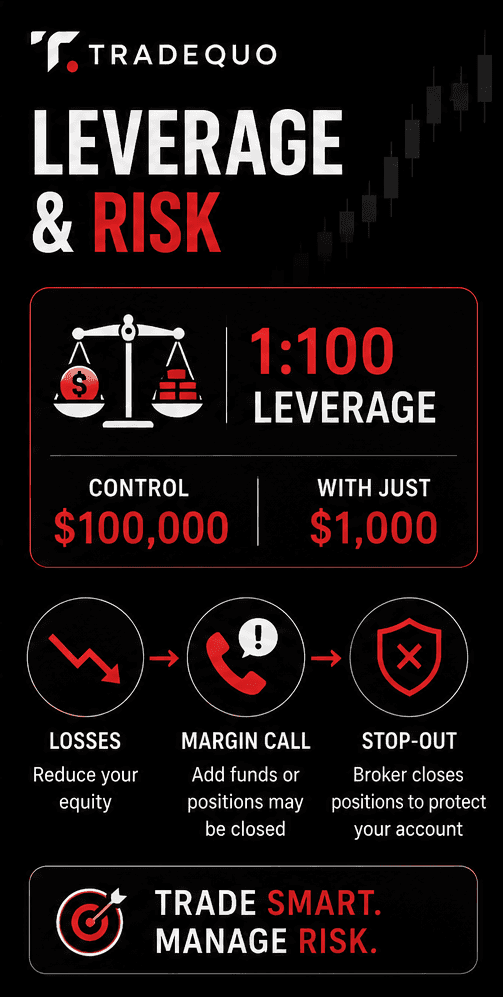
For example, if you use 1 to 100 leverage, you can control 100,000 units of currency with just 1,000 in your forex trading account. A standard lot in forex is 100,000 units of the base currency. Mini lots are 10,000 units, and micro lots are 1,000 units.
Leverage amplifies outcomes. If the market moves in your favour, gains are magnified. If it moves against you, losses are equally magnified. This is why forex markets volatile conditions can quickly impact account balances.
Margin is not a fee. It is a portion of your capital set aside as collateral. If losses reduce your available funds below required levels, you may receive a margin call requiring additional capital.
Because leveraged position exposure can be substantial, responsible risk management is essential. While leverage creates opportunity, it also increases the risk of significant losses in fast-moving financial markets.
What Happens If a Trade Moves Against You? (Margin Calls)
Margin acts as a cushion. As long as your account equity, your balance plus or minus any open profit or loss, stays above the required margin level, your broker leaves your positions alone. But when losses eat into that cushion, things change.
A margin call happens when your equity drops below the minimum margin needed to keep your open positions running. Your broker will typically ask you to deposit additional funds to restore that level. If you don't, or if the market keeps moving against you, most brokers will step in automatically and start closing positions, often the biggest loser first, to bring your account back within safe limits before your balance turns negative.
This is why volatile conditions are especially risky: prices can move sharply within seconds, leaving little time to react before a stop-out occurs. It's also why stop losses and sensible leverage matter so much. They keep you from ever reaching this point.
Placing a Trade: A Full Step-by-Step Example
Let us walk through a simple example to see how forex trading works in practice.
Step one: Choose a pair. Suppose you analyse economic data and believe the euro will strengthen due to improving growth and rising interest rates in the eurozone. You decide to trade EUR USD.
Step two: decide your position size. You choose one standard lot, which equals 100,000 euros.
Step three: check the price. EUR USD is quoted at 1.1000 1.1002. You enter at the ask price of 1.1002 because you are buying.
Step four: calculate margin. If your broker offers 1 to 100 leverage, you need 1 percent of the total position value as margin. The full value of the trade is 100,000 multiplied by 1.1002, which equals 110,020 US dollars. A one percent margin means you must allocate 1,100.20 from your forex account as collateral.
Step five: set risk controls. You place a stop loss at 1.0950 and a take profit at 1.1100. A stop loss automatically closes the trade if the market moves against you beyond a defined level. This protects you from larger losses. A take profit locks in gains if the market reaches your target.
Now consider the pip value. In EUR USD, one pip in a standard lot is typically 10 US dollars. If the price moves from 1.1002 to 1.1052, that is 50 pips. Fifty pips multiplied by 10 equals 500 US dollars profit, before costs.
If the price instead falls to 1.0950, your stop loss is triggered. That represents 52 pips of loss, approximately 520 US dollars.
This example shows how small price movements in currency markets translate into meaningful changes in account equity when trading leveraged positions. Practice this on a demo first - TradeQuo's platform lets you simulate without real money, building confidence in handling forex currency pairs and volatile conditions.
How a Trade Closes and Settles
A trade remains open until you close it manually or it is closed automatically by a stop-loss or take-profit order. When you close a position, the difference between your entry price and closing price determines your profit or loss. That amount is reflected directly in your forex trading account balance.
Because forex trading is a zero-sum environment, every gain corresponds to another participant’s loss. The foreign exchange market matches buyers and sellers continuously, allowing positions to be opened and closed at prevailing market price levels.
Some traders also hold positions overnight, where interest rate differentials between the two currencies may result in a small credit or debit, depending on the pair and direction. Interest rates set by central banks are one of the main drivers of currency prices in global FX markets.
Conclusion
Understanding how forex trading works gives you a clearer view of the opportunities and risks inside the foreign exchange market. You buy one currency, sell another, use margin to control position size, and aim to profit from exchange rate movements.
If you are new to trading currencies, begin with a demo account on TradeQuo. Practising in real market conditions without risking capital is one of the smartest ways to start forex trading and build confidence before moving into live FX trading.
Frequently Asked Questions
What is a pip in forex trading?
A pip is the standard unit used to measure price movement in a currency pair, typically equal to 0.0001 for most pairs and 0.01 for pairs involving the Japanese yen.
How much is one pip worth?
For a standard lot (100,000 units) on most USD-quoted pairs, one pip is worth approximately $10, though the exact value depends on the currency pair and position size.
What is the difference between leverage and margin?
Leverage is the ability to control a position larger than your account balance would normally allow, while margin is the portion of your own funds set aside as collateral to open and maintain that leveraged position.
What triggers a margin call in forex trading?
A margin call happens when losses on open positions reduce your account equity below the broker's required margin level, at which point you may need to deposit additional funds or have positions closed automatically.
What are the most traded currency pairs?
The major currency pairs are the most liquid and frequently traded, including EUR/USD, USD/JPY, GBP/USD, and USD/CHF, and they typically offer the tightest spreads because of how heavily they're traded.
Is the forex market regulated?
Yes, but regulation varies by country and broker; reputable forex providers are licensed by recognized financial authorities that enforce capital requirements and client fund protections.
Disclaimer: CFDs are complex instruments and come with a high risk of losing money rapidly due to leverage. You should consider whether you understand how CFDs work before investing.