CFDは複雑な金融商品であり、レバレッジにより短期間で急速に資金を失う高いリスクがあります。投資する前に、CFDの仕組みを理解しているかどうかをよくご検討ください。

Swing Trading vs Day Trading: Which Is Better?

によって

Table of Contents

  • Introduction

  • What Is Day Trading?

  • What Is Swing Trading?

  • Time Commitment and Lifestyle

  • Risk and Reward

  • Choosing the Right Style

  • Conclusion

  • FAQs

Introduction

There is no shortage of debate in trading communities about which approach reigns supreme. Scroll through any finance forum, and you will find passionate advocates on both sides. The truth, though, is that the swing trading vs day trading conversation is not really about which style is objectively better. It is about which one works for you. Your schedule, your temperament, your financial situation, and your appetite for risk all factor into this decision far more than any leaderboard of returns ever could. Before you commit to a path, it helps to understand exactly what each style demands and what it offers in return.

What Is Day Trading?

Day trading is exactly what the name suggests. Positions are opened and closed within the same trading session, meaning no trades are carried overnight. By the time markets close, a day trader's slate is wiped clean, for better or worse.

Day traders typically focus on highly liquid assets like large-cap stocks, forex pairs, or futures contracts, where tight spreads and rapid price movement create opportunities throughout the session. Technical analysis is the primary toolkit here: candlestick patterns, volume surges, intraday support and resistance levels, and momentum indicators like the RSI or MACD guide decisions that sometimes need to be made in seconds.

The learning curve is steep. Successful day traders develop a sharp ability to read price action in real time, manage positions under pressure, and execute without hesitation. A common day trading strategy involves scalping small price movements multiple times per session, or capitalizing on breakout patterns when a stock surges through a key level on heavy volume.

Consider how day trading plays out in practice. During a volatile earnings season, a day trader might enter a position in a tech stock the moment it breaks above its pre-market high, ride a three percent intraday move, and exit before the afternoon session softens. That same trade, held overnight, would introduce entirely different risks. For the day trader, the discipline is in getting in, getting out, and moving on.

How many trades do day traders make per day? Trade frequency varies widely depending on the strategy. Some scalpers execute many small trades during a session, while other intraday traders focus on only a few carefully selected setups. The goal is consistency, not volume for its own sake.

What Is Swing Trading?

Swing trading occupies the space between the frenetic pace of day trading and the patience of long-term investing. A swing trader holds positions for anywhere from two days to several weeks, aiming to capture a meaningful "swing" in price as a trend develops or reverses.

The approach is less reactive and more deliberate. While technical analysis usually plays a central role, some swing traders also incorporate fundamental or macroeconomic analysis when evaluating potential trades. A trader might identify a company with strong earnings momentum, wait for the stock to pull back to a key support zone, and enter a position expecting it to resume its upward trend. This blend of chart reading and macro awareness is part of what makes swing trading a compelling strategy for those who want a more thoughtful, structured approach.

How long do swing traders hold positions? Many swing trades develop over several days to a few weeks, depending on the market, asset class, and the trader's timeframe. Swing trading in forex, for example, often aligns with macroeconomic catalysts like central bank announcements or employment data releases.

A real-market example: In early 2023, as banking sector volatility took over U.S. markets, many swing traders identified oversold conditions in regional bank stocks after the initial selloff. Those who entered long positions near key support levels and held for one to two weeks captured significant recoveries as sentiment stabilized. That kind of trade requires patience and a plan, two qualities that define the swing trading mindset.

Can swing trading be done part-time? Absolutely, and that flexibility is one of its defining advantages, which brings us to one of the most important points of comparison.

Time Commitment and Lifestyle

This is where the swing trading vs day trading differences become genuinely practical. The time each style demands is not just a scheduling inconvenience. It shapes your entire relationship with the market.

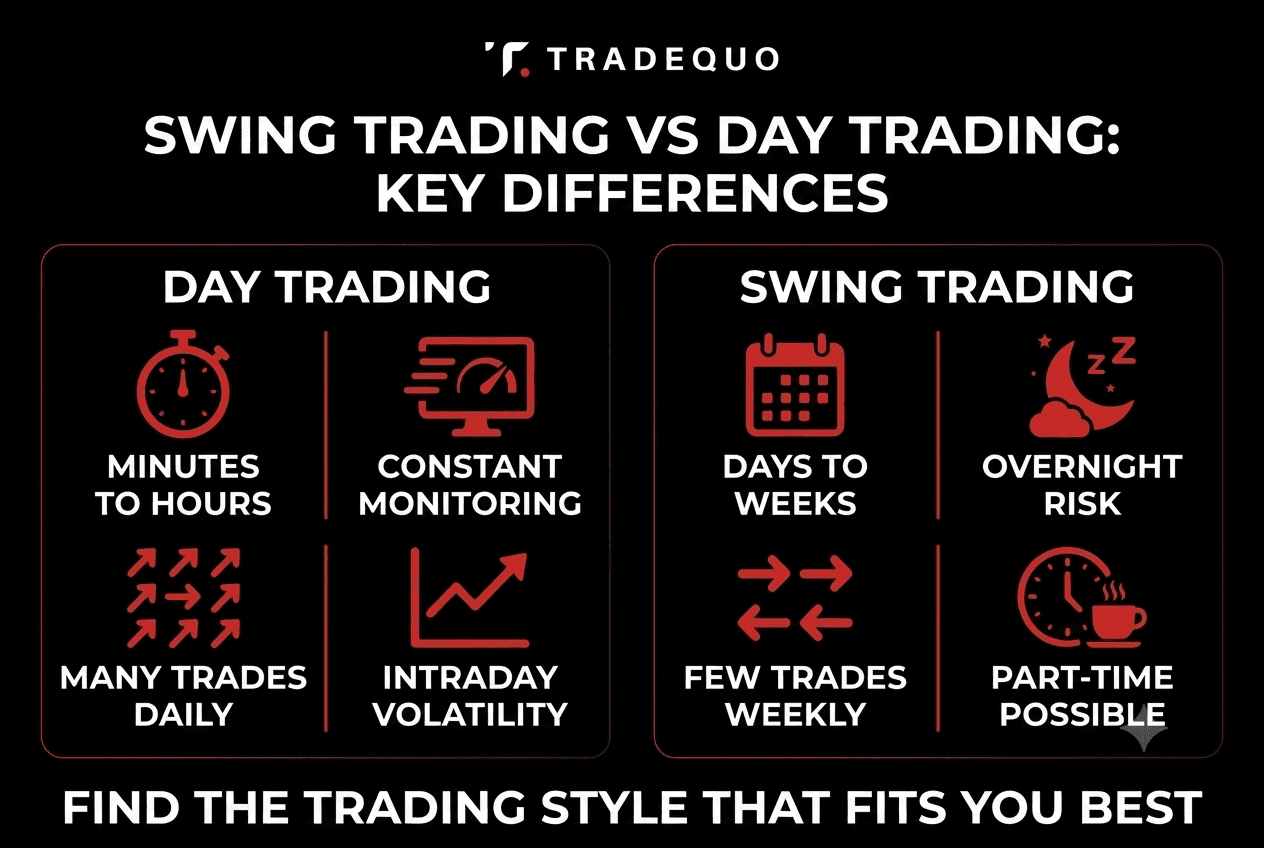
Day trading requires your full, undivided attention during market hours. For U.S. equity markets, that means being locked in from 9:30 AM to 4:00 PM Eastern, with the most critical action typically concentrated in the first and last hours of the session. Miss a setup or step away at the wrong moment, and a profitable trade can quickly become a losing one. This is not a style that accommodates a full-time job, childcare responsibilities, or any environment where you cannot monitor your screen continuously.

The infrastructure required is also worth considering. Serious day traders invest in fast internet connections, multi-monitor setups, direct-access trading platforms, and real-time data feeds. The overhead, both financial and mental, is considerable.

Swing trading operates on a fundamentally different schedule. The core analytical work, reviewing charts, setting alerts, planning entries, and adjusting stop-loss orders, can be done in the evenings or on weekends. Once a position is live, a swing trader checks in periodically rather than watching every tick. This makes it one of the most accessible active trading strategies for people with demanding professional lives or other commitments.

That said, "less time-intensive" does not mean passive. Swing traders still need to stay informed. Unexpected news events, earnings reports, and macroeconomic shifts can all impact open positions. The difference is that the decision-making is largely front-loaded into research and planning, rather than distributed across an entire trading day.

For beginners, this distinction matters enormously. Learning swing trading allows you to develop discipline and chart-reading skills without the relentless pressure of intraday volatility. Learning day trading, by contrast, often feels like being thrown into the deep end, where emotional decision-making under time pressure leads to costly mistakes before the fundamentals are even in place.

Risk and Reward

Both styles carry real risk. Neither is a shortcut to consistent profits. But the nature of the risk differs in ways that should inform your choice.

Day trading risk tends to be tightly controlled in terms of individual trade size, since positions are closed before the day ends. However, the sheer number of trades means that even small, repeated errors in judgment or discipline can compound quickly. Leverage is commonly used in day trading, particularly in forex and futures markets, which amplifies both gains and losses. High-frequency intraday trading also generates significant commission costs, which eat into margins in ways that are easy to underestimate.

Swing trading profitability is tied to capturing larger price moves, which typically means higher potential gains per trade but also greater exposure while the trade is open. The most significant risk unique to swing trading is the overnight gap. Markets can open dramatically higher or lower than the previous close in response to after-hours news, earnings surprises, or geopolitical events. A well-placed stop-loss order helps, but gaps can breach those stops without triggering at the expected price in fast-moving conditions.

Is day trading more profitable than swing trading? The honest answer is: it depends on the trader. Several academic studies have found that many retail day traders struggle to achieve consistent profitability over time, often due to high trading costs and psychological pressure. Swing traders who stick to defined setups and manage risk carefully can achieve strong returns with less emotional burnout.

Is swing trading safer than day trading? In terms of overnight exposure, day trading eliminates a specific category of risk. In terms of overall sustainability and the psychological demands placed on the trader, many professionals argue that swing trading is the more forgiving entry point for those still building their skills.

Choosing the Right Style


Swing Trading vs Day Trading

Before you commit to either approach, ask yourself a few honest questions. The answers will point you in the right direction more clearly than any performance statistic.

How much time can you realistically commit? If you have a full-time job, family obligations, or any other serious time constraint, day trading will likely create conflict and stress rather than income. Swing trading is designed for people who need flexibility without stepping away from active participation in the markets.

How do you handle stress and emotional pressure? Day trading requires split-second decisions, often under conditions of genuine financial uncertainty. If you find yourself second-guessing trades, freezing during volatile moments, or struggling to separate your emotional state from your market analysis, the psychological demands of day trading can become a serious liability. Swing trading offers more breathing room to think, reconsider, and act deliberately.

Are you comfortable holding positions overnight? If the idea of waking up to find a position moved sharply against you causes genuine anxiety, that is important information. Some traders find overnight exposure intolerable. Others see it as a natural part of capturing multi-day trends. Knowing which camp you fall into matters.

How much starting capital do you have? How much money do you need for day trading? In the United States, FINRA's Pattern Day Trader rule generally requires traders who execute four or more day trades within five business days in a margin account to maintain at least $25,000 in account equity. Swing trading has no such regulatory requirement, making it more accessible for traders who are starting with less capital.

Are you still learning? For beginners, swing trading strategies offer a more forgiving environment to develop skills. The slower pace allows time to analyze mistakes, refine your approach, and build confidence before moving into faster-paced trading environments.

There is no single best trading strategy for beginners, but for many newcomers, starting with swing trading creates the conditions for more sustainable learning.

Conclusion

The swing trading vs day trading debate will never produce a universal winner, and that is actually reassuring. It means the right answer is personal, not prescribed. Day trading rewards those with time, discipline, and a tolerance for high-intensity decision-making. Swing trading suits those who want active market participation without surrendering their entire schedule or their peace of mind.

If you are undecided, consider paper trading both styles before committing real capital. Experience is the most honest teacher. What matters most is choosing a style you can execute consistently, refine over time, and sustain without burning out. The best trading strategy is the one you can actually stick to.

FAQs

What is the main difference between swing trading and day trading? 

Day trading involves opening and closing all positions within a single trading session, while swing trading holds positions for several days to several weeks. Day trading demands continuous market monitoring, whereas swing trading allows for a more flexible, planned approach to entries and exits.

Can beginners start with swing trading? 

Yes. Swing trading is widely considered one of the more beginner-friendly active trading strategies because it allows time for analysis, reduces the pressure of real-time decision-making, and does not require the same level of capital or screen time as day trading.

Do swing traders trade every day? 

Not necessarily. Swing traders trade when high-probability setups align with their strategy, which may mean entering one or two trades per week rather than daily. Quality of setups takes priority over frequency.

Which trading style requires less time? 

Swing trading generally requires significantly less daily time commitment. Most of the analytical work can be done outside of regular market hours, making it compatible with other professional or personal responsibilities.

Is day trading stressful? 

For most people, yes. Day trading involves rapid decision-making under financial pressure, continuous screen monitoring, and frequent exposure to market volatility. Managing trading psychology is one of the most challenging aspects of the day trading lifestyle, and it is a key reason why many traders eventually migrate toward swing trading or longer-term strategies.

人々に愛されている

市場から信頼されています

2025年アワード
2025年アワード
2025年アワード

© 2026 Trade Quo. All rights reserved.

This website provides content by group of companies, which include:

Tradequomarkets Financial Services L.L.C is a registered, authorised and regulated company by the Securities and Commodities Authority (SCA) of the United Arab Emirates, with License No. 20200000320 Category 5, to carry out regulated activities of Financial Consultations and Introduction. Its registered office is located at Business Tower, Main Business Village 114499 Dubai, UAE.

Tradequomarkets LTD (2023/C0024). Located at #8 Jepson Lane, St. George, Goodwill, Commonwealth of Dominica

Trade Quo Global Ltd, a securities dealer firm that is authorized and regulated by the Seychelles Financial Services Authority (FSA) with license number SD140.

Tradequo (PTY) Ltd is licensed in South Africa by the Financial Sector Conduct Authority with FSP license number 54827. The registered office: 33rd Floor – 34 Whiteley Road, 2196, Johannesburg, South Africa.

Quo Markets LLC, registered with Financial Services Authority FSA: 3171 LLC 2024. Registered address: Suite 305, Griffith Corporate Centre, Beachmont, Kingstown, SVG.

Tqbg Ltd, registered in Cyprus with registration number HE438084, registered address Archiespiskopou Makariou III 160 1st floor, 3026, Limassol, Cyprus. Is apointed payment agent, and does not engage in any regulated activities.

Risk Warning: CFDs are complex instruments and come with a high risk of losing money rapidly due to leverage. 72.6% of retail investor accounts lose money when trading CFDs with this provider. You should consider whether you understand how CFDs work and whether you can afford to take the high risk of losing your money.

Regional Restrictions: This website including the information and materials contained in it, is not directed at, or intended for distribution to or use by, any person or entity who is a citizen or resident of the following countries: USA, Israel, Iran, Iraq, Russia, Afghanistan, Cuba, Cyprus, Eritrea, Liberia, Libya, Somalia and Syria or any jurisdiction where such distribution, publication, availability or use would be contrary to applicable law or regulation.

TradeQuo and its affiliates do not target EU/EEA/UK clients.

人々に愛されている

市場から信頼されています

2025年アワード
2025年アワード
2025年アワード

© 2026 Trade Quo. All rights reserved.

This website provides content by group of companies, which include:

Tradequomarkets Financial Services L.L.C is a registered, authorised and regulated company by the Securities and Commodities Authority (SCA) of the United Arab Emirates, with License No. 20200000320 Category 5, to carry out regulated activities of Financial Consultations and Introduction. Its registered office is located at Business Tower, Main Business Village 114499 Dubai, UAE.

Tradequomarkets LTD (2023/C0024). Located at #8 Jepson Lane, St. George, Goodwill, Commonwealth of Dominica

Trade Quo Global Ltd, a securities dealer firm that is authorized and regulated by the Seychelles Financial Services Authority (FSA) with license number SD140.

Tradequo (PTY) Ltd is licensed in South Africa by the Financial Sector Conduct Authority with FSP license number 54827. The registered office: 33rd Floor – 34 Whiteley Road, 2196, Johannesburg, South Africa.

Quo Markets LLC, registered with Financial Services Authority FSA: 3171 LLC 2024. Registered address: Suite 305, Griffith Corporate Centre, Beachmont, Kingstown, SVG.

Tqbg Ltd, registered in Cyprus with registration number HE438084, registered address Archiespiskopou Makariou III 160 1st floor, 3026, Limassol, Cyprus. Is apointed payment agent, and does not engage in any regulated activities.

Risk Warning: CFDs are complex instruments and come with a high risk of losing money rapidly due to leverage. 72.6% of retail investor accounts lose money when trading CFDs with this provider. You should consider whether you understand how CFDs work and whether you can afford to take the high risk of losing your money.

Regional Restrictions: This website including the information and materials contained in it, is not directed at, or intended for distribution to or use by, any person or entity who is a citizen or resident of the following countries: USA, Israel, Iran, Iraq, Russia, Afghanistan, Cuba, Cyprus, Eritrea, Liberia, Libya, Somalia and Syria or any jurisdiction where such distribution, publication, availability or use would be contrary to applicable law or regulation.

TradeQuo and its affiliates do not target EU/EEA/UK clients.

人々に愛されている

市場から信頼されています

2025年アワード
2025年アワード
2025年アワード

© 2026 Trade Quo. All rights reserved.

This website provides content by group of companies, which include:

Tradequomarkets Financial Services L.L.C is a registered, authorised and regulated company by the Securities and Commodities Authority (SCA) of the United Arab Emirates, with License No. 20200000320 Category 5, to carry out regulated activities of Financial Consultations and Introduction. Its registered office is located at Business Tower, Main Business Village 114499 Dubai, UAE.

Tradequomarkets LTD (2023/C0024). Located at #8 Jepson Lane, St. George, Goodwill, Commonwealth of Dominica

Trade Quo Global Ltd, a securities dealer firm that is authorized and regulated by the Seychelles Financial Services Authority (FSA) with license number SD140.

Tradequo (PTY) Ltd is licensed in South Africa by the Financial Sector Conduct Authority with FSP license number 54827. The registered office: 33rd Floor – 34 Whiteley Road, 2196, Johannesburg, South Africa.

Quo Markets LLC, registered with Financial Services Authority FSA: 3171 LLC 2024. Registered address: Suite 305, Griffith Corporate Centre, Beachmont, Kingstown, SVG.

Tqbg Ltd, registered in Cyprus with registration number HE438084, registered address Archiespiskopou Makariou III 160 1st floor, 3026, Limassol, Cyprus. Is apointed payment agent, and does not engage in any regulated activities.

Risk Warning: CFDs are complex instruments and come with a high risk of losing money rapidly due to leverage. 72.6% of retail investor accounts lose money when trading CFDs with this provider. You should consider whether you understand how CFDs work and whether you can afford to take the high risk of losing your money.

Regional Restrictions: This website including the information and materials contained in it, is not directed at, or intended for distribution to or use by, any person or entity who is a citizen or resident of the following countries: USA, Israel, Iran, Iraq, Russia, Afghanistan, Cuba, Cyprus, Eritrea, Liberia, Libya, Somalia and Syria or any jurisdiction where such distribution, publication, availability or use would be contrary to applicable law or regulation.

TradeQuo and its affiliates do not target EU/EEA/UK clients.