差價合約(CFD)是複雜的金融工具,並因槓桿作用而具有迅速虧損的高風險。您在投資前應考慮自己是否了解差價合約如何運作。

CFD vs Stock Trading: Key Differences

Table of Contents

  • Introduction

  • Ownership and Rights

  • Leverage and Capital Requirements

  • Costs and Fees

  • Short Selling and Flexibility

  • Regulation and Market Access

  • Which Is Right for You

  • Conclusion

  • FAQs

Introduction

Investors today have more ways than ever to gain exposure to the companies they believe in. Some prefer traditional stock trading, where they purchase company shares and become part-owners of the business. Others choose CFD trading, a form of derivative trading that allows them to speculate on price movements without actually owning the underlying asset.

Understanding CFD vs. share trading is important because these two approaches operate in very different ways. While both provide access to the stock market and global stocks, the mechanics, risks, and costs are not the same. Ownership rights, leverage, market access, and holding periods all differ significantly.

For some traders, the flexibility of trading CFDs makes them appealing for short-term trading strategies and reacting to market sentiment. For others, traditional stock investing offers stability, long-term wealth building, and shareholder privileges. Knowing the key differences helps traders choose the approach that best matches their financial objectives, trading style, and risk tolerance.

Ownership And Rights

One of the most important differences between CFDs and stocks is ownership.

When investors participate in share trading, they buy actual company shares through a brokerage account. These shares represent ownership in the company. Even a small number of shares gives investors a stake in the business and certain shareholder privileges.

Because stocks represent ownership, investors may receive dividend payments when companies distribute profits to shareholders. They may also gain voting rights, which allow them to participate in important corporate decisions such as electing board members or approving major company actions.

Traditional share dealing also means investors benefit directly from price appreciation when the stock price rises. If the company performs well, reports strong earnings, and maintains positive market sentiment, the share price can increase over time. Long-term investors often rely on these price rises along with dividends to build wealth.

In contrast, CFD trading means speculating on an asset's price rather than owning it. When CFD traders open a position, they enter a contract with their broker to exchange the difference in the asset's price between the opening and closing of the trade.

This means CFD investors do not have actual ownership of the underlying asset. They do not hold the shares themselves and therefore do not receive shareholder privileges such as voting rights. Dividend payments are not typically received either, although brokers may adjust positions to reflect dividend events.

Because CFDs are derivatives, traders are simply predicting whether the asset's price will move higher or lower. The trader may potentially profit from price changes, but they never own the asset itself.

For investors who value long-term ownership, passive income, and participation in company decisions, trading stocks may be more appealing. For traders focused purely on price movements, trading CFDs can offer a more flexible alternative.

Leverage And Capital Requirements

Another major difference in CFD trading vs stock investing involves capital requirements and leverage.

In traditional stock trading, investors typically pay the full value of the asset when they buy shares. If a trader wants to buy shares worth ten thousand dollars, they generally need to commit the full trade value upfront.

This higher initial investment can limit the size of positions for retail clients with smaller capital. However, it also reduces risk because losses are limited to the amount invested. If a stock falls to zero, the investor cannot lose more than the purchase price.

In contrast, CFD trading uses leverage. Instead of paying the full value of the asset, traders deposit a smaller initial deposit, known as margin, to control a larger position. For example, a trader may only need a fraction of the full trade value to open a position on share CFDs. This allows traders to gain market exposure to large positions even with relatively limited capital.

Leverage can amplify potential profits when the market moves in the trader's favor. However, it also magnifies losses if the market moves against them. Because of this, risk management becomes essential in derivative trading.

Another important point is that CFD trading can lead to losses that exceed the initial investment if leverage is used aggressively. Some brokers offer negative balance protection for retail clients to prevent accounts from going below zero, but traders should always check the policies of their chosen trading platform.

The ability to use leverage is one reason many active traders prefer CFDs, particularly for short-term trading strategies that focus on small price movements in volatile financial markets.

Costs And Fees

The cost structure is another important aspect here.

With traditional share trading, brokers often charge a commission for each transaction. Investors pay this fee when they buy or sell shares on a stock exchange. Additional charges may apply depending on the broker and the market.

In some jurisdictions, investors may also pay stamp duty when purchasing shares. Taxes such as capital gains tax may apply when investors sell shares for a profit, and dividend income may be taxed depending on local regulations. Because investors must purchase the full value of the shares, the initial cost of entering a position can be relatively high.

In CFD trading, the cost structure is different. Instead of traditional commissions, many brokers charge a spread. The spread represents the difference between the buy and sell prices on the trading platform. CFDs may appear cheaper initially because traders only deposit a margin rather than the full asset value. However, there are other costs to consider.

Positions held overnight often incur financing charges. These borrowing costs reflect the leverage used in the position. The longer a trade remains open, the higher the financing costs may become. This is one reason CFD traders often focus on short-term trading strategies. Holding leveraged positions for extended periods can make financing costs accumulate quickly.

Another tax difference sometimes discussed is that CFDs may be exempt from stamp duty in certain regions because traders are not purchasing the underlying shares. However, tax rules vary widely between countries, and traders should always check local regulations before making investment decisions.

Short Selling And Flexibility

One of the biggest differences between CFD and stock trading lies in short selling.

In traditional stock trading, most investors take a long position. They buy shares expecting the stock price to rise over time. If the price increases, they can sell the shares for a profit. Short selling shares is possible but usually requires borrowing stock through a margin account. This process may involve additional rules, collateral requirements, and borrowing fees.

With trading CFDs, going short is much simpler. Traders can open positions that benefit from falling prices just as easily as positions that benefit from price rises. This flexibility allows CFD traders to potentially profit from both rising and falling prices. During periods of market volatility or declining market conditions, this ability can be particularly useful.

CFDs also allow traders to speculate on many different financial instruments, including indices, commodities and forex pairs. In contrast, stock trading focuses primarily on company shares and exchange-traded funds.

This broad market exposure makes CFDs attractive for traders who want access to multiple asset classes within a single trading platform.

Regulation And Market Access

Regulation is another important distinction in CFDs vs. traditional share trading.

CFDs are traded over the counter between the trader and the broker rather than directly on an exchange. This means the broker acts as the counterparty to the trade. Because of their leveraged nature, regulators in several countries have placed restrictions on CFD trading. For example, CFDs are not permitted for retail investors in the United States.

Traditional share trading, however, is available worldwide and occurs on regulated exchanges such as the New York Stock Exchange and the London Stock Exchange. These exchanges provide transparency, standardized trading hours, and oversight designed to protect investors. When investors buy shares on an exchange, they become registered shareholders in the company. This structure provides clear ownership records and established investor protections. In contrast, CFD trading depends heavily on the broker's reliability since trades occur over the counter. For this reason, traders should always choose regulated brokers with strong reputations.

Both markets remain influenced by factors such as market sentiment, economic news, company performance, and earnings reports. Understanding these influences is essential for anyone participating in modern financial markets.

Which Is Right For You


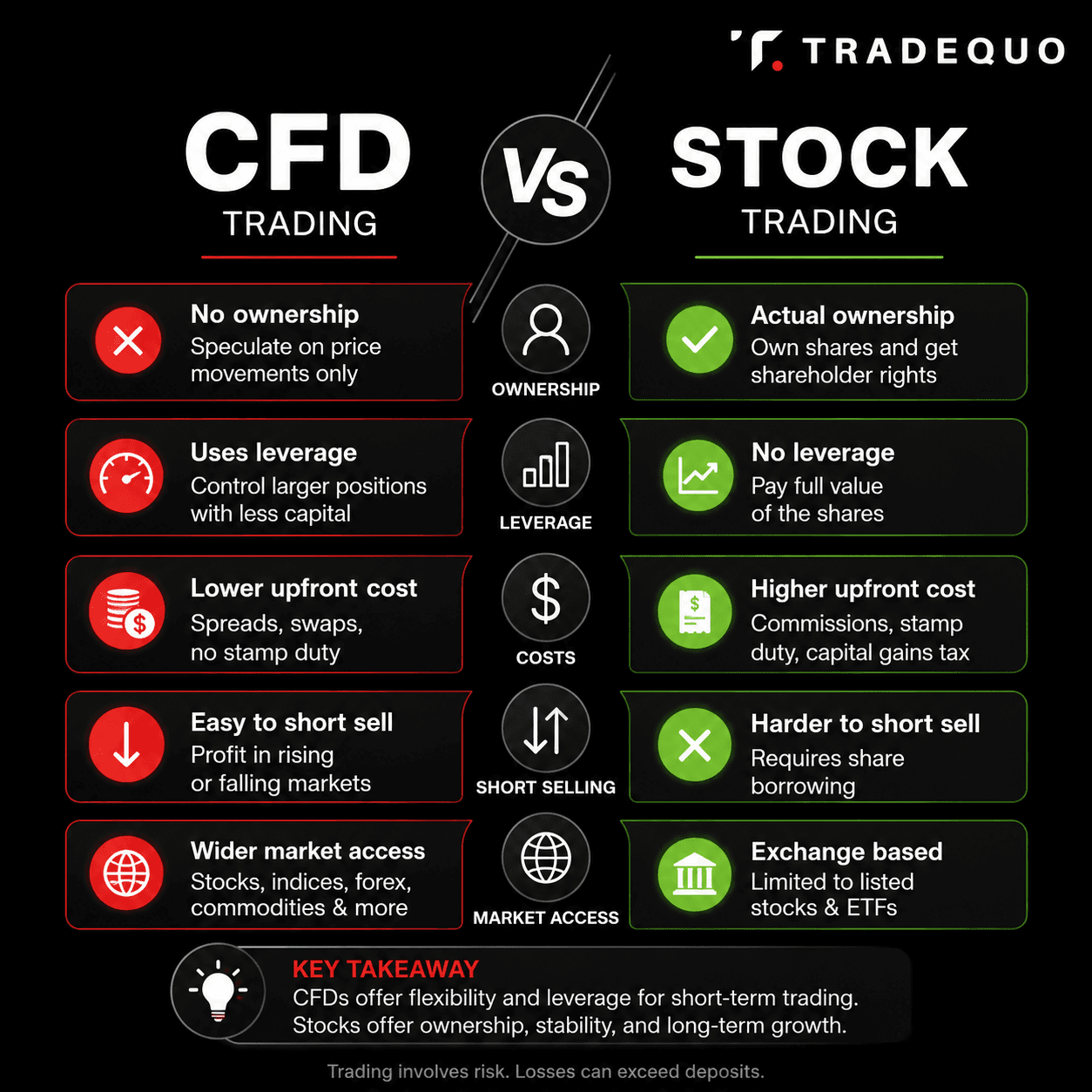
CFD vs Stock Trading

Choosing between CFD vs. share trading ultimately depends on your investment goals, trading style, and risk tolerance.

Investors focused on long-term wealth building often prefer stock investing. Buying and holding shares allows them to participate in company growth, receive dividend payments, and benefit from long-term price appreciation. These buy-and-hold strategies can be effective when investing in strong companies with solid fundamentals.

CFDs, on the other hand, are often favored by active traders who want to react quickly to changing market sentiment and short-term price movements. The ability to use leverage and open short positions makes CFDs particularly appealing during volatile market conditions.

However, the higher flexibility also comes with a higher risk. Because leveraged trades amplify both gains and losses, traders must approach CFDs with careful risk management and a clear understanding of their financial objectives.

New traders should also consider their available capital. If committing the full value of shares is difficult, CFDs may offer easier market exposure with a smaller initial deposit. Still, the risks associated with leverage should never be ignored. Ultimately, there is no single best choice for every trader. The right approach depends on how you want to participate in the stock market and how much risk you are willing to take.

Conclusion

Both approaches offer unique advantages and disadvantages. Stock trading provides ownership, shareholder privileges, and long-term investment potential. CFD trading offers flexibility, leverage, and the ability to profit from both rising and falling markets. Understanding the key differences between these methods helps traders choose the path that best matches their financial objectives and trading style.

FAQs

What Is The Main Difference Between CFD Trading And Stock Trading?

The main difference is ownership. In stock trading, investors purchase company shares and gain ownership rights, such as voting rights and dividend payments. In CFD trading, traders speculate on price movements without owning the underlying asset.

Can CFD Traders Profit From Falling Markets?

Yes. Trading CFDs allows traders to open short positions that benefit from falling prices. This makes CFDs useful during market downturns when traditional stock investors may struggle to profit.

Do CFD Traders Pay The Full Value Of A Trade?

No. CFDs allow traders to open positions using margin. Instead of paying the full trade value, traders deposit a smaller initial deposit that gives them market exposure to a larger position.

深受大家喜愛

深受市場信賴

2025 年獎項
2025 年獎項
2025 年獎項

© 2026 Trade Quo. All rights reserved.

This website provides content by group of companies, which include:

Tradequomarkets Financial Services L.L.C is a registered, authorised and regulated company by the Securities and Commodities Authority (SCA) of the United Arab Emirates, with License No. 20200000320 Category 5, to carry out regulated activities of Financial Consultations and Introduction. Its registered office is located at Business Tower, Main Business Village 114499 Dubai, UAE.

Tradequomarkets LTD (2023/C0024). Located at #8 Jepson Lane, St. George, Goodwill, Commonwealth of Dominica

Trade Quo Global Ltd, a securities dealer firm that is authorized and regulated by the Seychelles Financial Services Authority (FSA) with license number SD140.

Tradequo (PTY) Ltd is licensed in South Africa by the Financial Sector Conduct Authority with FSP license number 54827. The registered office: 33rd Floor – 34 Whiteley Road, 2196, Johannesburg, South Africa.

Quo Markets LLC, registered with Financial Services Authority FSA: 3171 LLC 2024. Registered address: Suite 305, Griffith Corporate Centre, Beachmont, Kingstown, SVG.

Tqbg Ltd, registered in Cyprus with registration number HE438084, registered address Archiespiskopou Makariou III 160 1st floor, 3026, Limassol, Cyprus. Is apointed payment agent, and does not engage in any regulated activities.

Risk Warning: CFDs are complex instruments and come with a high risk of losing money rapidly due to leverage. 72.6% of retail investor accounts lose money when trading CFDs with this provider. You should consider whether you understand how CFDs work and whether you can afford to take the high risk of losing your money.

Regional Restrictions: This website including the information and materials contained in it, is not directed at, or intended for distribution to or use by, any person or entity who is a citizen or resident of the following countries: USA, Israel, Iran, Iraq, Russia, Afghanistan, Cuba, Cyprus, Eritrea, Liberia, Libya, Somalia and Syria or any jurisdiction where such distribution, publication, availability or use would be contrary to applicable law or regulation.

TradeQuo and its affiliates do not target EU/EEA/UK clients.

深受大家喜愛

深受市場信賴

2025 年獎項
2025 年獎項
2025 年獎項

© 2026 Trade Quo. All rights reserved.

This website provides content by group of companies, which include:

Tradequomarkets Financial Services L.L.C is a registered, authorised and regulated company by the Securities and Commodities Authority (SCA) of the United Arab Emirates, with License No. 20200000320 Category 5, to carry out regulated activities of Financial Consultations and Introduction. Its registered office is located at Business Tower, Main Business Village 114499 Dubai, UAE.

Tradequomarkets LTD (2023/C0024). Located at #8 Jepson Lane, St. George, Goodwill, Commonwealth of Dominica

Trade Quo Global Ltd, a securities dealer firm that is authorized and regulated by the Seychelles Financial Services Authority (FSA) with license number SD140.

Tradequo (PTY) Ltd is licensed in South Africa by the Financial Sector Conduct Authority with FSP license number 54827. The registered office: 33rd Floor – 34 Whiteley Road, 2196, Johannesburg, South Africa.

Quo Markets LLC, registered with Financial Services Authority FSA: 3171 LLC 2024. Registered address: Suite 305, Griffith Corporate Centre, Beachmont, Kingstown, SVG.

Tqbg Ltd, registered in Cyprus with registration number HE438084, registered address Archiespiskopou Makariou III 160 1st floor, 3026, Limassol, Cyprus. Is apointed payment agent, and does not engage in any regulated activities.

Risk Warning: CFDs are complex instruments and come with a high risk of losing money rapidly due to leverage. 72.6% of retail investor accounts lose money when trading CFDs with this provider. You should consider whether you understand how CFDs work and whether you can afford to take the high risk of losing your money.

Regional Restrictions: This website including the information and materials contained in it, is not directed at, or intended for distribution to or use by, any person or entity who is a citizen or resident of the following countries: USA, Israel, Iran, Iraq, Russia, Afghanistan, Cuba, Cyprus, Eritrea, Liberia, Libya, Somalia and Syria or any jurisdiction where such distribution, publication, availability or use would be contrary to applicable law or regulation.

TradeQuo and its affiliates do not target EU/EEA/UK clients.

深受大家喜愛

深受市場信賴

2025 年獎項
2025 年獎項
2025 年獎項

© 2026 Trade Quo. All rights reserved.

This website provides content by group of companies, which include:

Tradequomarkets Financial Services L.L.C is a registered, authorised and regulated company by the Securities and Commodities Authority (SCA) of the United Arab Emirates, with License No. 20200000320 Category 5, to carry out regulated activities of Financial Consultations and Introduction. Its registered office is located at Business Tower, Main Business Village 114499 Dubai, UAE.

Tradequomarkets LTD (2023/C0024). Located at #8 Jepson Lane, St. George, Goodwill, Commonwealth of Dominica

Trade Quo Global Ltd, a securities dealer firm that is authorized and regulated by the Seychelles Financial Services Authority (FSA) with license number SD140.

Tradequo (PTY) Ltd is licensed in South Africa by the Financial Sector Conduct Authority with FSP license number 54827. The registered office: 33rd Floor – 34 Whiteley Road, 2196, Johannesburg, South Africa.

Quo Markets LLC, registered with Financial Services Authority FSA: 3171 LLC 2024. Registered address: Suite 305, Griffith Corporate Centre, Beachmont, Kingstown, SVG.

Tqbg Ltd, registered in Cyprus with registration number HE438084, registered address Archiespiskopou Makariou III 160 1st floor, 3026, Limassol, Cyprus. Is apointed payment agent, and does not engage in any regulated activities.

Risk Warning: CFDs are complex instruments and come with a high risk of losing money rapidly due to leverage. 72.6% of retail investor accounts lose money when trading CFDs with this provider. You should consider whether you understand how CFDs work and whether you can afford to take the high risk of losing your money.

Regional Restrictions: This website including the information and materials contained in it, is not directed at, or intended for distribution to or use by, any person or entity who is a citizen or resident of the following countries: USA, Israel, Iran, Iraq, Russia, Afghanistan, Cuba, Cyprus, Eritrea, Liberia, Libya, Somalia and Syria or any jurisdiction where such distribution, publication, availability or use would be contrary to applicable law or regulation.

TradeQuo and its affiliates do not target EU/EEA/UK clients.