差價合約(CFD)是複雜的金融工具,並因槓桿作用而具有迅速虧損的高風險。您在投資前應考慮自己是否了解差價合約如何運作。

How Much Money Do You Need to Start Trading Forex

Table of Contents 

  • The Minimum Capital for Forex Trading: Why There's No Single Answer

  • Broker Minimum Deposits: What You'll Actually Need to Open an Account

  • Leverage Considerations: How It Changes Everything

  • Risk Management and Position Sizing: The Math That Protects Your Account

  • Recommended Starting Capitals: What the Numbers Actually Look Like

  • Conclusion: Start Right, Not Just Fast

  • FAQs

The Minimum Capital for Forex Trading: Why There's No Single Answer

Walk into any trading forum, and you'll find the same question asked a hundred different ways: how much money do I actually need to start trading forex? Some people claim you can flip $10 into a fortune. Others insist you need tens of thousands before you should even glance at a currency pair. The truth, as it usually is, is somewhere in the middle and depends entirely on who you are as a trader.

The minimum capital for forex trading is not a fixed number. It shifts based on your goals, your risk tolerance, the broker you choose, and how seriously you plan to approach the market. A hobbyist testing the waters has very different needs from someone building a structured trading business. 

Let’s break down the real numbers, the real risks, and what you should actually have in your account before you place your first live trade.

Broker Minimum Deposits: What You'll Actually Need to Open an Account

Before you can trade a single currency pair, you need to fund an account. Broker minimums vary significantly depending on the account type, and understanding the differences matters more than most beginners realize.

Micro Accounts are the entry point for most new traders. Many brokers market beginner-friendly accounts with low funding thresholds, sometimes from around $10 to $100, though terms vary widely by broker and payment method. These accounts let you trade micro lots (0.01 lots), which means smaller position sizes and more manageable risk for those still learning. For example, TradeQuo’s minimum deposits depend on the payment system and can start from $1, although payment-method minimums may still apply.

Standard Accounts often require more funding than entry-level accounts, though the exact minimum varies by broker. These accounts give you access to standard lot sizes and generally come with tighter spreads than micro accounts. If you have some trading experience and want more flexibility in your position sizing, a standard account makes sense.

ECN (Electronic Communication Network) Accounts are designed for more active or professional traders. Raw spread or ECN-style accounts may require higher deposits and often add a commission structure, but requirements differ substantially across firms. 

One important note: a broker's stated minimum deposit and the amount you actually need to trade responsibly are two very different figures. Just because a broker lets you open an account with $50 doesn't mean $50 is enough to manage risk properly. We'll come back to that in a moment.

Leverage Considerations: How It Changes Everything


Trading Forex

Leverage is probably the most misunderstood element of forex trading, and it has a direct impact on how much starting capital you actually need.

In forex, leverage allows you to control a position much larger than your actual deposit. A 1:100 leverage ratio means that with $100 in your account, you can control a $10,000 position. A 1:500 ratio stretches that $100 to control $50,000 worth of currency. On paper, this sounds like an incredible opportunity. In practice, it is a double-edged tool that can wipe out an underfunded account in minutes.

Here is a concrete example to make this real. Suppose you want to trade 0.1 lots on EUR/USD. One standard lot of EUR/USD equals 100,000 units of the base currency, so 0.1 lots equals a $10,000 position.

Without leverage, you would need $10,000 in your account to control that position outright. With 1:100 leverage, you only need $100 in margin to open the same trade. With 1:500 leverage, that drops to $20.

So why not just use maximum leverage and trade with $20? Because a small price movement against your position can trigger a margin call before you even have a chance to react. At 1:500, a mere 0.2% adverse move in the currency pair is enough to erase your entire margin. Forex trading initial investment decisions made purely around leverage ratios, without accounting for account cushion, almost always end in blown accounts.

Retail brokers in the European Union are capped at 1:30 leverage for major currency pairs under ESMA regulations. In the United States, CFTC rules limit leverage to 1:50 for majors. Offshore brokers often offer much higher ratios with fewer restrictions, but those come with their own regulatory risks.

The practical takeaway: lower leverage gives your account room to breathe. The more capital you start with, the less leverage you need to use, and the more sustainable your trading becomes.

Risk Management and Position Sizing: The Math That Protects Your Account


 Risk Management and Position Sizing in forex

This is where most beginners skip ahead, and where most beginners lose money. Understanding risk management and position sizing is arguably more important than picking the right entry point on a trade.

The core rule you will hear from serious traders repeatedly is this: never risk more than 1 to 2 percent of your trading capital on any single trade. This is not a suggestion. It is the foundation of trading longevity.

Here is how it works in practice. If your starting balance is $1,000 and you follow the 1% rule, you risk $10 per trade. If your stop loss is 20 pips away from your entry on EUR/USD (where each pip on a 0.1 lot trade is worth approximately $1), that means your maximum position size is 0.1 lots. If you push your position to 0.3 lots with the same stop loss, you are risking $30, which is 3% of your account and already outside responsible parameters.

Now consider the same calculation with a $500 account. At 1% risk, you can only lose $5 per trade. With a 20-pip stop loss on EUR/USD, your maximum position size drops to 0.05 lots. There is nothing wrong with trading at this size, but your position flexibility is significantly constrained. You will find it harder to trade setups that require wider stop losses, and every string of losses hits proportionally harder.

A $500 account trading with proper risk management can absolutely survive and grow, but it requires discipline that many beginners simply have not developed yet.

The formula to keep in your head:

Position Size = (Account Balance × Risk Percentage) ÷ (Stop Loss in Pips × Pip Value)

Running this calculation before every trade is non-negotiable for anyone who wants to stay in the market long enough to actually improve.

Forex trading risk per trade management also includes thinking about the overall drawdown. A series of losing trades is inevitable for every trader. If you risk 1% per trade and hit five consecutive losses, your account is down only 5%. Recovering from that is entirely realistic. If you risk 10% per trade, five consecutive losses leave you down nearly 41% of your account. That kind of hole is psychologically devastating and mathematically grueling to climb out of.

Recommended Starting Capitals: What the Numbers Actually Look Like


how much money I need to start forex

Now that the mechanics are clear, let us talk about real numbers for different types of traders.

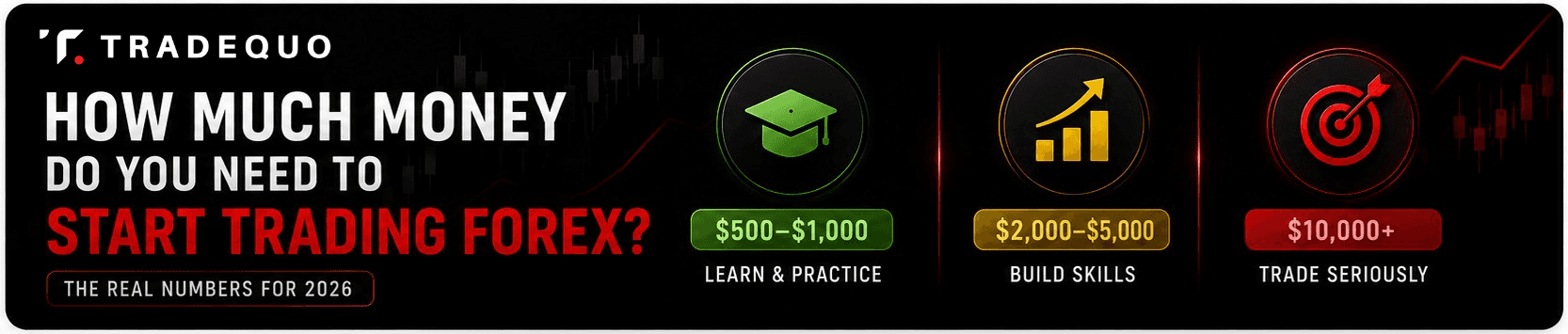
Casual Traders and Absolute Beginners: $500 to $1,000

If you are testing the waters, learning how the market moves, and getting comfortable with a trading platform, $500 to $1,000 is a workable starting range. You will not be generating life-changing income at this level, but that is not the goal here. The goal is learning without catastrophic losses.

At this level, stick to micro lots, use conservative leverage, and treat every trade as a learning exercise. Starting forex trading with $100 is possible, but leaves almost no room for error, so be honest with yourself about whether you are ready for that pressure.

Serious Beginners with a Plan: $2,000 to $5,000

This range is where things start to make more practical sense for someone approaching forex trading as a skill to develop over time. With $2,000 to $5,000, you have enough capital to trade standard position sizes with proper risk management, absorb normal drawdowns without panic, and develop a trading track record worth analyzing.

This is also a range where the psychological element becomes more manageable. Knowing you have a reasonable cushion reduces the temptation to over-leverage or revenge-trade after a loss, both of which are account-destroying habits.

Day Traders and Swing Traders: $10,000 and Above

For anyone serious about forex trading as an income source or primary trading activity, $10,000 is a more realistic floor. At this level, you can use lower leverage ratios (1:10 or even less), trade multiple pairs simultaneously, and generate meaningful returns from percentage gains without needing to expose yourself to extreme risk.

Professional forex traders typically work with significantly larger accounts, which is part of what allows them to manage risk so conservatively. The relationship between capital and sustainability is not a coincidence.

Is forex trading profitable with small capital? Yes, but it requires accepting that growth will be slow, leverage must be kept low, and the priority is skill-building rather than income generation.

Conclusion: Start Right, Not Just Fast

Here is what everything above comes down to: the best amount to start forex trading is the amount that lets you manage risk properly, absorb losses without panic, and stay in the game long enough to actually develop skill.

There is no shame in starting small. There is real danger in starting underfunded and over-leveraged. Whatever amount you decide to deposit, make sure it is money you can genuinely afford to lose. Forex markets are unforgiving of impatience and overconfidence, especially in the early stages.

Before you fund any live account, spend serious time on a demo account. Every reputable broker offers one. Demo trading lets you test your strategy, get comfortable with the platform, and understand how position sizing works in real-time without any financial consequences. It is not glamorous, but it is how traders build the kind of foundation that survives their first year in the market.

When you are ready to go live, start with a modest deposit, trade small, follow your risk rules obsessively, and give yourself time to grow. The forex market will still be there when you are ready to scale up.

FAQs

Can you start forex trading with $100? 

Yes, many brokers allow you to open a micro account with $100 or less. However, $100 leaves very little room for proper risk management. At 1% risk per trade, you are risking just $1 per position, which severely limits your position size flexibility. It is possible to learn with $100, but treat it as a training exercise rather than a serious income attempt.

Is $500 enough to trade forex? 

$500 is a workable starting point if you trade micro lots and follow strict risk management rules. You will not have the flexibility of a larger account, and your returns in dollar terms will be modest, but you can absolutely develop solid trading habits and grow your account over time from this starting point.

What is the minimum amount to start forex trading? 

Technically, some brokers or payment methods allow funding from very small amounts, sometimes as low as $1 to $10, depending on the broker and payment system. Practically, trading responsibly at that level is nearly impossible. A more realistic minimum for meaningful practice with proper risk controls is $500, with $1,000 or more preferred for beginners who want a reasonable margin for error.

How much do professional forex traders use? 

Professional traders and institutional desks typically work with accounts ranging from tens of thousands to millions of dollars. The larger account size is precisely what allows them to use lower leverage, take smaller percentage risks, and remain profitable over time without relying on high-risk strategies.

How much money can you lose in forex trading? 

In a standard retail account without negative balance protection, you can theoretically lose your entire deposit. With negative balance protection (which many regulated brokers, including TradeQuo, now offer), your maximum loss is limited to your account balance. This is why starting with an amount you can afford to lose entirely, and always using stop-loss orders, is the foundation of safe forex trading for beginners.

深受大家喜愛

深受市場信賴

2025 年獎項
2025 年獎項
2025 年獎項

© 2026 Trade Quo. All rights reserved.

This website provides content by group of companies, which include:

Tradequomarkets Financial Services L.L.C is a registered, authorised and regulated company by the Securities and Commodities Authority (SCA) of the United Arab Emirates, with License No. 20200000320 Category 5, to carry out regulated activities of Financial Consultations and Introduction. Its registered office is located at Business Tower, Main Business Village 114499 Dubai, UAE.

Tradequomarkets LTD (2023/C0024). Located at #8 Jepson Lane, St. George, Goodwill, Commonwealth of Dominica

Trade Quo Global Ltd, a securities dealer firm that is authorized and regulated by the Seychelles Financial Services Authority (FSA) with license number SD140.

Tradequo (PTY) Ltd is licensed in South Africa by the Financial Sector Conduct Authority with FSP license number 54827. The registered office: 33rd Floor – 34 Whiteley Road, 2196, Johannesburg, South Africa.

Quo Markets LLC, registered with Financial Services Authority FSA: 3171 LLC 2024. Registered address: Suite 305, Griffith Corporate Centre, Beachmont, Kingstown, SVG.

Tqbg Ltd, registered in Cyprus with registration number HE438084, registered address Archiespiskopou Makariou III 160 1st floor, 3026, Limassol, Cyprus. Is apointed payment agent, and does not engage in any regulated activities.

Risk Warning: CFDs are complex instruments and come with a high risk of losing money rapidly due to leverage. 72.6% of retail investor accounts lose money when trading CFDs with this provider. You should consider whether you understand how CFDs work and whether you can afford to take the high risk of losing your money.

Regional Restrictions: This website including the information and materials contained in it, is not directed at, or intended for distribution to or use by, any person or entity who is a citizen or resident of the following countries: USA, Israel, Iran, Iraq, Russia, Afghanistan, Cuba, Cyprus, Eritrea, Liberia, Libya, Somalia and Syria or any jurisdiction where such distribution, publication, availability or use would be contrary to applicable law or regulation.

TradeQuo and its affiliates do not target EU/EEA/UK clients.

深受大家喜愛

深受市場信賴

2025 年獎項
2025 年獎項
2025 年獎項

© 2026 Trade Quo. All rights reserved.

This website provides content by group of companies, which include:

Tradequomarkets Financial Services L.L.C is a registered, authorised and regulated company by the Securities and Commodities Authority (SCA) of the United Arab Emirates, with License No. 20200000320 Category 5, to carry out regulated activities of Financial Consultations and Introduction. Its registered office is located at Business Tower, Main Business Village 114499 Dubai, UAE.

Tradequomarkets LTD (2023/C0024). Located at #8 Jepson Lane, St. George, Goodwill, Commonwealth of Dominica

Trade Quo Global Ltd, a securities dealer firm that is authorized and regulated by the Seychelles Financial Services Authority (FSA) with license number SD140.

Tradequo (PTY) Ltd is licensed in South Africa by the Financial Sector Conduct Authority with FSP license number 54827. The registered office: 33rd Floor – 34 Whiteley Road, 2196, Johannesburg, South Africa.

Quo Markets LLC, registered with Financial Services Authority FSA: 3171 LLC 2024. Registered address: Suite 305, Griffith Corporate Centre, Beachmont, Kingstown, SVG.

Tqbg Ltd, registered in Cyprus with registration number HE438084, registered address Archiespiskopou Makariou III 160 1st floor, 3026, Limassol, Cyprus. Is apointed payment agent, and does not engage in any regulated activities.

Risk Warning: CFDs are complex instruments and come with a high risk of losing money rapidly due to leverage. 72.6% of retail investor accounts lose money when trading CFDs with this provider. You should consider whether you understand how CFDs work and whether you can afford to take the high risk of losing your money.

Regional Restrictions: This website including the information and materials contained in it, is not directed at, or intended for distribution to or use by, any person or entity who is a citizen or resident of the following countries: USA, Israel, Iran, Iraq, Russia, Afghanistan, Cuba, Cyprus, Eritrea, Liberia, Libya, Somalia and Syria or any jurisdiction where such distribution, publication, availability or use would be contrary to applicable law or regulation.

TradeQuo and its affiliates do not target EU/EEA/UK clients.

深受大家喜愛

深受市場信賴

2025 年獎項
2025 年獎項
2025 年獎項

© 2026 Trade Quo. All rights reserved.

This website provides content by group of companies, which include:

Tradequomarkets Financial Services L.L.C is a registered, authorised and regulated company by the Securities and Commodities Authority (SCA) of the United Arab Emirates, with License No. 20200000320 Category 5, to carry out regulated activities of Financial Consultations and Introduction. Its registered office is located at Business Tower, Main Business Village 114499 Dubai, UAE.

Tradequomarkets LTD (2023/C0024). Located at #8 Jepson Lane, St. George, Goodwill, Commonwealth of Dominica

Trade Quo Global Ltd, a securities dealer firm that is authorized and regulated by the Seychelles Financial Services Authority (FSA) with license number SD140.

Tradequo (PTY) Ltd is licensed in South Africa by the Financial Sector Conduct Authority with FSP license number 54827. The registered office: 33rd Floor – 34 Whiteley Road, 2196, Johannesburg, South Africa.

Quo Markets LLC, registered with Financial Services Authority FSA: 3171 LLC 2024. Registered address: Suite 305, Griffith Corporate Centre, Beachmont, Kingstown, SVG.

Tqbg Ltd, registered in Cyprus with registration number HE438084, registered address Archiespiskopou Makariou III 160 1st floor, 3026, Limassol, Cyprus. Is apointed payment agent, and does not engage in any regulated activities.

Risk Warning: CFDs are complex instruments and come with a high risk of losing money rapidly due to leverage. 72.6% of retail investor accounts lose money when trading CFDs with this provider. You should consider whether you understand how CFDs work and whether you can afford to take the high risk of losing your money.

Regional Restrictions: This website including the information and materials contained in it, is not directed at, or intended for distribution to or use by, any person or entity who is a citizen or resident of the following countries: USA, Israel, Iran, Iraq, Russia, Afghanistan, Cuba, Cyprus, Eritrea, Liberia, Libya, Somalia and Syria or any jurisdiction where such distribution, publication, availability or use would be contrary to applicable law or regulation.

TradeQuo and its affiliates do not target EU/EEA/UK clients.