差价合约(CFDs)是复杂的金融工具,并且由于杠杆作用,存在迅速亏损的高风险。投资前,您应考虑自己是否了解差价合约的运作方式。

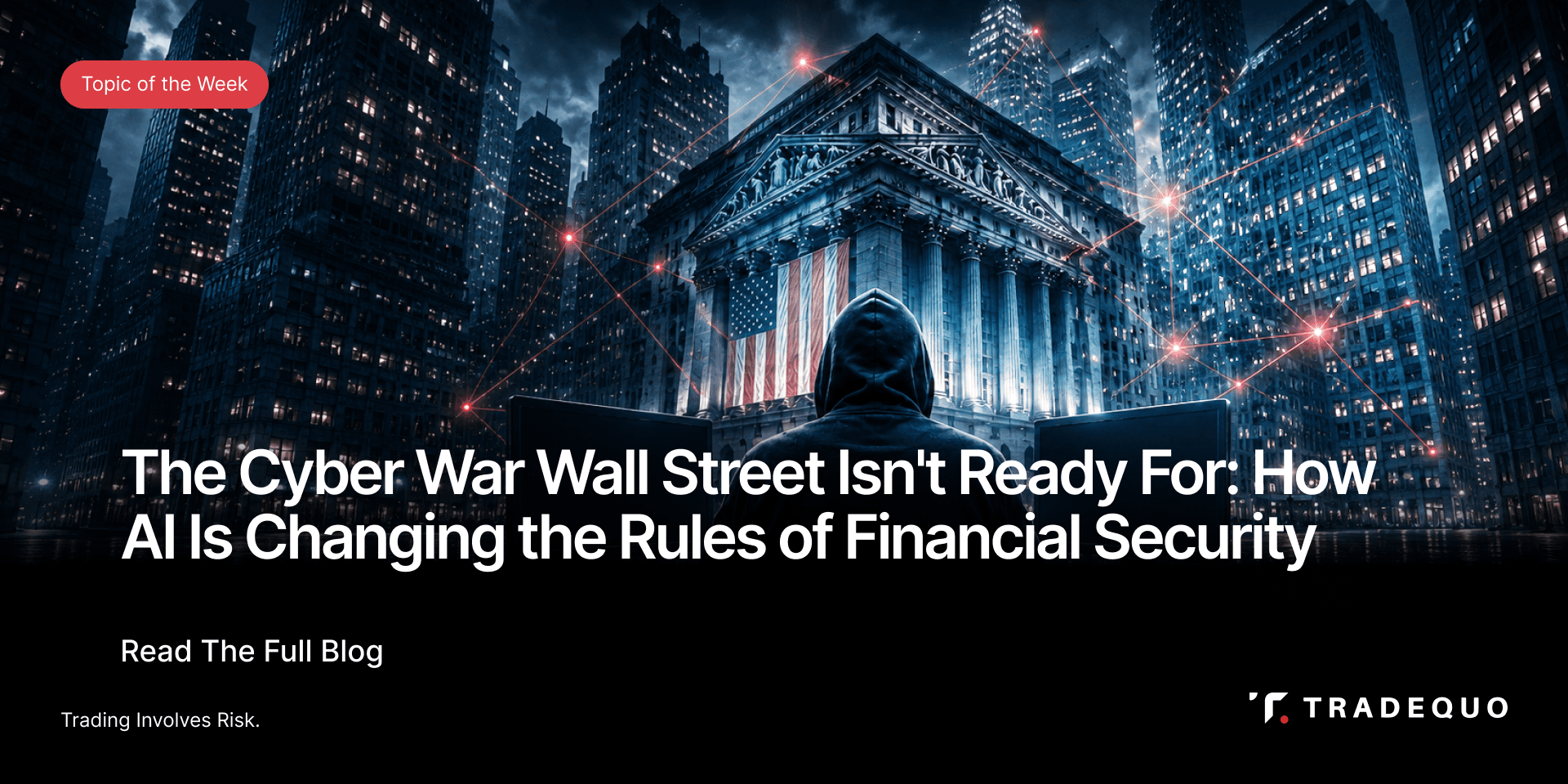
The Cyber War Wall Street Isn't Ready For: How AI Is Changing the Rules of Financial Security

Imagine waking up to a notification that your brokerage account has been drained. Not because you clicked a suspicious link or shared your password, but because an AI-driven attack exploited a vulnerability no human engineer had even imagined existed. You call your financial institution, only to hear automated hold messages while markets tumble and billions vanish in the time it takes to brew your morning coffee. 

This isn't science fiction. This is the cyber war Wall Street isn't ready for, and the rules of financial security are quickly becoming the most urgent conversation in every boardroom around the world. 

For decades, investors trusted that their money was safe. The Federal Deposit Insurance Corporation protected bank deposits. The Securities Investor Protection Corporation stepped in if a brokerage firm failed. But those frameworks were designed for an era of physical vaults and paper statements. Today's threats move at machine speed, learn from every defense, and target not just individual accounts but the entire architecture of modern finance. 

Let’s walk through what's happening, why it matters for every single person with a brokerage account, and what the financial industry must do before it's too late. 

The Financial Industry Has Become a Prime Cyber Battlefield 

Think about what a single financial institution holds. Customer names, addresses, social security numbers, account numbers, trading histories, and enough sensitive data to fuel identity theft for years. Banks hold cash. Brokerage firms hold stocks, mutual funds, and other securities. Payment networks process trillions in transactions. Digital asset exchanges operate around the clock. 

For a cybercriminal, breaking into a financial system is like finding the master key to a city's entire treasury. And AI has just handed them a lockpicking toolkit that learns and improves with every attempt. 

The traditional model of security relied on firewalls, antivirus software, and employees trained to spot obvious phishing emails. But malicious software can now log keystrokes to capture sensitive data while remaining invisible to conventional scans. Identity thieves use AI-generated phishing campaigns that personalize every message based on your social media activity, your recent transactions, and even the weather where you live. 

The Growing Cost of Cybercrime 

When a brokerage firm suffers a breach, the damage cascades. Customers lose access to their investments. Trading halts. Regulators launch investigations. The Securities and Exchange Commission demands answers. Lawsuits follow. 

But the deepest wound is often invisible: trust. Once investors question whether a financial institution can protect their assets, they move their money. They close accounts. They tell their friends. And in an industry built entirely on confidence, that single disappointment can be more devastating than any immediate financial loss. 

A single successful attack can trigger unauthorized transactions from thousands of accounts simultaneously. Reversing those trades, verifying legitimate ownership, and restoring customer assets takes weeks or months. Meanwhile, the perpetrators have already moved funds through countless wallets and offshore accounts. 

From Isolated Hacks to Systemic Risk 

The vast majority of financial institutions now rely on the same few AI vendors for security, trading algorithms, and risk management. That concentration creates a single point of failure. If an attacker compromises one major operating system or cloud provider, they could potentially access dozens of banks, brokerage firms, and exchanges at once. 

The IMF identified this concentration risk as a systemic amplifier. Multiple firms using similar AI models can cause simultaneous asset sell-offs, creating algorithmic echo chambers where everyone's software reaches the same catastrophic conclusion at the same moment. 

This is no longer about one company losing money. It is about the financial stability of entire economies. 

AI-Powered Phishing Is Becoming Almost Impossible to Detect 

Traditional phishing scams are clumsy. Misspelled words, generic greetings, obvious fake URLs. Most of us learned to spot them in the 1990s. But generative AI crafts highly personalized phishing emails at a massive scale. These messages mimic the tone, vocabulary, and formatting of legitimate communications from your bank, your broker, or even the US government. 

Imagine receiving an email that appears to come from your SIPC member brokerage firm. It references your most recent trade, mentions your account number's last four digits, and warns of suspicious login attempts from your approximate geographic area. It asks you to verify your identity through a link that leads to a perfect replica of your broker's website. 

You enter your credentials. Within seconds, attackers have full access. They change your password regularly to lock you out. They liquidate your holdings. They transfer cash to accounts you have never seen. 

Deepfake Executives and Voice Cloning 

Now take that threat and multiply it. AI-generated voices can now impersonate CEOs, compliance officers, or financial advisors with terrifying accuracy. An attacker calls a brokerage firm's help desk, sounding exactly like a high-net-worth client. They request a wire transfer. They authorize a trade. They ask for a password reset. 

The person on the other end of the phone has no reason to doubt. The voice matches. The background information is correct. The request seems urgent but reasonable. 

Automated Vulnerability Discovery 

Cybercriminals once spent weeks manually probing software for exploitable flaws. Now, AI tools can scan entire systems, identify weakness discovery points, and generate attack code in hours. The time between a vulnerability being discovered and an attack being launched has collapsed from months to days to potentially minutes. 

Financial institutions that once had weeks to patch security issues now find themselves racing against machines. And the average user, whether an individual investor or an institutional trader, has no idea this arms race is happening behind their online session screen. 

Intelligent Malware and Adaptive Attacks 

The most frightening development is adaptive malware. Traditional viruses follow fixed instructions. AI-driven malware learns during an attack. If it encounters a defense, it changes strategy. If it detects a sandbox environment, it lies dormant. If it gains partial access, it searches for better entry points. 

These attacks don't just break in. They explore, adapt, and evolve until they achieve their objective. And because they operate at machine speed, human security teams often cannot respond before significant damage occurs. 

Wall Street's AI Defense Strategy 

Fighting AI With AI 

Every threat I just described has a defensive counterpart. Financial institutions now embed advanced machine learning systems into their core infrastructures to detect and neutralize security threats in real time. 

Banks integrate anti-money laundering and cybersecurity signals into AI dashboards that monitor millions of transactions per second. When something unusual appears, the system flags it instantly. Modern AI can flag execution patterns indicative of financial crimes like spoofing and wash trading, behaviors that human monitors might never spot. 

Advanced AI fraud detection systems can significantly reduce false positives while improving detection rates. That matters because false alerts used to be so common that security teams ignored them. Now AI can distinguish genuine threats from noise with remarkable accuracy. 

Real Time Threat Detection 

Traditional monitoring systems trigger high rates of false alerts in fraud detection, demotivising the very people responsible for responding. AI solves this by learning what normal behavior looks like for each account, each device, each network connection. 

When your brokerage account logs in from an unfamiliar wireless connection, AI checks dozens of signals: typing patterns, mouse movements, the specific temporary internet files on the device, even the angle at which you hold your phone. If something feels wrong, the system challenges the login, freezes the account, or alerts a human analyst before any money moves. 

Predictive Security: Preventing Attacks Before They Happen 

The real transformation is from reactive to predictive. Instead of waiting for a breach and cleaning up afterward, AI helps financial institutions identify vulnerabilities before hackers exploit them. Machine learning models analyze past attacks to predict where the next one will strike. They scan code for potential weaknesses. They simulate thousands of attack scenarios per second to find the weakest links in a security chain. 

Institutional investors now scrutinize security governance as part of their risk assessment. They ask questions like: Does this brokerage firm use centralized AI security? How often are models updated? What happens if a vendor is compromised? These aren't technical details. They are fundamental to hedging against systemic risks. 

What Happens If a Major Financial Institution Is Hit? 

Scenario 1: A Large Brokerage Goes Offline During Market Volatility 

Picture a Tuesday afternoon. Markets are down 3% on geopolitical news. Suddenly, one of the largest online brokers experiences a complete systems outage. Customers cannot log in. Orders cannot be placed or canceled. Phones ring endlessly. 

Within minutes, traders on social media are panicking. Within hours, news outlets are asking if this is a hack. By market close, the affected brokerage's stock has dropped 15% simply on fear, not even confirmed losses. 

Days later, the company reveals that an AI-driven ransomware attack encrypted their customer databases. They paid the ransom. Accounts are now restored. But thousands of investors sold other holdings to raise cash they could not access, creating a cascade of unexpected selling across unrelated securities. 

Scenario 2: A Major Bank Suffers a Data Breach 

A regional bank with $50 billion in assets announces that attackers gained access to customer data for nearly six months before being detected. Social security numbers, account numbers, addresses, driver's license images, everything. 

The bank offers free credit monitoring. Regulators fine them $10 million. Class action lawyers circle. But the real damage is slower and deeper. Customers begin leaving. Not in a panic, but steadily, quietly, moving their direct deposits, their savings, their retirement accounts to competitors. 

Within a year, the bank has lost 20% of its deposits. Its stock trades at a discount to peers because investors now see it as permanently damaged. 

Scenario 3: Critical Market Infrastructure Is Targeted 

The scariest scenario involves central infrastructure. Stock exchanges. Clearing houses. Payment systems. These entities are designed to be resilient, but they also represent the most tempting targets. 

If attackers disrupted a major exchange's ability to match buyers and sellers, even for an hour, the chaos would be immediate. If clearing houses could not settle trades, counterparty risk would explode. If the Fedwire system was compromised, the entire US payment system could freeze. 

This is why the US government now treats financial cyber threats as national security issues, not just crimes. 

Why Traders and Investors Should Pay Attention 

If you have a brokerage account, you need to care about this. Not because you can personally stop a state-sponsored attack, but because you need to understand how security issues relating to financial firms affect your portfolio. 

When a financial institution discloses a breach, its stock typically drops 2% to 5% in the first week. But the long-term damage depends on customer response. If customers leave, earnings suffer for years. If regulators impose restrictions, growth stalls. If the breach reveals deeper operational failures, management may need to be replaced. 

What Investors Should Look For 

Before opening an account with any brokerage firm, ask about its security practices. Do they use AI for real-time threat detection? How often do they conduct vulnerability discovery tests? Do they encrypt sensitive data both at rest and in transit? What is their response time for security incidents? 

Look at publicly traded financial institutions as investments. Which ones are increasing cybersecurity spending faster than competitors? Which ones have clean records with the exchange commission regarding data protection? Which ones have third-party audits verifying their security claims? 

And watch regulatory developments. Governments are increasingly holding financial leaders personally responsible for security failures. New rules around AI governance, data handling, and breach disclosure are coming. Companies that get ahead of these rules will have advantages. Those that fall behind will face fines, lawsuits, and customer losses. 

Extra Caution for Individual Investors 

On a personal level, use extra caution with every financial interaction. Never click links in unsolicited messages, even if they look legitimate. Type your broker's website address manually. Use unique, complex passwords for every financial account. Enable multifactor authentication everywhere it is offered. Monitor your statements monthly for unauthorized activity. 

Remember that no financial institution will ever ask for your password, your social security number, or your account number via email, text, or phone call. If someone asks, hang up, delete the message, and contact your broker using a verified number from their official website. 

Quantum Computing and the Next Security Challenge 

Just as financial institutions begin adapting to AI threats, quantum computing looms on the horizon. Quantum machines will eventually break much of the encryption that currently protects every online transaction, every secure message, every stored customer asset. 

The race is on to develop quantum-resistant cryptography before quantum computers become powerful enough to destroy existing protections. Estimates vary, but many experts believe we have less than a decade. 

The Battle Between Offensive and Defensive AI 

This is an arms race without a finish line. Offensive AI gets smarter, faster, and more creative. Defensive AI does the same. Neither side will ever achieve permanent victory. The best any financial institution can hope for is staying one step ahead. 

But that requires constant investment, constant vigilance, and constant adaptation. The days of buying a security software package and installing it for five years are over. Financial security is now an ongoing process, not a product. 

Why Financial Security May Become One of Wall Street's Most Important Investments 

The financial system's stability depends entirely on trust. If investors lose confidence that their money is safe, markets break. That is not hyperbole. That is the lesson of every financial crisis in history. 

AI is not making this worse because it is evil or broken. AI is making this more urgent because it is powerful. The same technology that can protect a brokerage account can also drain it. The same algorithms that detect fraud can commit it. The same networks that connect global markets can crash them. 

Wall Street has survived wars, depressions, bubbles, and crashes. It will survive this, too. But not by ignoring it. Not by pretending that old rules still apply. And not by hoping that hackers will choose easier targets. 

The front line of finance has moved online. And the next market crisis may start not with a bank run or a Fed announcement, but with a single line of malicious code, written by an AI that learned everything it needed from the very systems it was about to destroy.

Ready to trade with a platform that takes security seriously? Open a TradeQuo account or start with a demo to experience what modern, security-conscious trading infrastructure looks like in practice. 

FAQs

What Is a SIPC Member Brokerage Firm?

A SIPC member brokerage firm is a brokerage that participates in the Securities Investor Protection Corporation program. If the firm fails financially and customer assets are missing, the Securities Investor Protection Corporation may help return eligible securities and cash to customers, subject to coverage limits.

What Does the Securities Investor Protection Corporation Protect?

The Securities Investor Protection Corporation, commonly known as SIPC, helps protect customers when a SIPC member brokerage firm becomes insolvent. SIPC protects eligible stocks, bonds, mutual funds, and other securities held in customer accounts. However, SIPC does not protect investors from market losses or declines in investment value.

Does SIPC Protection Cover Losses From Cyberattacks?

Not necessarily. SIPC protects customers when a SIPC member brokerage firm fails, and customer assets are missing. It does not protect against losses caused by market fluctuations, poor investment decisions, or most forms of fraud and cybercrime. Investors should still follow cybersecurity best practices to safeguard their accounts.

Why Is Financial Stability Important in the Age of AI?

Financial stability is essential because modern financial institutions are increasingly interconnected through digital infrastructure, cloud services, and artificial intelligence systems. A major cyber incident affecting one organization can quickly impact other businesses, investors, and markets, making cybersecurity a critical component of overall financial stability.

How Can Investors Better Protect Their Accounts?

Investors should use strong passwords, update them regularly, enable multi-factor authentication, monitor account activity, and avoid accessing financial accounts through unsecured wireless networks.

深受人们喜爱

深受市场信赖

2025奖项
2025奖项
2025奖项

© 2026 Trade Quo. All rights reserved.

This website provides content by group of companies, which include:

Tradequomarkets Financial Services L.L.C is a registered, authorised and regulated company by the Securities and Commodities Authority (SCA) of the United Arab Emirates, with License No. 20200000320 Category 5, to carry out regulated activities of Financial Consultations and Introduction. Its registered office is located at Business Tower, Main Business Village 114499 Dubai, UAE.

Tradequomarkets LTD (2023/C0024). Located at #8 Jepson Lane, St. George, Goodwill, Commonwealth of Dominica

Trade Quo Global Ltd, a securities dealer firm that is authorized and regulated by the Seychelles Financial Services Authority (FSA) with license number SD140.

Tradequo (PTY) Ltd is licensed in South Africa by the Financial Sector Conduct Authority with FSP license number 54827. The registered office: 33rd Floor – 34 Whiteley Road, 2196, Johannesburg, South Africa.

Quo Markets LLC, registered with Financial Services Authority FSA: 3171 LLC 2024. Registered address: Suite 305, Griffith Corporate Centre, Beachmont, Kingstown, SVG.

Tqbg Ltd, registered in Cyprus with registration number HE438084, registered address Archiespiskopou Makariou III 160 1st floor, 3026, Limassol, Cyprus. Is apointed payment agent, and does not engage in any regulated activities.

Risk Warning: CFDs are complex instruments and come with a high risk of losing money rapidly due to leverage. 72.6% of retail investor accounts lose money when trading CFDs with this provider. You should consider whether you understand how CFDs work and whether you can afford to take the high risk of losing your money.

Regional Restrictions: This website including the information and materials contained in it, is not directed at, or intended for distribution to or use by, any person or entity who is a citizen or resident of the following countries: USA, Israel, Iran, Iraq, Russia, Afghanistan, Cuba, Cyprus, Eritrea, Liberia, Libya, Somalia and Syria or any jurisdiction where such distribution, publication, availability or use would be contrary to applicable law or regulation.

TradeQuo and its affiliates do not target EU/EEA/UK clients.

深受人们喜爱

深受市场信赖

2025奖项
2025奖项
2025奖项

© 2026 Trade Quo. All rights reserved.

This website provides content by group of companies, which include:

Tradequomarkets Financial Services L.L.C is a registered, authorised and regulated company by the Securities and Commodities Authority (SCA) of the United Arab Emirates, with License No. 20200000320 Category 5, to carry out regulated activities of Financial Consultations and Introduction. Its registered office is located at Business Tower, Main Business Village 114499 Dubai, UAE.

Tradequomarkets LTD (2023/C0024). Located at #8 Jepson Lane, St. George, Goodwill, Commonwealth of Dominica

Trade Quo Global Ltd, a securities dealer firm that is authorized and regulated by the Seychelles Financial Services Authority (FSA) with license number SD140.

Tradequo (PTY) Ltd is licensed in South Africa by the Financial Sector Conduct Authority with FSP license number 54827. The registered office: 33rd Floor – 34 Whiteley Road, 2196, Johannesburg, South Africa.

Quo Markets LLC, registered with Financial Services Authority FSA: 3171 LLC 2024. Registered address: Suite 305, Griffith Corporate Centre, Beachmont, Kingstown, SVG.

Tqbg Ltd, registered in Cyprus with registration number HE438084, registered address Archiespiskopou Makariou III 160 1st floor, 3026, Limassol, Cyprus. Is apointed payment agent, and does not engage in any regulated activities.

Risk Warning: CFDs are complex instruments and come with a high risk of losing money rapidly due to leverage. 72.6% of retail investor accounts lose money when trading CFDs with this provider. You should consider whether you understand how CFDs work and whether you can afford to take the high risk of losing your money.

Regional Restrictions: This website including the information and materials contained in it, is not directed at, or intended for distribution to or use by, any person or entity who is a citizen or resident of the following countries: USA, Israel, Iran, Iraq, Russia, Afghanistan, Cuba, Cyprus, Eritrea, Liberia, Libya, Somalia and Syria or any jurisdiction where such distribution, publication, availability or use would be contrary to applicable law or regulation.

TradeQuo and its affiliates do not target EU/EEA/UK clients.

深受人们喜爱

深受市场信赖

2025奖项
2025奖项
2025奖项

© 2026 Trade Quo. All rights reserved.

This website provides content by group of companies, which include:

Tradequomarkets Financial Services L.L.C is a registered, authorised and regulated company by the Securities and Commodities Authority (SCA) of the United Arab Emirates, with License No. 20200000320 Category 5, to carry out regulated activities of Financial Consultations and Introduction. Its registered office is located at Business Tower, Main Business Village 114499 Dubai, UAE.

Tradequomarkets LTD (2023/C0024). Located at #8 Jepson Lane, St. George, Goodwill, Commonwealth of Dominica

Trade Quo Global Ltd, a securities dealer firm that is authorized and regulated by the Seychelles Financial Services Authority (FSA) with license number SD140.

Tradequo (PTY) Ltd is licensed in South Africa by the Financial Sector Conduct Authority with FSP license number 54827. The registered office: 33rd Floor – 34 Whiteley Road, 2196, Johannesburg, South Africa.

Quo Markets LLC, registered with Financial Services Authority FSA: 3171 LLC 2024. Registered address: Suite 305, Griffith Corporate Centre, Beachmont, Kingstown, SVG.

Tqbg Ltd, registered in Cyprus with registration number HE438084, registered address Archiespiskopou Makariou III 160 1st floor, 3026, Limassol, Cyprus. Is apointed payment agent, and does not engage in any regulated activities.

Risk Warning: CFDs are complex instruments and come with a high risk of losing money rapidly due to leverage. 72.6% of retail investor accounts lose money when trading CFDs with this provider. You should consider whether you understand how CFDs work and whether you can afford to take the high risk of losing your money.

Regional Restrictions: This website including the information and materials contained in it, is not directed at, or intended for distribution to or use by, any person or entity who is a citizen or resident of the following countries: USA, Israel, Iran, Iraq, Russia, Afghanistan, Cuba, Cyprus, Eritrea, Liberia, Libya, Somalia and Syria or any jurisdiction where such distribution, publication, availability or use would be contrary to applicable law or regulation.

TradeQuo and its affiliates do not target EU/EEA/UK clients.