Table of Contents
Introduction
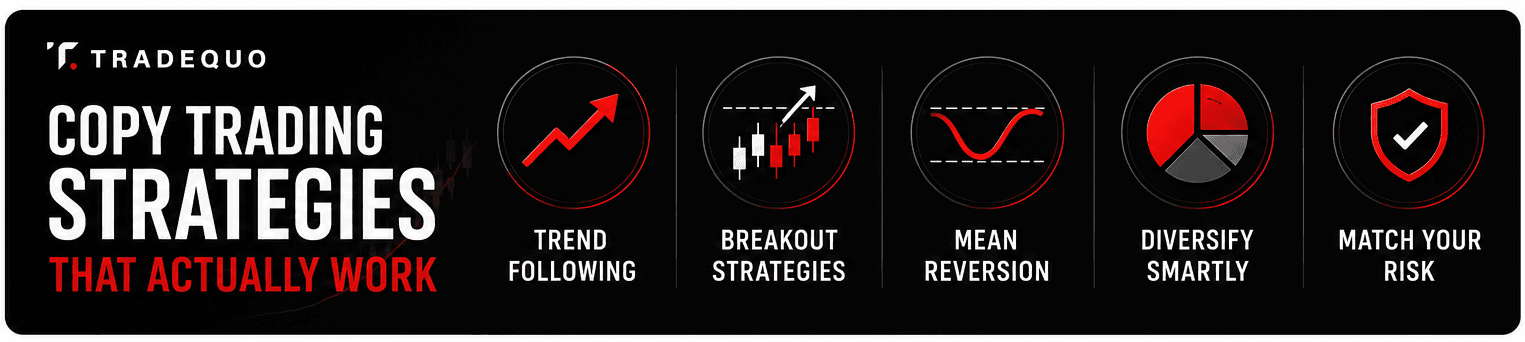
Trend Following Strategies
Breakout Strategies
Mean Reversion and Range Strategies
Diversification Across Traders and Assets
Matching Strategy to Risk Tolerance
Conclusion
FAQs
Introduction
Copy trading allows you to automatically replicate the trades of experienced traders in real-time, opening the door to the forex and CFD markets without needing years of practice first. But here is the part most beginners overlook: simply hitting the "copy" button is not a strategy.
The traders who actually see consistent results are the ones who think carefully about which copy trading strategies to use, how much capital to allocate, and how their choices align with their personal risk tolerance. This guide walks you through the approaches that matter most in 2026, from trend following and breakout trading to mean reversion, diversification, and smart risk alignment.

Trend Following Strategies
Trend following remains one of the most widely used copy trading strategies in the forex market and across global markets. At its core, this trading strategy focuses on identifying sustained market movements by analysing patterns such as higher highs in bullish trends or lower lows in bearish ones through technical analysis.
Many professional traders and expert traders rely on moving averages, algorithmic trading systems, and historical trades to determine whether forex pairs are likely to continue moving in a specific direction. When you copy traders using this approach, your copy trading account automatically replicates their trading decisions as they aim to ride strong market movements over time.
This approach often suits balanced or conservative copy traders who prefer consistency over aggressive exposure. Swing trading is also commonly used within trend-based systems, helping active traders capture medium-term moves across changing market conditions.
However, there are risks involved. Trend strategies can struggle during ranging market conditions or sharp price swings, particularly when market risk increases. If one trader applies high leverage while trading CFDs, losses may accumulate quickly, especially in volatile markets.
For this reason, using robust risk management tools such as take-profit levels, copy-stop-loss, and predefined risk management settings is essential. Following traders with a track record of at least six to twelve months and a drawdown below thirty percent may also improve your ability to make informed decisions. Still, past performance is never an indicator of future performance, and traders tend to adapt differently when market conditions change.
Breakout Strategies
Breakout-based mirror trading strategies aim to capture price movements that occur when an asset breaks through established support or resistance levels. In forex copy trading environments, successful traders often wait for confirmation signals before starting to trade a breakout setup, such as increased trading volume or alignment with broader market sentiment.
These strategies are particularly common among aggressive traders who seek opportunities during busy trading sessions when forex trading activity is highest. A lead trader may use automated trading signals or manual trading decisions to enter positions just as market movements accelerate.
From a copy trading perspective, the benefit is speed. When you copy a trading system built around breakout logic, your trading account can react to emerging opportunities across financial markets without constant monitoring.
Yet execution delays can result in different entry or exit prices compared to the trader being copied, especially during fast-moving conditions in crypto trading or forex trading. This can impact your take-profit levels or increase your exposure to market risk.
To mitigate this, it is advisable to use proportional copying or fixed-size allocation methods so that no more than two to three percent of your capital is exposed to any single copied trade. Many copy trading platforms also allow you to implement strategy-level hard stops to automatically stop copying one trader if the drawdown reaches personal limits.
Mean Reversion And Range Strategies
Mean reversion strategies focus on the idea that prices often return to their average after temporary extremes. In stable or range-bound market conditions, forex trader accounts may use reversal-based technical analysis to identify overbought or oversold levels across key forex pairs.
This copy trading strategy often appeals to conservative traders who prefer predictable patterns rather than chasing rapid momentum. Expert traders using this method typically rely on trading history and track record data to determine where price exhaustion may occur.
Range trading works best in calm financial markets where sudden market movements are limited. However, during unexpected economic data releases or strong directional trends, this strategy may underperform.
Psychologically, this approach suits copy traders with lower risk tolerance who are comfortable holding positions until the price stabilises. Still, risk management remains essential. Applying the one percent rule by risking no more than one to two percent of total capital on each trade can help reduce the likelihood of losing money over time.
Running any new traders to copy within a demo environment for at least one week before allocating real funds can also help evaluate whether their trading preferences align with your own trading experience.
Diversification Across Traders And Assets

Relying on one trader or signal provider exposes your trading account to unnecessary concentration risk. Effective copy trading involves allocating capital across three to five different traders with varying trading styles, including day trading, swing trading, or algorithmic trading approaches.
Diversifying across multiple traders allows your portfolio to participate in different financial markets simultaneously, including forex pairs and commodities, depending on your chosen copy trading platform.
For instance, one lead trader may specialise in trend systems while another focuses on range-based strategies. This reduces reliance on a single trading system and spreads exposure across different market conditions.
A copy trading account that distributes capital wisely can better withstand underperformance from any one trader. It also supports more informed trading decisions by enabling you to compare trader statistics such as win rate, average holding time, and maximum drawdown.
Matching Strategy To Risk Tolerance
Matching a copy trading strategy to your risk tolerance is essential for long-term sustainability. Traders usually fall into conservative, balanced, or aggressive categories depending on their risk appetite and trading style.
Before allocating how much capital to each provider, review their trading history across changing market conditions. Look for consistency in their track record rather than short-term gains driven by excessive leverage.
Modern copy trading platforms provide advanced risk management tools and risk management features such as stop-loss limits, proportional copying, and capital allocation controls. These tools help copy traders maintain portfolio balance even during volatile markets.
Setting a copy stop loss ensures your system stops following a trader if your investment drops below a defined threshold. Monitoring performance regularly is equally important since copy trading is not a passive activity and requires oversight to remain aligned with your financial goals.
Conclusion

No single trading strategy performs consistently across all market conditions. Trend following may thrive in directional markets, while mean reversion or breakout strategies may offer advantages during periods of consolidation or volatility.
Successful copy trading in 2026 depends on diversification, disciplined risk management, and selecting traders to copy whose trading preferences match your own risk tolerance. Starting with a small amount of capital, testing strategies through a demo account, and evaluating historical trades before committing real funds can make a meaningful difference over time.
TradeQuo offers access to a regulated broker environment, educational resources, and copy trading tools designed to support both new and experienced traders. Whether you are exploring social trading for the first time or refining an existing copy trading journey, the right platform combined with thoughtful strategy selection can help you make more informed decisions.
FAQs
Is Copy Trading Legal?
The legal status of copy trading depends on the regulated broker and the jurisdiction you are using. Most reputable trading platforms operating under financial regulation allow copy trading within established compliance frameworks.
Can Copy Trading Be Profitable?
Copy trading's profitable outcomes depend on the traders you follow, your risk management settings, and how closely their trading style matches your risk tolerance.
How Much Capital Should I Start With?
It is advisable to start trading with a small amount of capital while testing strategies on a demo account before committing larger funds.
Should I Copy Multiple Traders?
Diversifying across multiple traders can help manage risk and reduce the impact of one trader’s poor performance on your overall portfolio.