
Copy trading is a simple and accessible form of social trading that lets everyday people automatically replicate the trades of experienced traders in real time. Instead of sitting in front of charts all day, conducting your own market analysis and making every trading decision, you link your trading account to a signal provider whose strategy you trust. You allocate a portion of your capital to that provider, and whenever they open or close a position, the exact same trade appears in your copy trading account, scaled proportionally to the funds you have committed.
This approach differs from manual trading because you do not need advanced trading skills or hours of research to participate. The platform handles everything through automation, so the system manages position openings and closings based on the leader’s actions. Beginners gain exposure to financial markets like forex trading or stocks without the steep learning curve of traditional trading.
At the same time, it carries real risks such as market risk and dependency on the provider’s performance. That is why responsible use matters. Always research providers carefully, diversify across multiple traders, and remember that trading involves risk. TradeQuo streamlines the process by providing transparent statistics and built-in risk controls to help you stay informed and protected.
How Does Copy Trading Work
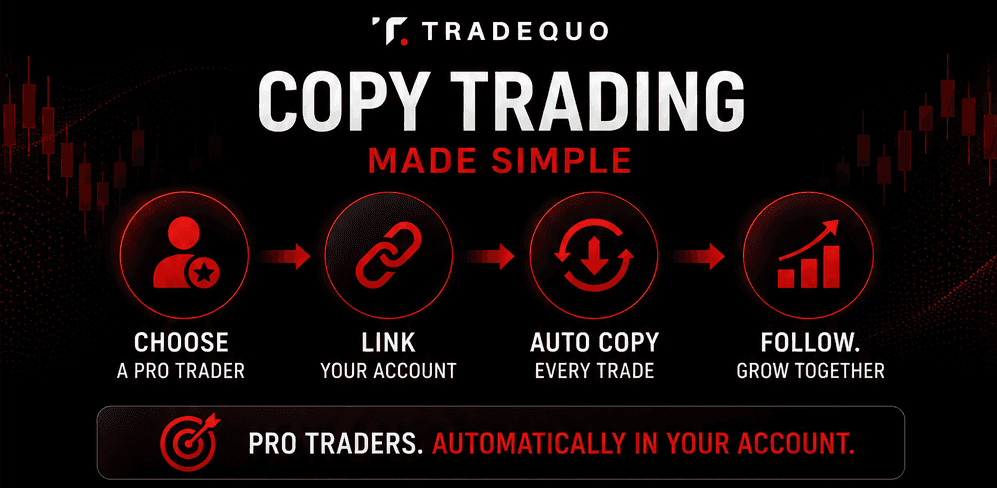
At its core, copy trading connects three parties: the signal provider (the experienced trader sharing their trading strategy), the copier (the follower replicating those trades), and the platform (the broker or exchange that facilitates the connection and automates execution).
Account Linking and Proportional Execution
When you join a copy trading platform and choose a trader to follow, you allocate a portion of your capital to their strategy. From that point, the system handles everything automatically. When the signal provider opens a trade, the platform instantly opens the same trade in your account, scaled proportionally to your allocated funds.
Understanding proportional copy trading is important. If a signal provider has $10,000 in their account and opens a position using 5% of their capital, the platform will apply that same 5% ratio to your allocation. So if you have allocated $1,000, your position would be $50, mirroring the leader's exposure without requiring an identical account size.
Mirror trading is a related concept where you copy an entire predefined trading strategy rather than individual decisions, but standard copy trading focuses on real-time replication of live actions. Execution slippage can sometimes occur, meaning your entry or exit price might differ slightly from the leader’s due to market volatility or timing. Still, the core idea remains the same: you gain the benefit of professional traders without handling every step yourself. This setup removes much of the daily work while keeping you directly tied to their results.
A Simple Example
Say you allocate $500 to follow a pro trader who opens a buy position on EUR/USD using 10% of their $20,000 account. That represents $2,000 on their end. On your end, 10% of your $500 allocation equals $50. The trade is opened in your account at $50, in the same direction, at the same market price, at the same time.
When the provider closes the trade, yours closes too. If they take a 3% profit, you take roughly the same, minus any spreads or platform fees. If they take a loss, that loss is reflected in your account as well. The automation manages position openings and closings entirely based on the leader's actions, with no input needed from you.
This is what separates copy trading from social trading more broadly. Social trading involves sharing market insights, commentary, and strategies between different traders. Copy trading takes it a step further by automating the actual replication of trades, removing the manual step of deciding whether to act on someone else's analysis.
Benefits of Copy Trading
Easy Entry for Beginners
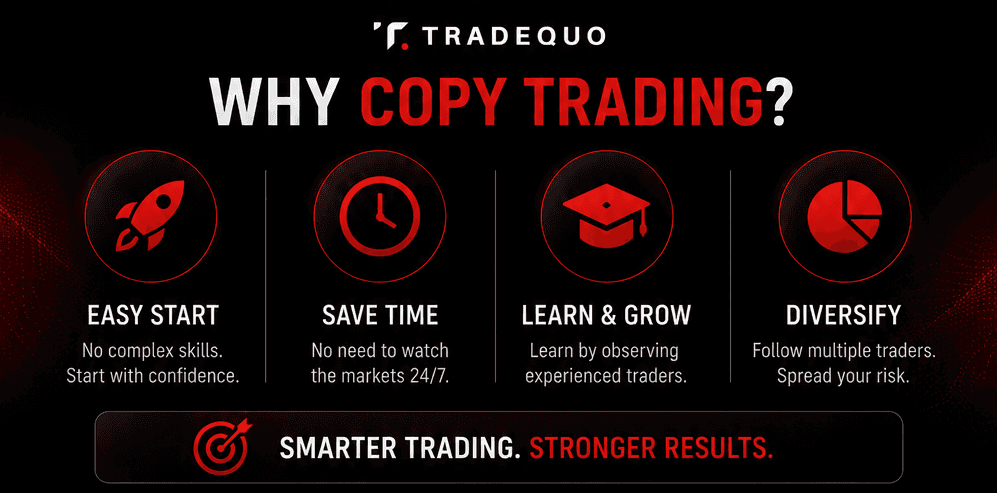
One of the biggest advantages of copy trading for beginners is accessibility. You do not need to understand technical analysis, spend hours reading economic reports, or develop a trading strategy from scratch. Copy trading allows beginners to participate in financial markets without the extensive knowledge or experience that manual trading demands. You are, in effect, borrowing the expertise of more experienced traders while you build your own understanding over time.
Time Savings
Markets move continuously, and staying on top of them requires constant attention. For anyone balancing work, family, or other commitments, that kind of dedication simply is not realistic. Copy trading eliminates the need for extensive market research and daily monitoring. Your account operates based on the provider's activity, which means you can gain exposure to global markets without needing to be present at every moment.
Learning Through Observation
There is genuine educational value in watching how experienced traders respond to different market conditions. By following a skilled signal provider, you can observe their trading style, see how they manage risk, and begin to understand the logic behind their decisions. Over time, this exposure can help you develop your own trading knowledge and build the confidence to eventually trade more independently if you choose to.
Portfolio Diversification
Copy trading also makes it practical to follow multiple traders simultaneously, each with a different strategy, asset focus, or risk profile. This kind of diversification spreads your exposure across different approaches, reducing your dependence on the success of any single trader.
Risks and Challenges of Copy Trading
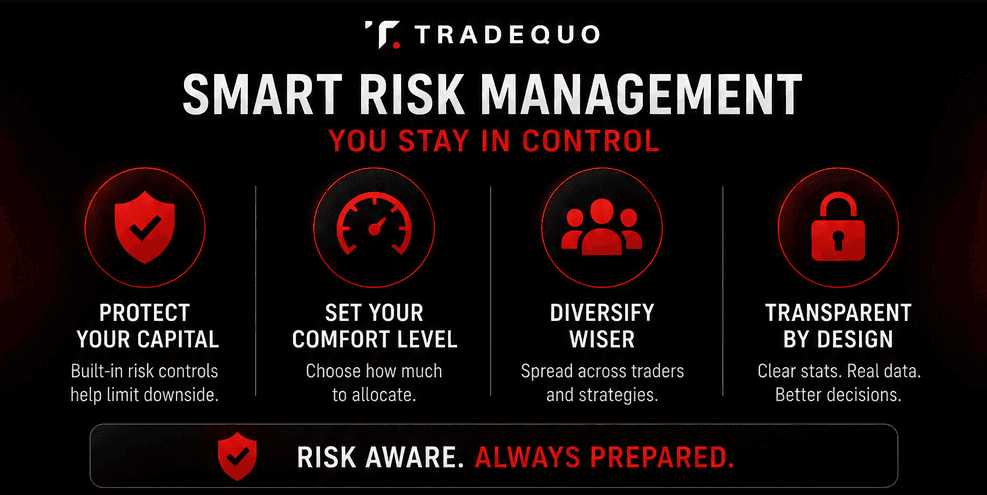
Understanding what can go wrong is just as important as knowing what can go right. Copy trading does not eliminate market risk, and there are several challenges worth understanding before you start trading.
No Guaranteed Returns
Past performance is not a reliable indicator of future results. A trader who delivered strong returns over the past six months may struggle in different market conditions. The success of your copy trading account is directly tied to the ongoing performance of the signal providers you follow, and that performance can change.
Lack of Control
When you copy a trader, you hand over decision-making authority. The trades placed in your account are not your own choices, and depending on the platform, you may have limited ability to intervene quickly if a strategy starts going wrong. This lack of control is one of the defining risks of the model.
Differences in Risk Tolerance
Your risk appetite may be very different from the trader you are copying. A provider who treats drawdowns as acceptable parts of their strategy may be comfortable with losses that would be alarming to you. Without carefully reviewing a trader's risk profile and historical drawdowns before following them, you can end up exposed to more volatility than you intended.
Influencer Misinformation
Not every visible or popular trader on a platform is a qualified professional. Some high-profile accounts attract followers through marketing rather than verified performance. Copying traders based on social proof alone, without examining their actual trading history and risk metrics, can expose you to significant losses.
Execution Slippage and Platform Issues
Even on well-run platforms, slight differences can occur between the price a signal provider receives and the price your trade executes at. This execution slippage may be small in most cases, but in volatile market conditions, it can affect outcomes meaningfully. Platform outages or technical delays are also real risks that can impact trade timing.
Cost Erosion
Spreads, commissions, and any performance fees charged by signal providers all add up over time. Even profitable traders may deliver lower net returns to copiers once these costs are factored in. Reviewing the full cost structure of any copy trading service before committing capital is a necessary step, not an optional one.
Proper risk management, due diligence on providers, and a clear understanding of what you are signing up for are all essential before you allocate any real funds.
How to Choose Successful Traders to Copy
Selecting the right signal provider is the most consequential decision you will make as a copier. Their performance directly shapes your results, so the evaluation process deserves serious attention.
Review Performance History Carefully
Start with a trader's full track record, not just their recent wins. An effective copy trading strategy evaluates how a trader performs during market volatility, not just during favorable periods. Consistent, steady returns over an extended period are more meaningful than a short streak of high gains.
Examine Drawdown and Risk Scores
Maximum drawdown tells you the largest peak-to-trough decline a trader's account has experienced. This metric gives you a realistic sense of how much loss you could face during a rough patch. A trader who shows high returns but has also experienced severe drawdowns may not be compatible with your risk tolerance.
Assess Strategy Compatibility
Consider whether a trader's strategy aligns with your own goals. A scalper who opens dozens of trades a day operates very differently from a swing trader holding positions for several days. Make sure the trading style and asset classes they trade match what you are comfortable with.
Diversify Across Multiple Providers
Relying on a single trader concentrates all your risk in one place. Spreading your allocated funds across multiple signal providers, ideally with different trading styles and market focuses, gives you a more resilient portfolio. If one provider hits a difficult period, others may offset the impact.
Monitor Continuously
Choosing a trader is not a one-time decision. Markets evolve, trader behavior changes, and strategies that worked in one environment may underperform in another. Regularly reviewing the performance of the professional traders you follow and being willing to adjust your portfolio when necessary is part of responsible copy trading.
Social Trading on TradeQuo
Getting started on TradeQuo is designed to be straightforward, even for complete beginners. At the core of this experience is SocialTrading.ai, TradeQuo’s dedicated copy trading ecosystem built to go beyond traditional copy trading platforms. To access it, simply create a TradeQuo trading account, complete verification, and connect it seamlessly to the SocialTrading.ai environment.
What makes SocialTrading.ai stand out is that it’s not just a copy trading tool; it’s a full trading ecosystem built around transparency, performance, and community intelligence. Inside the platform, you’ll find a wide selection of trader profiles with detailed, real-time statistics, including historical performance, risk metrics, and strategy breakdowns, allowing you to make decisions based on actual data, not marketing claims.
Unlike many competitors that offer static leaderboards or limited filtering, SocialTrading.ai provides real-time rankings and advanced strategy selection, helping you identify consistently performing traders, not just short-term winners.
Another key advantage is flexibility. You’re not locked into a single strategy; you can copy multiple traders at once, diversify your portfolio, and adjust allocations dynamically, which is critical for managing risk in volatile markets.
For more advanced users, the platform also introduces a monetization layer that most competitors lack. Skilled traders can become Leaders, earn performance fees, receive trading volume rewards, and build a followers base, effectively turning their trading activity into a scalable income stream.
On top of that, SocialTrading.ai adds an interactive and community-driven experience through rankings, medals, and achievement systems, encouraging transparency, consistency, and long-term performance rather than risky short-term gains.
And importantly, this isn’t a closed or isolated system. SocialTrading.ai connects you to a global network of thousands of traders, giving beginners access to real strategies and insights while accelerating their learning curve through observation and replication.
Combined with TradeQuo’s infrastructure, this creates a copy trading environment that is not only easy to use but also more dynamic, more transparent, and more scalable than most traditional social trading platforms.
Final Remarks
Copy trading offers a practical and accessible route into financial markets, particularly for those who are new to trading or who simply do not have the time for hands-on market analysis. By automatically replicating the trades of experienced traders, you can gain market exposure and learn from skilled professionals while managing your own risk parameters.
That said, it is not a passive path to profit. The risks are real, the choice of signal provider matters enormously, and ongoing monitoring is essential. Approach copy trading as a disciplined strategy, not a shortcut, and it can be a genuinely valuable part of your financial journey.
Ready to explore it for yourself? Visit TradeQuo to browse trader profiles, review transparent performance data, and start copy trading with the risk controls that suit your goals.
FAQs
Is Copy Trading for Beginners Profitable?
Copy trading profitable outcomes depend on the signal provider, their trading strategy, market conditions, and how you use risk management tools. There are no guarantees.
Is Copy Trading Legal On Most Copy Trading Platforms?
Copy trading legal status varies by country. Always choose regulated trading platforms for better transparency and security.
Is Copy Trading Suitable For Beginners With Limited Trading Knowledge?
Copy trading for beginners offers access to markets without deep trading knowledge. By following a signal provider and their trading signals, you can learn while participating.
Can I Practice Copy Trading Before Using Real Money?
Yes. Many platforms provide a demo account so you can test strategies and explore risk management tools without risking real funds.
Do I Still Need My Own Trading Strategy When Copy Trading?
Yes. Even in social trading, you should understand basic trading strategies and monitor performance to manage risk effectively.
How Do I Choose A Reliable Signal Provider?
Look for a signal provider with a transparent, long-term history of consistency rather than short-term gains. Prioritize those with low drawdowns to ensure their strategy aligns with your personal risk tolerance.
What Is The Difference Between Copy Trading And Social Trading?
Social trading involves sharing market insights, commentary, and strategies between traders, while copy trading automates the actual replication of trades so a follower's account mirrors a signal provider's positions without requiring a manual decision each time.
Disclaimer: CFDs are complex instruments and come with a high risk of losing money rapidly due to leverage. You should consider whether you understand how CFDs work before investing.