If you have been looking for ways to participate in financial markets without the traditional barriers to entry, you have likely come across the term CFD trading. For beginners, the world of contracts for difference can seem complex at first glance, but it is essentially a method of speculating on price movements without ever owning the underlying asset. Instead of purchasing shares of a company or barrels of oil, you enter into an agreement with a broker to exchange the difference in an asset’s value from the time you open the trade to when you close it.
This approach has attracted significant attention because it allows traders to potentially profit in both rising and falling markets while accessing global markets with relatively small amounts of capital. However, like any financial instrument that offers flexibility, CFD trading comes with its own set of risks and nuances that every beginner needs to understand before committing real money.
What Is CFD Trading and How Does It Work
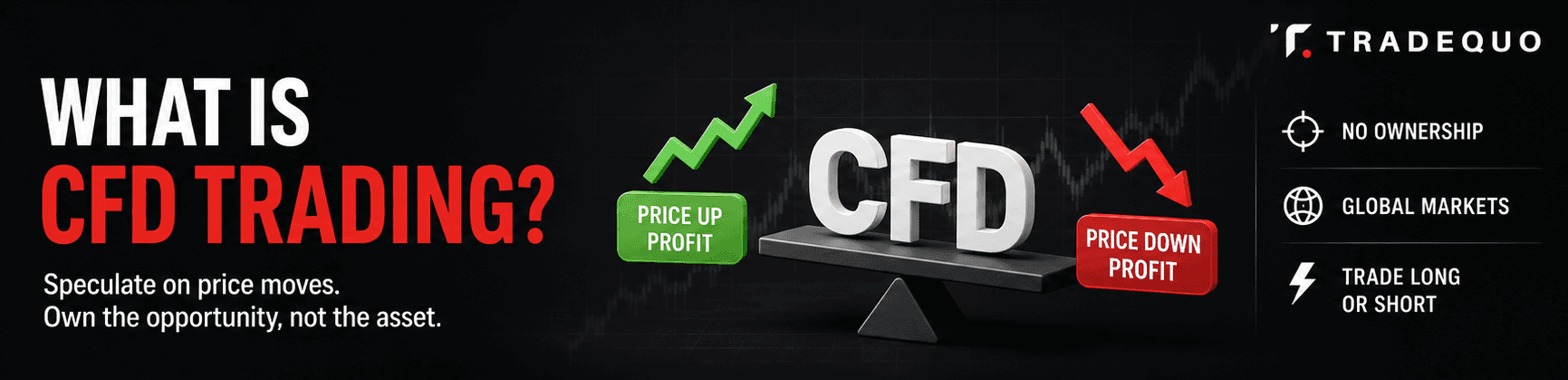
At its core, CFD trading is a form of financial derivative trading. The name itself tells you what happens: you enter into a contract for the difference in price of an underlying asset. Whether that asset is a company share, a currency pair, a commodity like gold, or even a cryptocurrency, you never take ownership of it. You are simply speculating on whether that asset’s price will go up or down.
Let’s say you believe Tesla shares will rise. With traditional investing, you would buy the shares, pay the full price, and own them until you sell. With a CFD, you tell your broker you want to open a position that reflects the performance of Tesla shares. If the price goes up, the broker pays you the difference. If it goes down, you pay the broker the difference. This is why CFDs are classified as over-the-counter instruments; the trade happens directly between you and your broker rather than on a centralized exchange.
Understanding how CFD trading works also means recognizing that you are dealing with price fluctuations rather than asset ownership. You do not get voting rights or dividends, but you also do not have to worry about physical delivery or stamp duties. The entire experience is designed to mimic the price movements of the actual market, allowing you to focus purely on direction and timing.
Trading Both Directions
One of the defining characteristics of contracts for difference is the ability to trade in both directions. If traders expect an asset to rise, they open a long position. If they expect the underlying market to fall, they can open short positions and benefit from falling markets.
This flexibility allows CFD traders to remain active regardless of whether global markets are bullish or bearish.
Markets Available for CFD Trading
CFDs cover a wide variety of asset classes, including:
Stocks
Indices
Commodities such as gold, oil, and silver
Currency pairs in forex trading
Cryptocurrencies
This diversity enables traders to monitor market dynamics across several sectors and build diversified trading strategies within a single CFD trading account.
Key Terms Explained
Before you open your first position, you need to become comfortable with the specific language used in CFD trading. These terms will appear on every platform and in every discussion about managing your trades.
Margin
Margin is the amount of money you need to put up to open a leveraged position. It is not a fee or a cost; it is a deposit that ensures you can cover potential losses. Brokers express margin as a percentage of the total trade value. For example, if a broker offers 5% margin on a stock trade, you can control $10,000 worth of shares with just $500.
Leverage
Leverage is what makes that possible. It is expressed as a ratio, such as 30:1, meaning that for every dollar in your account, you can control thirty dollars in the market. Leverage amplifies everything. If the market moves in your favor, your returns are magnified relative to your initial outlay. If it moves against you, your losses are similarly magnified. This is why leverage is often described as a double-edged sword.
Spread
The spread is the difference between the buy price (ask) and the sell price (bid) of a CFD. When you open a trade, you immediately start at a small disadvantage because you buy at the higher price and sell at the lower price. The spread is how many brokers make their money, and it varies depending on market volatility and the asset you are trading.
Pip
In forex trading, you will hear the term pip, which stands for percentage in point. It is the smallest price movement in a currency pair, usually the fourth decimal place. Traders use pips to calculate profits and losses and to set precise entry and exit levels. For example, if EUR/USD moves from 1.1000 to 1.1001, that change represents one pip.
Financing Costs
If you hold a position overnight, you will encounter financing costs, also called swap rates. Because leveraged trading involves borrowed funds, brokers charge interest on positions kept open past a certain time. Depending on the interest rate differentials between the currencies you are trading, you might pay a fee or, in some cases, receive a small credit. These costs make CFD trading less suited for long-term buy-and-hold strategies and more aligned with shorter-term approaches like swing trading.
Steps To Place a CFD Trade
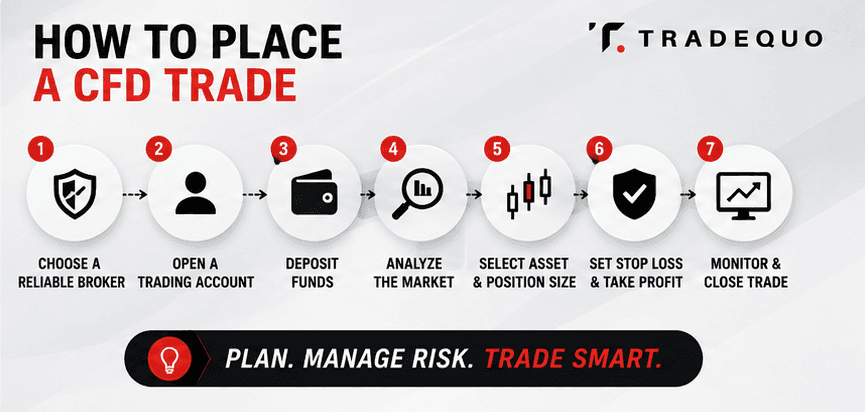
Starting your first CFD trade involves several important steps. While modern platforms simplify the process, following a structured approach improves decision-making and supports effective risk management.
Step 1: Choose a Reliable Broker
The first step is selecting a reputable and regulated broker that offers a secure CFD trading platform. A trustworthy provider should offer transparent pricing, detailed instruments' market information sheets, and robust automated trading capabilities.
Choosing the best CFD trading platform ensures you can track market prices, access thorough market analysis, and monitor market volatility efficiently.
Step 2: Open a Trading Account
Once a broker is selected, traders must open a CFD trading account. This typically involves identity verification and completing forms related to investment objectives, financial experience, and risk tolerance.
Many brokers also provide a demo account, which allows beginners to practice CFD trading without risking real money.
Step 3: Deposit Funds
After the account is approved, traders can deposit funds using available payment methods. These funds form the account cash balance, which will be used to meet margin requirements for new trades.
Step 4: Analyze the Market
Before placing a trade, traders perform market analysis. This may involve reviewing economic data, conducting technical analysis, or monitoring market conditions that influence price movements.
Some traders rely on established trading strategies such as trend following, range trading, breakout trading, swing trading, or news trading.
Step 5: Select the Asset and Position Size
Next, traders select the specific financial asset they want to trade. They then determine the size of the CFD position, which affects both potential returns and potential losses.
Position sizing should always reflect the trader's risk tolerance and risk management strategy.
Step 6: Set Stop Loss and Take Profit Orders
Professional traders rarely enter trades without protective orders. A stop loss automatically closes the position if the price reaches a predetermined level, limiting potential losses.
A take-profit order locks in profits once the market price reaches a target level. These tools are essential for effective risk management strategies.
Step 7: Monitor and Close Your Position
Once the trade is active, traders can monitor the market price, track market moves, and adjust their strategy if necessary.
To exit the trade, traders simply execute the opposite order to close their position.
Advantages of CFD Trading
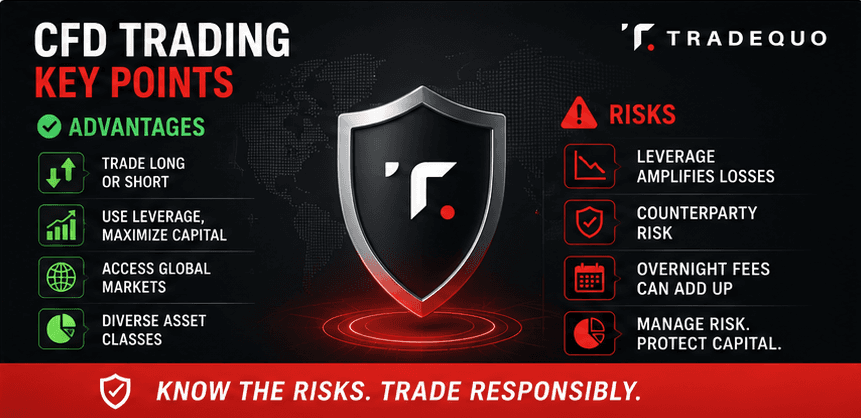
CFD trading provides several unique benefits that help explain why it has become so popular among retail traders around the world. The most frequently cited benefit is the ability to trade in both directions. In traditional investing, you typically need prices to rise to make money. With CFDs, if you believe a market is overvalued or facing headwinds, you can open a short position and potentially profit from falling markets. This flexibility means traders are not forced to sit on the sidelines during downturns.
Leverage is another significant draw. Being able to control a larger position with a smaller amount of capital means your money goes further. You might open positions across several different markets with the same amount of cash that would only buy a handful of shares in a traditional brokerage account.
Access to global markets from a single platform is also a major advantage. Whether you want to trade German indices, US tech stocks, Australian commodities, or Japanese currency pairs, you can usually do so through the same CFD trading account. There is no need to open multiple accounts in different countries or navigate foreign exchange complications just to fund your trades.
For those interested in specific sectors, CFD trading provides exposure to a wide range of asset classes, including forex trading, commodities like oil and gold, and even cryptocurrencies. This variety allows for diversification within a single account, spreading risk across unrelated markets.
Risks and How to Manage Them
For all its advantages, CFD trading carries risks that beginners must take seriously. The most immediate risk comes from leverage. While it can magnify profits, it can also magnify losses to the point where you lose more than your initial deposit. This is not theoretical; it happens regularly to traders who overextend themselves without proper precautions.
Counterparty risk is another consideration. Because CFDs are traded directly with your broker, you are relying on that broker to remain solvent and honor their commitments. If a broker faces financial difficulties, your positions could be affected. This is why choosing a regulated broker is not just a suggestion; it is essential protection. Regulatory bodies impose capital requirements and conduct oversight to ensure brokers operate fairly.
Overnight fees can also eat into profits if you hold positions for extended periods. A trade that moves in your direction might still end up unprofitable if swap charges accumulate over weeks or months. Traders need to factor these costs into their planning, especially if they prefer swing trading over day trading.
Effective risk management strategies address these dangers head-on. Setting stop-loss orders on every trade is the most basic and important habit to develop. You should also limit your position sizes so that no single loss devastates your account. Many experienced traders recommend risking only a small percentage of capital per trade, ensuring you can survive a losing streak and continue trading.
Diversification across different asset classes can provide a buffer against sector-specific shocks. If you only trade technology stocks and the tech sector drops, your entire account suffers. By including commodities, indices, or currencies, you spread your exposure and reduce the impact of any single market move.
Conclusion
CFD trading offers genuine opportunities for those who approach it with preparation and discipline. The ability to access a wide range of global markets, speculate on the price of assets in both rising and falling markets, and use leverage to enhance capital efficiency makes it an attractive option for retail traders. But these same features carry real risk, and the learning curve, while manageable, should not be underestimated.
For anyone beginning their CFD trading journey, the single most important step is spending meaningful time on a demo account first. Most reputable brokers provide demo accounts that replicate real market conditions, allowing traders to practice without putting real money at risk. Practice your strategy, get comfortable with the platform, and test your risk management approach before you ever deposit funds into a live account. Choose a regulated broker, keep your leverage modest in the early stages, and treat every trade as a lesson. The traders who thrive in CFD markets are rarely the boldest. They are the most prepared.
FAQs
What is CFD trading in simple terms?
CFD trading is a form of financial derivative trading where traders speculate on the price movements of assets without owning the underlying asset. Instead of buying the asset itself, traders enter contracts for difference with a broker based on the change between the opening price and closing price.
Can beginners start CFD trading safely?
Beginners can start learning through a demo account, which allows them to practice trading strategies and explore a CFD trading platform without risking real money. This helps build confidence before moving to live markets.
What markets can be trade+d using CFDs?
CFDs provide access to many global markets, including stocks, commodities, indices, cryptocurrencies, and currency pairs in forex trading. This wide coverage allows traders to diversify across multiple asset classes.
Why is risk management important in CFD trading?
Because CFDs use leverage, both gains and losses can be magnified. Implementing a clear risk management strategy, including stop-loss orders and proper position sizing, helps traders protect their capital.
Are profits from CFD trading taxable?
Tax treatment varies by country. In many jurisdictions, profits from CFD trading may be considered taxable income or capital gains. Traders should consult local tax authorities or professional advisors to understand their specific obligations.