Introduction:
Most articles about an introducing broker tell the same simple story. Refer a trader to the trading platform, earn a commission, and repeat the process. While that's technically true, it leaves out the strategy that many successful partners use to grow beyond direct referrals.
The real opportunity lies in building a network. Instead of relying only on your own referred clients, you can develop a team of Sub IBs who introduce their own traders while you earn an override commission on their trading volume. This approach transforms an ordinary IB program into a scalable business with recurring revenue potential.
In this guide, you'll learn how the Master IB model works, how override commissions are calculated, and why experienced partners use this structure to build long-term, sustainable passive income. You'll also learn how TradeQuo's multi-tier structure works and how experienced partners use it to build scalable, long-term businesses.
What Is an IB Partnership Program?

A Forex IB program is a partnership between a forex broker and an independent partner who introduces new traders to the brokerage. Whenever those referred clients open a trading account and actively trade, the Introducing Broker earns commissions based on their trading activity.
Unlike a traditional forex affiliate program, which usually pays a one-time CPA commission, an introducing broker IB focuses on building ongoing client relationships. As long as active traders continue trading, the IB continues earning recurring commissions.
This model benefits both sides. Brokers gain qualified traders without expanding their internal sales teams, while IB partners create recurring revenue by helping traders succeed in the financial markets.
If you're new to the concept, it's worth understanding the basics of the Introducing Broker model before exploring how Master IB networks expand earning potential.
What Is a Sub IB?
A Sub IB is an Introducing Broker who joins through an existing Master IB rather than applying directly with the broker.
This distinction is important because many newcomers misunderstand how the relationship works.
A Sub IB is not an employee, salesperson, or subordinate of the Master IB. Instead, they become an independent broker partner with their own referral business, their own client base, and their own commission agreement with the broker.
Their responsibilities remain exactly the same as those of any other Introducing Broker. They:
Refer new clients to the broker.
Help traders understand the broker's services.
Share educational resources and market analysis.
Provide ongoing support to improve client retention.
Build lasting relationships with their trading community.
The only difference is how they joined the partnership network.
What Is a Master IB?
A Master IB performs all the responsibilities of a regular Introducing Broker while also expanding their business by recruiting Sub IBs. Instead of earning commissions only from personally referred traders, a Master IB receives income from two sources.
First, they earn direct commissions from their own clients trading through the broker. Second, they receive an override commission based on the trading volume generated by the clients introduced through their Sub IB network.
This allows experienced partners to build an IB business that grows beyond their own personal marketing efforts. As the network expands, the Master IB spends less time finding every individual trader and more time helping Sub IBs succeed through marketing materials, ongoing education, business guidance, and client support.
The broker continues handling account management, compliance, deposits, withdrawals, and execution. The Master IB focuses on relationship building and network development.
How Does the Override Commission Actually Work?
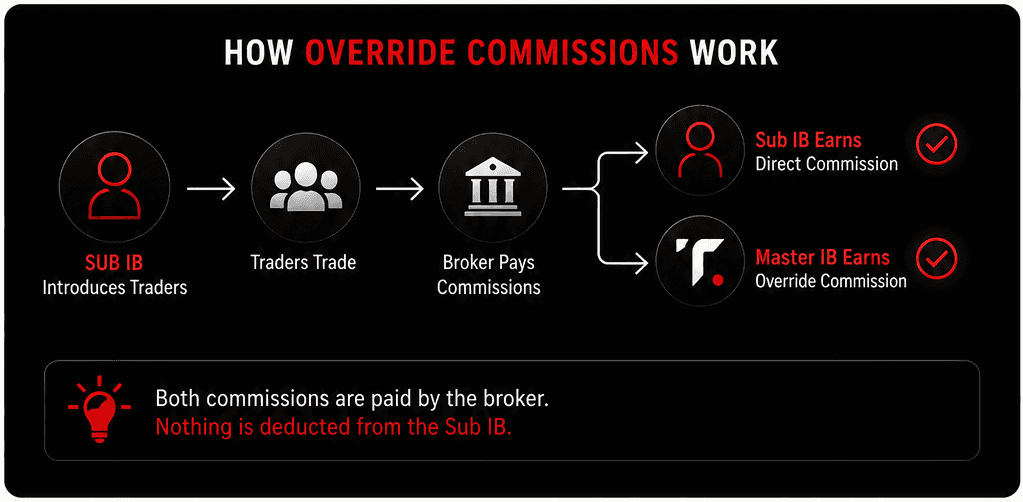
This is the question that creates the most confusion. Many people assume a Master IB receives part of a Sub IB's commission. That is not how legitimate multi-tier IB programs operate. Instead, both commissions are paid independently by the broker.
Imagine the following example: A Sub IB introduces traders who collectively generate 1,000 lots during a month. The broker pays the Sub IB their agreed commission for those trades. Separately, the broker also pays the Master IB an override commission on the same trading volume. Nothing is deducted from the Sub IB's earnings.
For example, when clients referred through a Sub-IB trade, the broker pays the Sub-IB according to their commission agreement. Separately, the broker also pays the Master IB an additional override commission based on the trading activity generated through that Sub-IB's client network. The exact commission depends on the agreed rebate plan and partnership terms, and the Master IB's payment does not reduce the Sub-IB's earnings.
This structure encourages collaboration rather than competition. Master IBs are motivated to help their Sub IBs grow because stronger trading activity benefits everyone involved. Successful Master IBs often provide:
Regular market analysis
Trading webinars
Trading strategies
Educational articles
Community discussions
Business coaching
Client retention support
The stronger the Sub IB performs, the stronger the entire network becomes.
TradeQuo's Sub IB Structure: The Real Numbers
TradeQuo's partnership model is designed for partners who want to build long-term, scalable businesses rather than relying only on direct referrals. Direct IBs earn commissions according to their individual partnership agreement and rebate structure. Master IBs also receive additional commissions generated by the trading activity of clients referred through their Sub-IB network. Commission amounts vary depending on the agreed rebate plan and partnership terms.
One feature that separates TradeQuo from many brokers is its approach to sub-IB structures. While many brokers limit networks to two, three, or five levels, TradeQuo places no limit on the number of Sub IB levels a Master IB can build. This creates significantly greater long-term scaling potential for partners who invest in growing their network over time.
As a Master IB expands its network, additional commissions can be generated from the trading activity of clients referred through each Sub-IB. The overall earning potential depends on many factors, including the size of the network, client activity, trading volume, retention, market conditions, and the specific rebate agreements in place. Rather than relying solely on direct referrals, Master IBs can build a scalable partnership business by supporting the growth of their Sub-IB network.
Is Sub IB Income Really Passive?
One of the biggest selling points of a Forex IB program is the opportunity to generate passive income, but it's important to understand what "passive" actually means in this context.
Building a successful Master IB network takes work. You'll need to recruit reliable IB partners, provide onboarding support, answer questions, and help your Sub IBs grow their businesses. Many successful Master IBs also create educational resources, organize webinars, publish market analysis, and share trading strategies to keep their network engaged. Once that foundation is in place, however, the income becomes far less dependent on your daily involvement.
As your Sub-IBs continue referring new traders and their active clients keep trading, additional commissions are generated based on the trading activity of clients referred through your Sub-IB network, according to the agreed rebate structure. You are not required to manage every trading account, execute trades, or supervise individual clients.
That is why many experienced partners describe Master IB income as largely passive rather than completely passive. The recurring revenue comes from ongoing trading volume, but maintaining a healthy network still requires communication, relationship building, and occasional support.
The strongest Master IB businesses focus on long-term relationships instead of quick recruitment campaigns. Partners who consistently provide value tend to enjoy higher client retention and more stable cash flow over time.
Multi-Tier IB vs MLM: Is It a Pyramid Scheme?
Because a Master IB structure includes multiple levels of partners, people sometimes wonder whether it resembles a multi-level marketing business or even a pyramid scheme. The answer is no, provided the broker operates a legitimate Introducing Broker program.
The defining difference is how commissions are earned. In a legitimate IB model, commissions are paid only when referred clients trade financial products such as Forex or CFDs. Every payment is linked to genuine trading activity and measurable trading volume. A Master IB does not earn simply because another IB joins the network. If no clients trade, there are no trading commissions to distribute.
A pyramid scheme works very differently. Participants are primarily rewarded for recruiting additional members, regardless of whether any genuine product or service is being used. With a regulated broker program, the economic activity comes from real trading conducted by verified clients. Recruitment helps expand the network, but commissions depend on actual client trading, not recruitment itself.
This distinction is one reason why choosing a regulated broker is so important. Regulation adds credibility and helps ensure the partnership program operates transparently.
How to Become a Master IB on TradeQuo
Building a Master IB business doesn't usually happen overnight. Most successful partners begin as direct Introducing Brokers before expanding into a larger network. A typical journey looks like this:
Start as a Direct Introducing Broker
Join the TradeQuo IB partnership and begin referring your own clients. Focus on understanding the broker's products, commission structure, and partner portal.
Build Trust With Your Client Base
Rather than chasing as many signups as possible, concentrate on attracting qualified clients who are genuinely interested in forex trading and CFD trading. Providing educational content and responsive client support helps improve retention and long-term trading activity.
Develop Your Personal Brand
Many successful IBs become recognized trading educators within their communities. They publish educational articles, record videos, host seminars, or create trading communities where beginner and experienced traders can learn together.
Recruit Sub IBs
Once you've established credibility, you can invite other professionals to join your network as Sub IBs through the TradeQuo Partner Portal. Instead of competing for the same traders, you're helping other partners build successful businesses while expanding your own network.
Scale With Dedicated Support
TradeQuo provides dedicated Business Development Manager support to help partners grow. Combined with marketing resources and partner tools, this allows ambitious Master IBs to focus on expanding their networks while maintaining high service standards.
Partners interested in joining can apply through TradeQuo's Introducing Broker program page.
Is Building a Sub-IB Network Worth It?
For many partners, the answer depends on their long-term goals. If your objective is simply to refer a handful of traders, a traditional introducing broker account may be all you need. However, if you already have an audience through social media, education, professional networking, or trading communities, building a Master IB network can significantly increase your earning potential.
The biggest advantage isn't simply higher commissions. It's leverage. Instead of relying solely on your own referrals, you're creating a network of partners who introduce clients independently while you receive additional commissions generated by the trading activity of clients referred through your Sub-IB network, according to your partnership agreement.
That said, success doesn't come from recruitment alone. The strongest Master IBs invest in long-term relationships, provide ongoing education, support their Sub IBs, and help traders become more confident in the markets. This creates stronger client retention, more consistent trading volume, and a business that can continue generating recurring income over time.
For partners willing to invest in people rather than just referrals, the Master IB structure offers one of the most scalable opportunities available within today's Forex partnership landscape.
Conclusion
Most people discover an introducing broker program because they want to earn commissions by referring traders. That's a solid starting point, but it isn't where the biggest growth opportunities end. The Master IB structure adds another layer of scalability by allowing experienced partners to build networks of independent Sub-IBs while receiving additional commissions generated by the trading activity of clients referred through their Sub-IB network. The exact commission depends on the agreed rebate plan and partnership terms. As the network grows, so does the potential for recurring revenue without managing every client personally.
Success still depends on attracting quality traders, supporting your partners, and maintaining long-term relationships. Those who consistently provide education, guidance, and value are often the ones who build sustainable businesses rather than short-lived referral campaigns.
If you're ready to move beyond direct referrals and build a scalable partnership business, TradeQuo's Introducing Broker program provides the tools, flexible commission structure, and unlimited Sub IB levels to support long-term growth.
Frequently Asked Questions
What is a Sub IB in Forex?
A Sub IB is an Introducing Broker who joins through an existing TradeQuo Master IB instead of applying directly with the broker. They refer their own clients and earn commissions based on those clients' trading activity.
How is a Master IB different from a Sub IB?
A Master IB earns commissions from their own referred clients while also receiving additional commissions generated by the trading activity of clients referred through their Sub-IB network. The amount received depends on the agreed rebate structure between the partner and broker.
Does a Master IB's override reduce a Sub IB's commission?
No. The Sub IB receives its full commission directly from TradeQuo. The Master IB's override is a separate payment made by the broker and does not reduce the Sub IB's earnings.
How many Sub IB levels can a TradeQuo partner build?
TradeQuo does not place a limit on the number of Sub IB levels a Master IB can build. This differs from many brokers that cap multi-tier structures at two to five levels.
Is Sub IB income truly passive?
Override income becomes largely passive once an established network is generating consistent client trading activity. However, recruiting new partners, providing ongoing support, and maintaining relationships remain important for long-term success.
Is a multi-tier IB structure the same as an MLM or pyramid scheme?
No. Legitimate IB programs pay commissions only on real client trading volume. Recruitment alone does not generate commissions, which is the key difference between an Introducing Broker program and a pyramid scheme.
Risk Disclaimer: CFDs are complex instruments and come with a high risk of losing money rapidly due to leverage. Partner commissions vary depending on the agreed rebate structure, client trading activity, retention, and market conditions. Any potential earnings depend on individual partnership agreements and actual trading volume generated through referred clients.