

Gold and silver can move together, but they do not behave the same way when markets turn. That is why the question is gold or silver a better investment has no useful one-size-fits-all answer. The more important question is what you want the metal to do in your trading strategy.
The gold vs silver debate becomes especially interesting in 2026. Gold continues to attract attention from central banks and investors during periods of geopolitical and economic uncertainty, while silver has a second source of demand because of its industrial uses.
For traders comparing silver vs gold, the differences in volatility, market drivers, and sensitivity to economic growth can matter just as much as the direction of the metals themselves.
Is Gold or Silver a Better Investment?
There is no universal answer here, and anyone who tells you otherwise is probably selling something. Gold has a long history as a safe haven asset, the kind of thing investors turn to when the stock market gets shaky or when economic uncertainty starts creeping into headlines. Silver shares some of that reputation, but it also carries a second identity as an industrial metal, which changes how it responds to the world around it.
So when people ask should I purchase gold or silver, the more useful question is what you are actually trying to achieve. Are you looking for something that tends to hold steady during economic downturns, or are you comfortable with sharper swings in exchange for the chance of bigger moves? That is really what separates the two metals, and it is worth sitting with before you decide anything.
Gold vs Silver at a Glance

Both metals fall under the umbrella of precious metals, and both have played a role in investment portfolios for generations. Investors can gain exposure to either one in a few different ways. Physical gold and physical silver, in the form of coins or bars, remain the most direct route, though they come with additional costs like secure storage. Precious metal ETFs and exchange-traded funds offer market-based exposure without the hassle of holding physical assets, while mining stocks give investors indirect exposure tied to the companies that produce these metals rather than the metals themselves.
The gold-to-silver ratio is one tool analysts use to compare the two. It measures how many ounces of silver it takes to buy one ounce of gold, and it can shift noticeably depending on market conditions. A rising ratio generally means silver is cheaper relative to yellow metal, while a falling ratio suggests the opposite. It is a useful reference point, but it is not a crystal ball, and it should never be read as a signal on its own.
How Gold Behaves
Gold has earned its reputation the hard way. During periods of economic instability, high inflation, or geopolitical tension, investors tend to move toward gold because it is viewed as a reliable asset that does not depend on any single government or company staying afloat. Central banks play a significant role here too. Central bank gold purchases remain a major factor in overall demand, and when central banks around the world are buying, it tends to reinforce gold's position as a store of value.
Gold is also closely tied to monetary policy. Interest rate decisions, the strength of the US dollar, and shifts in the broader economy all influence its price, often more directly than they influence silver. This is part of why gold has historically shown greater stability and lower relative volatility compared to silver, even though neither metal is immune to swings.
How Silver Behaves
Silver's demand is closely tied to industrial activity, which makes it a bit of a different animal. A substantial share of silver's use comes from solar panels, medical devices, electronics, and other industrial applications rather than jewelry or silver coins. That gives silver a dual identity as both a safe haven and an industrial metal, and it is part of what makes silver's demand story more complex than gold's.
Because industrial demand is sensitive to economic activity, silver prices can react more sharply to changes in the global economy than gold does. When industrial activity picks up, silver often benefits from that additional demand, and when it slows down, silver can feel the pullback more than gold does. Interestingly, the silver market has been running in a structural deficit for several years running, with 2026 expected to mark a sixth consecutive year of that trend, a reflection of how tightly investment demand and industrial demand are competing for available supply.
Is Silver More Volatile Than Gold?
Yes, and this is one of the more consistent patterns in the gold vs silver conversation. Silver's smaller market size means that shifts in supply, demand, or investor sentiment can move its price more dramatically than similar shifts would move gold. Add in the fact that silver's demand is split between industrial buyers and investors, and you get a metal that can swing in either direction more sharply depending on what is driving the market that week.
This does not make silver a bad choice. It simply means the ride tends to be bumpier, which some traders actively look for while others prefer to avoid it.
What Moves Both Metals

Gold and silver do share some common ground. Both react to interest rate expectations, both are sensitive to changes in the value of the US dollar, and both can serve as a hedge against inflation when investors lose confidence in traditional currencies. Geopolitical developments, from trade tensions to broader economic instability, tend to push both metals in similar directions, even if the size of the reaction differs.
Where they diverge is in the details. Gold is more affected by monetary policy and central bank behavior, while silver leans more heavily on industrial demand and the pace of the global economy. Understanding that distinction helps explain why the two metals do not always move in lockstep, even though they are often mentioned in the same breath.
Should I Buy Gold or Silver?
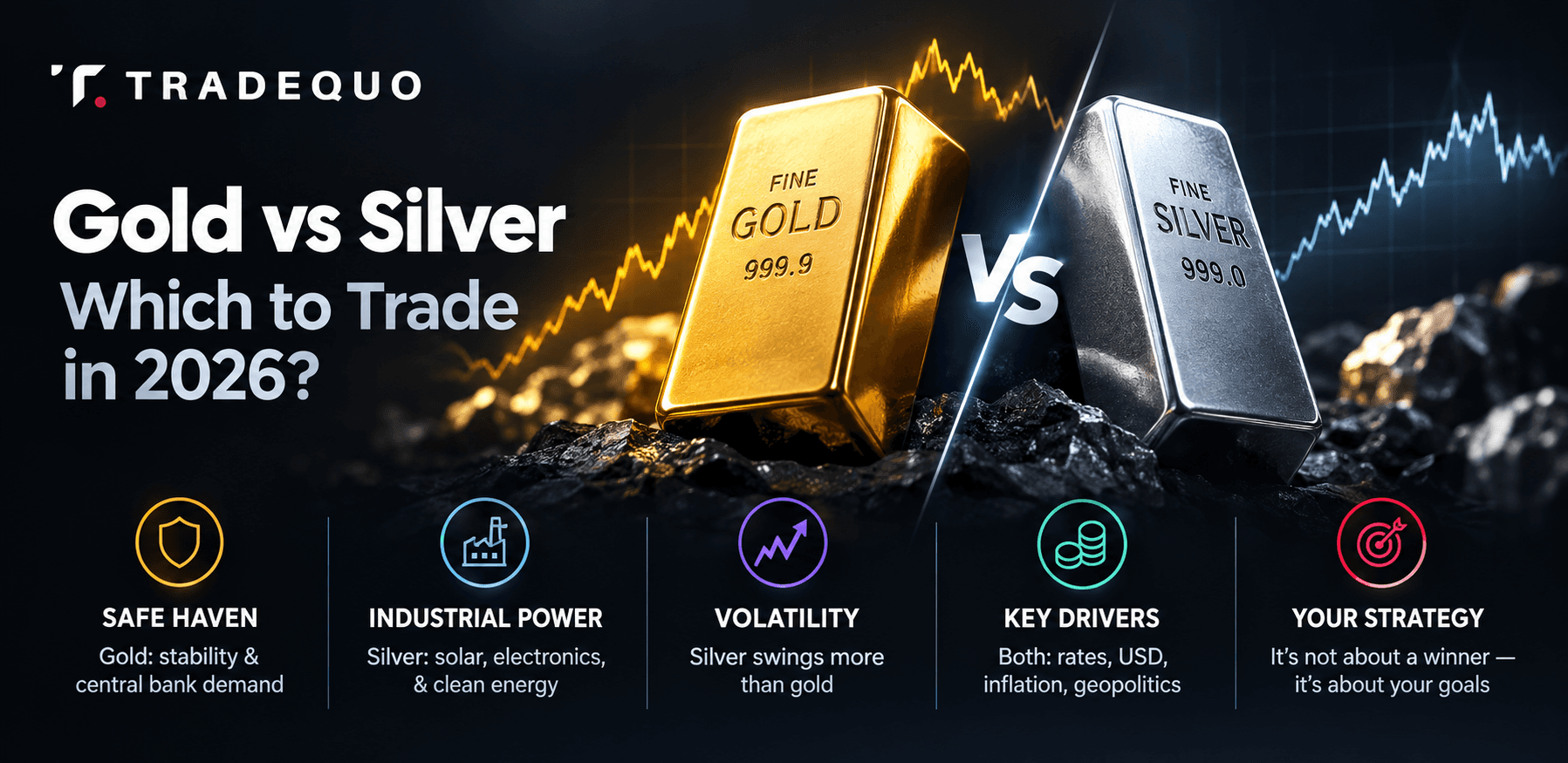
Rather than looking for a verdict, it helps to think through a few questions first. What is your investment objective, are you aiming for long-term stability, shorter-term opportunities, or some mix of both? What is your time horizon; are you thinking in months or years? And how much market volatility can you actually sit with without losing sleep?
Your risk tolerance matters more here than any general opinion about which is better: gold or silver. Some investors choose to gain exposure to both metals rather than picking one, using gold for its steadier reputation and silver for its industrial ties and lower price point. A financial advisor can help you weigh these factors against your broader investment portfolio and financial goals, but ultimately the right mix depends on you, not on a headline.
Trading Gold and Silver With TradeQuo
If you want to explore how gold and silver move without owning the physical metal, TradeQuo offers CFDs on both XAUUSD and XAGUSD, giving traders a way to speculate on price direction in either market. This approach lets you follow the XAUUSD vs XAGUSD relationship in real time, reacting to the same forces that drive the broader gold vs silver 2026 conversation, interest rates, the US dollar, and shifts in economic conditions.
CFD trading carries a high level of risk, particularly given the market volatility both metals are known for, and it is not the same as holding physical gold or silver. It is worth practising on a demo account first to get a feel for how each metal behaves before committing real capital.
Conclusion
The gold vs silver debate is not really about picking a winner. Gold and silver each play a different role, shaped by different sources of demand, different levels of volatility, and different relationships with the wider economy. Whether you lean toward gold's steadiness, silver's industrial ties, or a combination of both, the smartest approach is understanding how each metal actually behaves before deciding where it fits into your own plans for 2026.
FAQs
Is gold or silver a better investment?
Neither is better for everyone. Gold has tended to move more steadily and is driven mainly by its role as a store of value. Silver has tended to move more sharply because it is also used in industry, so it can rise faster and fall faster. The better fit depends on your goals, your time horizon, and how much price movement you can tolerate.
Is silver more volatile than gold?
Yes, silver has generally been more volatile than gold. Silver is a smaller market, and a large share of its demand comes from industry, so changes in economic growth affect it more. Gold demand is driven more by investors and central banks, which tends to make its price moves smaller.
Should beginners start with gold or silver?
There is no right metal for every beginner. Gold has usually moved less than silver, while silver has usually swung more, so risk tolerance and time horizon matter more than the metal itself.
What moves gold and silver prices?
Both metals respond to interest rates, the US dollar, inflation expectations, and geopolitical tension. Gold also reacts to central bank buying. Silver reacts more to economic growth and to industrial demand from areas such as solar panels, electronics, and electric vehicles.
Can I trade gold and silver with TradeQuo?
Yes. TradeQuo offers CFDs on both gold and silver, so you can speculate on price movements without owning the metal.