Before anyone begins day trading, one question inevitably comes up. How much money do you actually need to start? The answer is not as simple as a single number. The required amount of capital depends on several factors, including the market you trade, the broker’s margin rules, and your personal risk tolerance.
Day trading is a fast-paced form of investing where traders buy and sell financial instruments within the same trading day to capture small price movements. These day trading activities often focus on short-term trends and rapid market fluctuations, which means capital management becomes essential from the very beginning.
Understanding capital requirements helps traders avoid common pitfalls such as margin calls, excessive borrowing, or exposing themselves to severe financial losses. Many retail traders underestimate the risks involved and assume quick profits are easy to achieve. In reality, responsible traders treat capital planning as the foundation of their investment strategy before they even start trading.

Regulatory Minimums For Day Trading
In some financial markets, regulators impose minimum balance requirements for active traders. The most widely known rule applies to trading stocks in the United States.
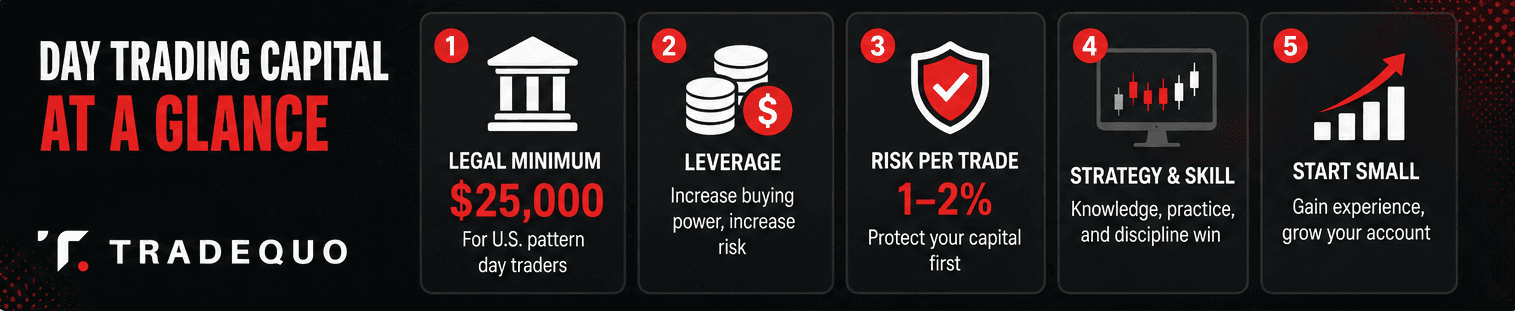
According to the Financial Industry Regulatory Authority, anyone who executes four or more day trades within five business days in a margin account may be classified as a pattern day trader. A pattern day trader account must maintain a minimum equity of twenty-five thousand dollars. This requirement applies to any trading day that the trader engages in day trading activities.
If the account value drops below the required minimum equity, the trader will not be allowed to continue day trading until the balance is restored. In practical terms, this means adding funds to the brokerage account or reducing open positions to meet the requirement.
The pattern day trader rule was introduced to limit excessive risk among inexperienced beginner traders who may underestimate the dangers of rapid trading. Regulators recognized that the speed and volatility of short-term price movements can quickly lead to losing money, especially when traders rely heavily on leverage.
There are also restrictions related to cash accounts. Under regulatory guidelines, day trading is generally not permitted in a cash account because securities must be fully paid for before they can be sold. Since day trading involves buying and selling securities on the same trading day, a margin account is usually required.
Other markets have lower entry barriers. Forex trading, contracts for difference, and certain derivatives often allow smaller trading accounts because brokers provide higher leverage. However, lower entry requirements do not reduce the risks involved. In many cases, leverage can increase the likelihood of substantial losses.
Understanding these regulatory thresholds is the first step before entering the stock market or any other financial markets.
Leverage And Margin Considerations
Leverage is one of the defining features of day trading, but it is also one of the most misunderstood. When traders use leverage, they are effectively using funds provided by their broker to take control of a larger market position than their own account balance would typically permit.
In a margin account, brokers extend day trade buying power based on the trader’s available maintenance margin excess. For example, if a trader has $30.000 in a pattern day trader account, they may be able to control a significantly larger position during the same day.
This buying power can magnify gains if the stock price moves in the desired direction. However, the opposite is also true. If the market moves against the position, losses increase quickly.
When a trader exceeds their day trade margin limits or their account falls below the required maintenance margin, the broker may issue a day trade margin call. The trader must deposit additional funds within five business days to meet the requirement. If the call is not satisfied, the broker may restrict trading activities or liquidate positions.
Because short-term trends can shift rapidly, leveraged trades expose traders to higher levels of risk than long-term investing, which typically focuses on the fundamental value of an asset.
Another important factor is transaction costs. Frequent opening trades and closing them within the same day means paying commissions, spreads, and platform fees repeatedly. These costs can quietly erode profits over time.
Competition is also fierce. Many professional day traders operate within large financial institutions that use sophisticated technology, advanced analytics, and real-time market data systems. The rise of algorithmic trading and high-frequency trading has made it harder for individual traders to compete.
For this reason, anyone considering day trading should fully understand how leverage works and how quickly losing positions can escalate into a margin call.
Determining Your Trading Capital

Beyond regulatory minimums, the next step is determining how much capital makes sense for your personal situation. The answer depends largely on risk management principles.
Many experienced traders follow a simple guideline. Risk only one to two percent of your trading account on a single trade. This approach protects the account from large drawdowns if a trade fails.
For example, imagine a trader with a brokerage account worth twenty thousand dollars. If they risk 1% per trade, the maximum acceptable loss would be two hundred dollars. If they risk 2%, the limit becomes four hundred dollars.
To calculate position size, traders typically use the following logic:
First, determine the acceptable risk per trade based on your account value.
Second, identify the difference between the entry price and the stop loss level.
Third, divide the acceptable loss by that price difference to determine the number of shares or contracts.
Suppose a trader plans to buy a stock at fifty dollars with a stop loss at forty nine dollars. The risk per share is one dollar. If the trader wants to risk two hundred dollars on the trade, they could purchase two hundred shares.
This structure allows traders to maintain consistent risk management across all trading patterns and market conditions.
Practice on Demo
A disciplined trading strategy also considers liquidity and volatility. Many day traders focus on highly liquid assets where entering and exiting positions does not significantly affect the stock price. Liquidity is essential when attempting to profit from small price movements.
Successful traders also rely heavily on technical analysis, studying past prices, chart patterns, and market data to identify potential opportunities. Strategies such as momentum trading aim to capture bursts of volatility when assets move strongly in one direction.
But keep in mind, capital used for day trading activities should never be money required for essential living expenses or long-term financial security.
Small Account Strategies
Not everyone has tens of thousands of dollars available to fund a trading account. Many retail traders begin with a small account and gradually build experience before committing larger sums.
One approach is trading smaller position sizes using instruments that allow fractional exposure. In forex trading, for instance, traders can use micro lots to reduce risk while learning how financial markets behave.
Another option is focusing on assets with lower transaction costs and tight spreads. Reducing costs helps preserve capital while refining your trading experience.
Discipline becomes especially important for traders with modest balances. A small account cannot absorb repeated losses without serious consequences. Strict risk management rules and carefully planned open positions are essential.
Beginner traders should also resist the temptation to follow hot tips from online forums or websites catering to speculative trading ideas. Decisions based on hype rather than analysis often lead to substantial losses.
Instead, traders should build in-depth knowledge of a particular market or sector. Some specialize in technology stocks, others focus on currencies or commodities. Developing a deep understanding of how specific assets behave improves the quality of investment decisions.
It is also wise to practice strategies in simulated environments before risking real capital. Paper trading allows individuals to test day trading strategies, analyze short-term trends, and learn how markets behave before committing funds.
Patience matters as well. Many experienced traders emphasize that consistent success rarely happens quickly. The early stages of trading are primarily about learning, not generating immediate gains.
Conclusion
The question of how much money you need to day trade has two answers: the legal minimum and the practical minimum. While $25,000 is the hard line for U.S. stock day traders, the practical reality is that you need enough to withstand market fluctuations and the costs of doing business. Day trading is a high-stakes environment where short-term price movements are often unpredictable and influenced by large financial institutions and high-frequency algorithms.
To succeed, you need more than just a brokerage account and a laptop. You need a deep understanding of financial instruments, a disciplined approach to risk tolerance, and the emotional fortitude to handle substantial losses. Most day traders lose money because they underestimate the complexity of the financial markets. Treat this as a business rather than a hobby, prioritize risk management over immediate gains, and never trade with money that is essential for your cost of living.
FAQs
Can I Day Trade with Less than $25,000?
Yes, but not in a U.S. margin account for stocks. You can use a cash account, though you will be limited by settlement times, or you can trade other markets like forex, commodities, or futures, which have different regulatory requirements.
What Happens If My Account Falls Below The Required Balance?
If a pattern day trader account drops below the required balance, the trader will not be allowed to continue day trading activities until the account value is restored to the minimum level.
Why Do Many Day Traders Lose Money?
Many day traders lose money due to high transaction costs, emotional investment decisions, and unpredictable market fluctuations. Short-term trading requires skill, discipline, and strong risk management.
Can Beginners Start Day Trading With A Small Account?
Yes, but beginner traders should proceed carefully. Starting with a small account, using strict risk management, and developing a structured trading strategy can help traders gain experience before committing larger amounts of capital.