
Introduction
Day trading attracts many investors because of its promise of quick profits and the excitement of participating directly in financial markets. Yet learning how to start day trading is far more complex than simply placing a trade and hoping for a favorable outcome. A successful trading day requires preparation, discipline, and a structured approach to risk.
Day traders buy and sell stocks or other assets quickly, aiming to make money from small price changes throughout the day. While traditional investors hold onto their assets for years, day traders finish their work before the day ends, so they don't have to worry about price changes happening while they sleep.
Starting day trading in 2026 means understanding the rules that govern trading accounts, selecting the right market, setting up reliable technology, and developing a trading strategy based on both fundamental and technical analysis. With careful preparation, realistic expectations, and strong emotional control, new traders can approach this field with greater confidence.
Regulatory And Account Considerations
Before placing the first trade, every aspiring day trader must understand the regulatory environment that governs trading accounts. Regulations differ across markets, but they are designed to protect investors and maintain orderly financial markets.
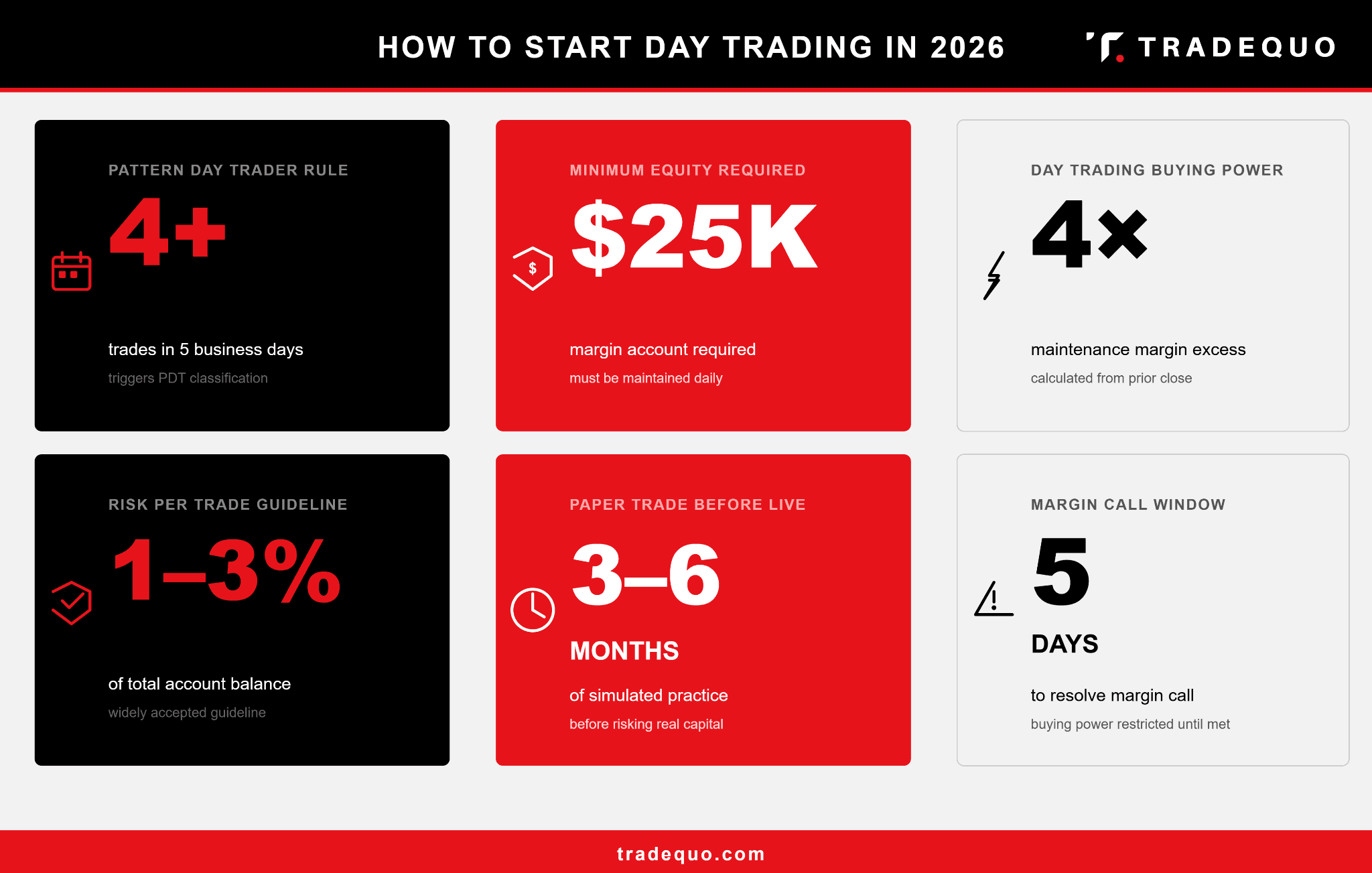
One of the most important rules in the United States stock market is the pattern day trader rule enforced under FINRA rules. A pattern day trader is defined as someone who executes four or more day trades within five business days when those trades represent more than six percent of their total trades during that same period. Once an account is designated for pattern day trading, it remains classified that way even if no day trades occur for a period of five business days.
Pattern day traders must maintain a minimum equity of twenty-five thousand dollars in their margin account on any day they trade. If the account falls below this threshold, the trader cannot continue day trading until the account is restored to the required level. In addition, pattern day traders may trade up to four times their maintenance margin excess as their day trading buying power, calculated from the close of the previous trading day.
If a trader exceeds their day trading buying power, the brokerage firm will issue a margin call that must be resolved within five business days. Until that margin call is met, buying power may be restricted.
Account structure also matters. Day trading in a cash account is generally restricted because securities must be paid for in full before they are sold. For that reason, active traders usually operate through a margin account, which allows access to borrowed funds and greater flexibility. However, margin also increases the risks involved, making careful risk management essential.
In 2026, there has also been discussion about replacing the fixed pattern day trader equity threshold with a risk-based intraday margin framework, although the core principles of account supervision and margin requirements remain central to the trading industry.
Above all, traders should always choose a regulated broker that offers transparent pricing, reliable execution, and strong client protection.
Choosing A Market
The next step when you start day trading is selecting the market that fits your goals and risk tolerance. The most common environments for day traders include stocks, foreign exchange, crypto, and contracts for difference.
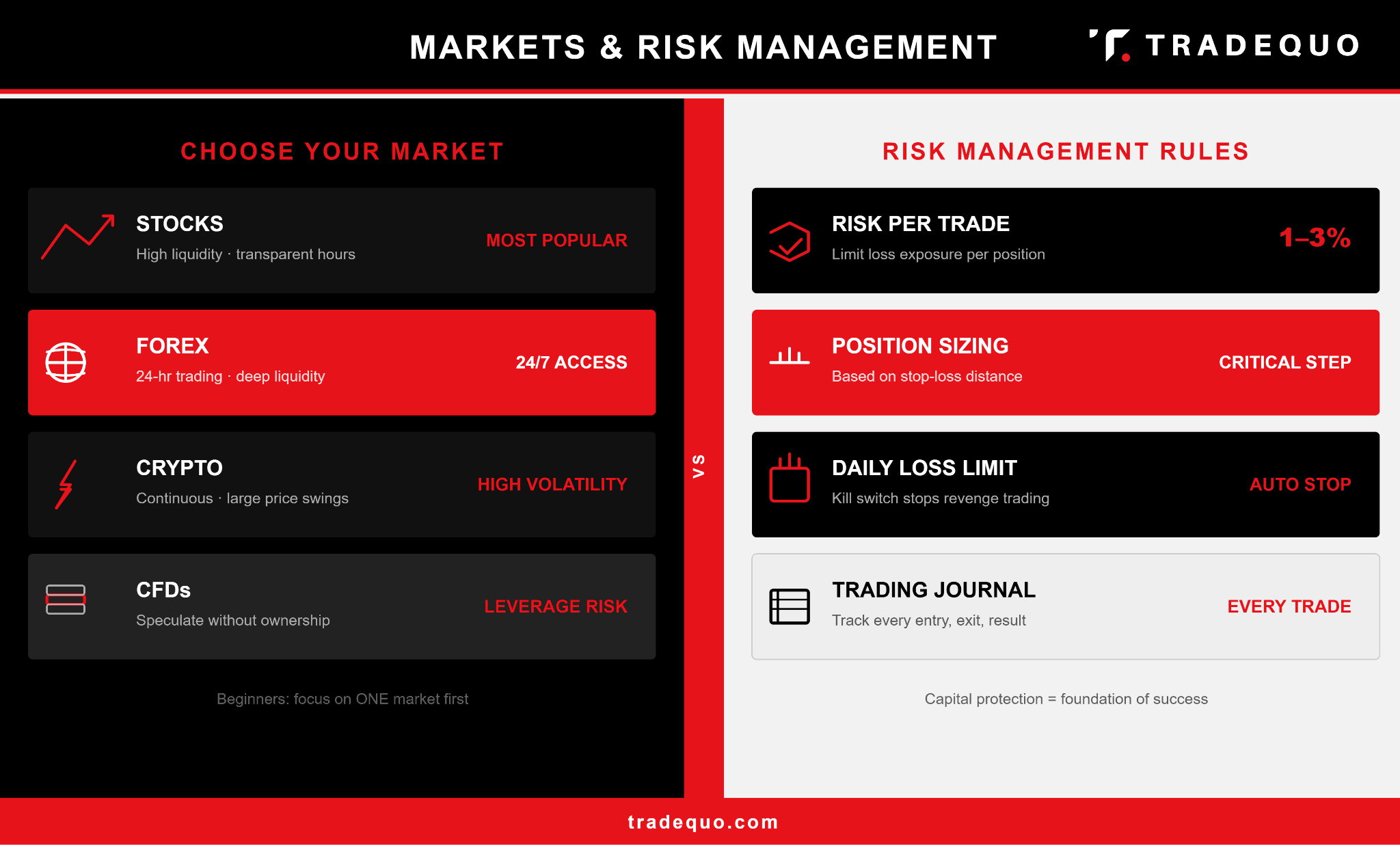
The stock market remains one of the most popular options because it offers highly liquid securities and transparent trading hours. Many day trading stocks have strong volume and volatility, creating trading opportunities based on price action around earnings reports or market news.
Forex markets attract active traders because they operate nearly twenty-four hours a day and offer deep liquidity. Currency pairs often experience short-term price fluctuations driven by economic data and central bank announcements.
Cryptocurrency markets provide continuous trading and large price swings, which some traders see as opportunities. However, extreme volatility can also amplify risk, particularly for inexperienced investors.
CFDs allow traders to speculate on price movements across different assets without owning the underlying securities. These instruments are widely used in certain regions but involve leverage that increases both potential profit and potential loss.
Beginners should focus on one highly liquid market rather than splitting attention across multiple financial markets. Concentrating on a single environment helps traders build a deep understanding of price behavior, trading opportunities, and the factors that drive market movements.
Setting Up Technology
Modern day trading relies heavily on reliable technology. Execution speed, real-time data, and analytical tools can significantly influence trading outcomes.
At a minimum, traders need a reliable computer with enough processing power to run advanced charting tools and trading platforms simultaneously. A high-speed internet connection is essential because delayed data or slow order execution can turn profitable setups into missed opportunities.
Most professional traders also use a dual monitor setup. Two screens allow traders to watch multiple charts, track price action, and monitor open positions during the same trading day. Advanced setups often include additional high-resolution monitors for tracking market news, technical indicators, and order flow.
The trading platform itself is the central workspace for day traders. Platforms such as MetaTrader 5 provide real-time market data, fast order execution, and advanced charting capabilities. These platforms often include tools for technical analysis, customizable indicators, and automated trade management.
Charting tools help traders identify patterns, analyze trend direction, and determine potential entry and exit points. Common intraday charts include one-minute, five-minute, and fifteen-minute time frames that highlight price movements throughout the trading day.
Execution quality is another critical factor. Brokers that provide fast execution, low-cost commissions, and direct access to liquidity help traders react quickly to short-term price movements. Many platforms now offer commission-free trading for stocks, which has lowered the barrier for retail investors entering the market.
Reliable technology does not guarantee profit, but it ensures traders can operate efficiently and make informed decisions in financial markets.
Developing A Trading Strategy That Can Actually Work
Having a general interest in the markets is not a trading strategy. A real trading strategy defines exactly when you enter a trade, where your stop-loss sits, what your target is, and how much of your account you are risking. Without that structure, you are not trading. You are guessing.
Day trading strategies usually rely on technical analysis rather than long-term fundamental analysis. Traders examine charts, technical indicators, and market data to identify patterns and determine potential entry and exit points.
Common Day Trading Strategies
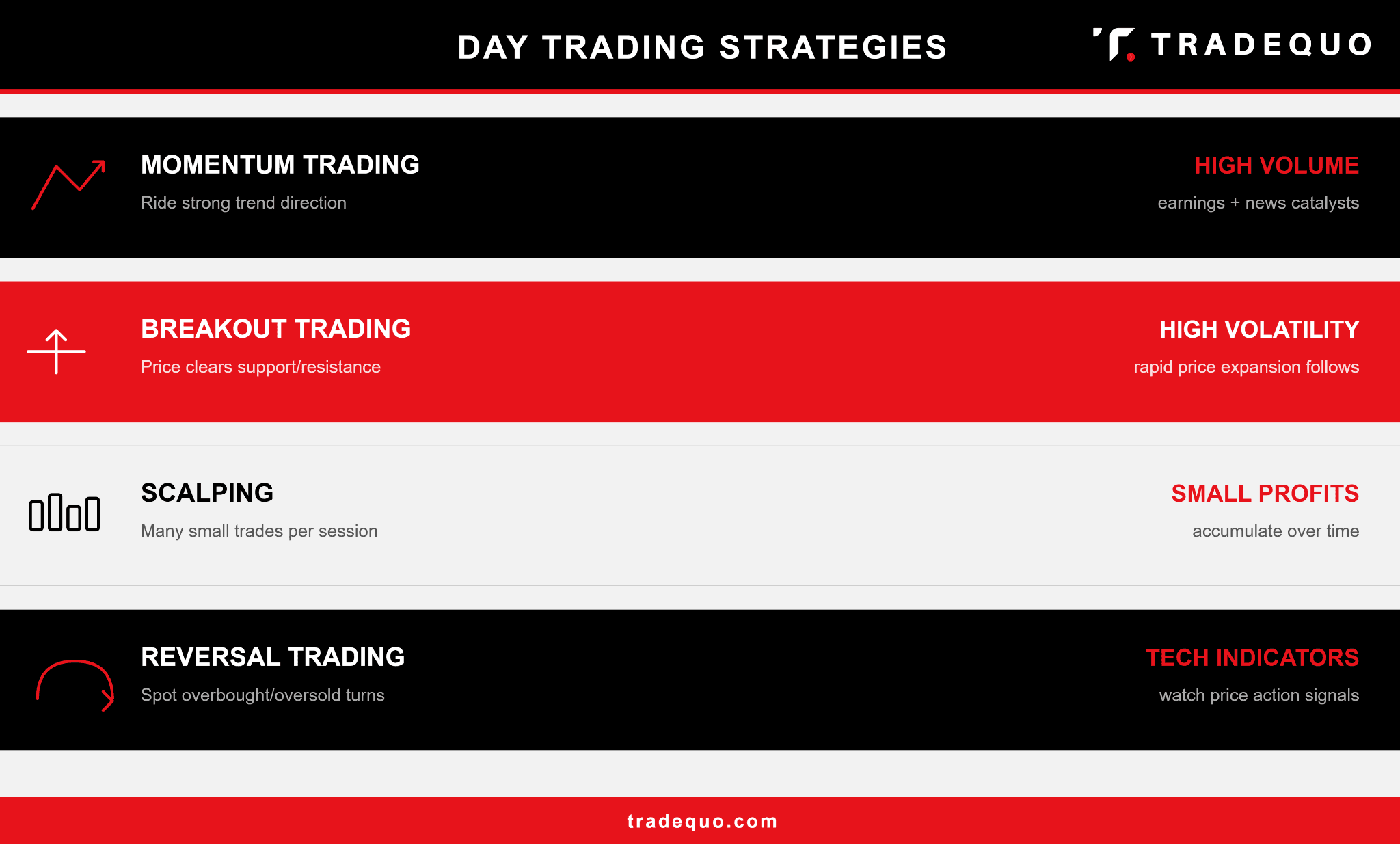
Momentum trading is one of the most widely used strategies. It focuses on assets experiencing a strong trend direction driven by positive news, high trading volume, or an earnings report that exceeds expectations. Traders attempt to capture price movement as momentum builds.
Breakout trading capitalizes on increased volatility by entering the market once the price successfully hurdles a previous ceiling (resistance) or dives through a previous floor (support). These levels often act as barriers, and once broken, they can lead to rapid price expansion.
Scalping is another popular method among active traders. This strategy focuses on making many small trades during a single trading day, targeting small profits that accumulate over time.
Reversal trading attempts to identify moments when an asset becomes overbought or oversold and is likely to change direction. Traders watch technical indicators and price action signals to anticipate these turning points.
Backtesting and Paper Trading
Before you risk a single dollar, test your strategy against historical data. Backtesting lets you see how a strategy would have performed in the past, and while past performance does not guarantee future results, it reveals whether the logic behind your approach has any structural validity.
After backtesting, spend at least three to six months paper trading, using a simulated account that mirrors real market conditions without real funds at stake. This period is not just about proving your strategy. It is about building the habits and emotional routines you will need when real money is on the line.
Managing Risk And Capital
Day trading requires disciplined risk management more than almost any other form of investing. Even experienced traders face losses, so managing risk determines whether a trading account survives long enough to become profitable.
One widely accepted guideline is limiting risk to one to three percent of the total account per trade. This approach protects the account from large drawdowns while allowing traders to continue participating in future trading opportunities.
Position sizing plays a critical role. Traders must calculate how many shares or contracts to trade based on their stop loss distance and acceptable risk. Without proper position sizing, even a small price movement can lead to significant losses.
Leverage through a margin account increases buying power but also magnifies losses. Traders using borrowed money should remain aware of margin requirements and maintain sufficient capital to avoid forced liquidation.
Many traders also implement a daily loss limit. This kill switch automatically stops trading if losses reach a predetermined level, preventing emotional decisions such as revenge trading.
Protecting capital through disciplined risk management is the foundation of any sustainable trading strategy.
Practice And Evaluation
The safest way to start day trading is by practicing in a simulated environment. Most trading platforms offer paper trading accounts that replicate real market conditions without risking real capital.
Beginners should spend three to six months using paper trading before transitioning to a live account. This period allows traders to test strategies, learn platform tools, and experience the rhythm of a typical trading day without financial pressure.
During this phase, traders should track every trade in a trading journal. Recording entry and exit points, position size, reasoning behind the trade, and the final result helps identify patterns in both successful and unsuccessful decisions.
A trading journal also reveals behavioral patterns. Many traders discover that emotional responses such as fear or impatience lead to unnecessary trades or early exits. Recognizing these tendencies helps build emotional control over time.
Once consistent performance appears in a demo environment, traders can begin trading small positions with real capital. Starting with a minimal size reduces psychological stress while allowing traders to experience real market dynamics.
Regular evaluation is crucial. Traders should review performance weekly or monthly, analyzing which strategies produced consistent results and which led to losses. This process transforms trading into a disciplined practice rather than a series of random decisions.
Conclusion
Starting day trading in 2026 is not about finding a shortcut to quick profits. It is about building a practice that is grounded in education, informed by regulation, supported by the right tools, and governed by genuine risk discipline. The traders who succeed are the ones who respect the process: they learn the rules, choose a market, develop a strategy, manage their capital carefully, and review their performance without ego.
Patience and persistence matter more than any single trading insight. The market will always be there. Your job is to still be there, too.
FAQs
What Is Day Trading?
Day trading refers to buying and selling financial assets within the same trading day in order to profit from short-term price movements. Traders typically close all positions before the market closes to avoid overnight positions.
What Is The Pattern Day Trader Rule?
The pattern day trader rule states that traders who execute four or more day trades within five business days in a margin account are classified as pattern day traders and must maintain at least 25000 dollars in equity.
Is Day Trading Profitable For Beginners?
Day trading can be profitable, but it is challenging. Many beginners lose money in their early trading careers because the financial markets move quickly and require strong discipline and risk management.
Should Beginners Use Paper Trading First?
Yes. Paper trading allows beginners to practice trading strategies, understand trading platforms, and build confidence without risking real money. Many experts recommend practicing for several months before trading live capital.