
CFDs are complex instruments and come with a high risk of losing money rapidly due to leverage. You should consider whether you understand how CFDs work before investing.

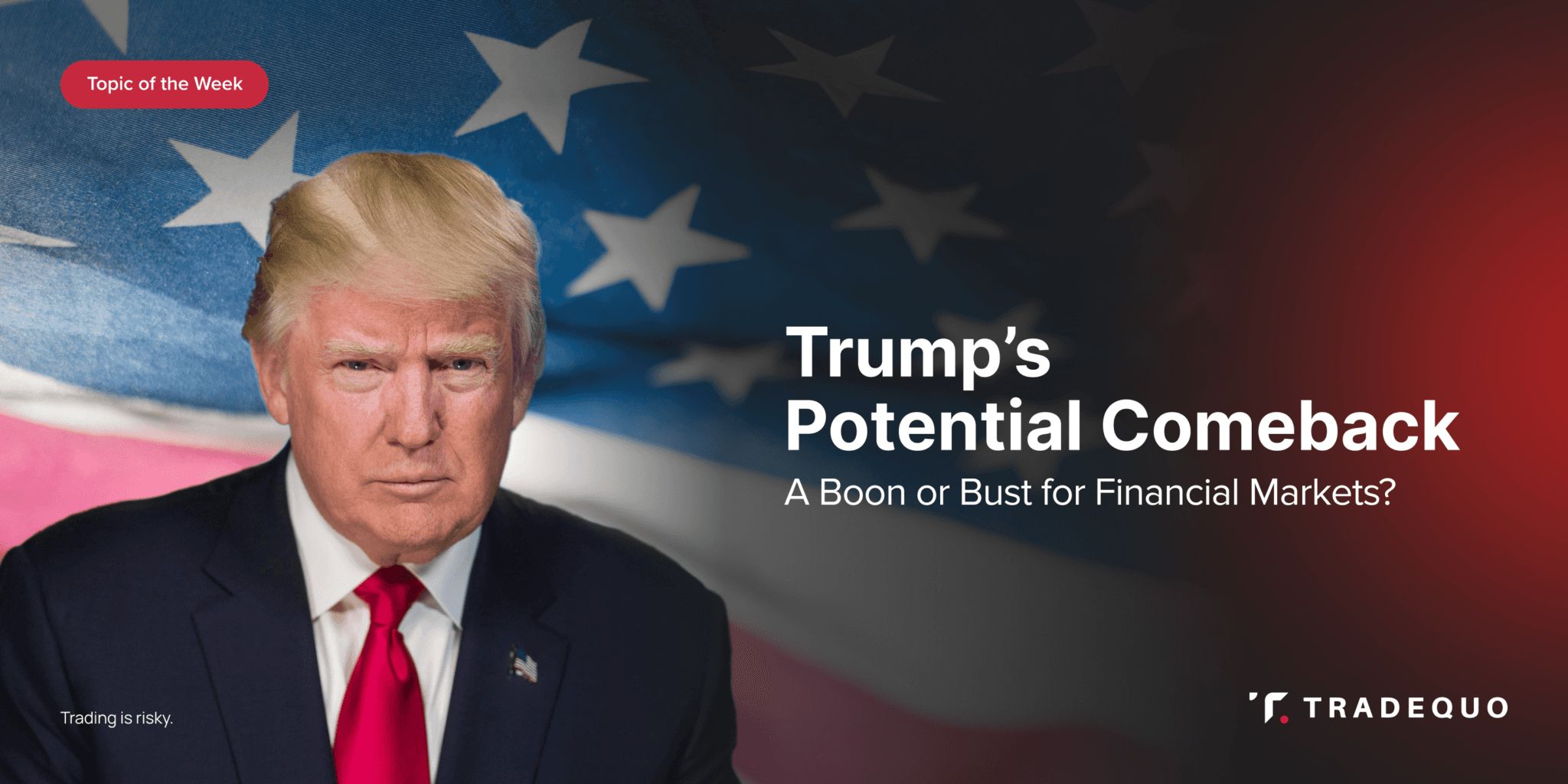
Trump’s Potential Comeback: A Boon or Bust for Financial Markets?

Donald Trump’s Potential Impact on Financial Markets

1. Economic and Infrastructure Policies 

Donald Trump’s potential return to office could bring both new opportunities and big challenges for the financial markets, affecting everything from traditional stocks and real estate to the evolving world of cryptocurrency. Reflecting on his last term, Trump’s pro-business approach, marked by lower corporate taxes and fewer regulations, boosted sectors like finance, energy, and manufacturing. Investors may see his re-election as a chance for similar growth, especially for big energy companies, banks, and industries that benefit from lighter regulations. These favorable policies could spark optimism, initially lifting stock prices in certain sectors. 

Trump has also been a strong advocate for investing in U.S. infrastructure, which could create momentum in industries tied to construction, real estate, and heavy machinery. By offering tax breaks for businesses and incentives for manufacturers, these policies could encourage more domestic production and investment, further strengthening the economy and creating jobs. This support might drive a surge in the stock market, as companies benefit from the favorable environment. 

Yet, this approach also has potential downsides. Increased market volatility could come from reigniting trade tensions with major economies, especially with China. Renewed tariffs or trade disputes could disrupt international supply chains, adding uncertainty for businesses that rely on imports. Tech and consumer goods companies, which depend heavily on overseas production, might find themselves facing cost increases that could lead to stock price swings, making investors more cautious. 


2. Fiscal Policies, Debt, and Cryptocurrency 

The impact on U.S. debt could also be a concern. With large tax cuts and infrastructure spending, the national debt would likely rise, which could pressure the Federal Reserve to hike interest rates to keep inflation in check. Higher borrowing costs could strain both companies and consumers, slowing down economic growth. Major financial institutions warn that the added debt could make investors wary, especially in the bond market. If borrowing rates climb, real estate and other sectors relying on cheap financing might find themselves in a tight spot. 

The cryptocurrency market would be in an interesting position under Trump’s administration. While Trump has historically been skeptical of digital assets, the increased mainstream interest in crypto might push for more regulation. This clearer framework could bring more stability to the market, especially for big players like Bitcoin and Ethereum. A solid regulatory environment might even encourage institutional investors, who see crypto’s potential as a hedge against inflation. 

In fact, rising inflation could drive even more interest in cryptocurrencies like Bitcoin. Often called “digital gold,” Bitcoin might attract those looking to protect their money from inflation and currency fluctuations. However, this environment could also pose challenges, particularly for decentralized finance (DeFi) projects or privacy-focused coins that could face tighter rules. A regulated approach could affect innovation within these areas, as projects strive to stay compliant. 


3. Sectoral and Global Impacts 

Another angle to consider is the possible introduction of a central bank digital currency (CBDC) in the U.S. Competing with China’s digital yuan, a Trump administration might push for a digital dollar. This development could add credibility to blockchain technology while potentially reducing reliance on private digital assets as mainstream payment solutions. Private stablecoins might face limitations as the digital dollar becomes more widely accepted. 

Different sectors of the economy would feel the effects of Trump’s policies in varied ways. The energy sector, for example, would likely see strong support. Trump’s stance leans toward boosting fossil fuels over renewable energy, which could lead to profits for oil, gas, and coal companies. On the other hand, renewable energy investments and green technology could face challenges due to reduced federal incentives. This could also deter some socially conscious investors who are focused on environmental, social, and governance (ESG) goals. 

The technology sector might see a mix of benefits and hurdles. On one hand, Trump’s push to “bring jobs back to America” could support U.S.-based tech companies with domestic production. But tech giants with significant international revenue, like Apple and Microsoft, may face higher costs if trade tensions rise. Dependence on Chinese markets for manufacturing could add risk, making the sector’s future a bit murky. 

The real estate and infrastructure landscape would also be significantly impacted. Trump’s infrastructure plans could fuel growth in commercial real estate and construction, offering new opportunities for developers and builders. Lower taxes on investments may draw interest in real estate investment trusts (REITs) as well. Yet rising interest rates could hit the residential market hard. As mortgage costs increase, fewer people might be able to afford homes, putting a strain on housing demand, especially in high-cost urban areas. 

Globally, the potential re-election could strengthen the U.S. dollar, making it attractive to international investors. A stronger dollar would boost confidence and might attract more foreign capital to U.S. markets. This could also help U.S.-based multinational companies see better profits when converting foreign earnings. But a stronger dollar can put emerging markets in a tough spot, increasing the cost of dollar-denominated debt for these economies. In places like Latin America and parts of Asia, investors might start pulling back, making these regions more volatile. 

Trade relations would be another major piece of the puzzle. Trump’s aggressive trade policies could affect the global economy, especially if tariffs and sanctions are back on the table. Asia and Latin America, where economies rely heavily on exports to the U.S., could feel these impacts the hardest. Europe, too, could experience shifts, especially in industries tied to U.S. supply chains, like automotive and manufacturing. 

In summary, Trump’s return could bring a mix of benefits and challenges, shaping markets in different ways. On one hand, financial markets might enjoy an initial boost from lower taxes and fewer regulations. On the other, debt and trade tensions could create long-term uncertainty. For cryptocurrency, increased regulation and inflationary concerns could drive demand, but some areas within the sector might face challenges. For investors, understanding these dynamics will be key in navigating the opportunities and risks ahead. 

Stay ahead in the financial world—follow us for the latest updates, expert insights, and everything you need to make informed investment decisions. Don’t miss out on the trends that matter most! 
Loved by people

Trusted by the market

Award 2025
Award 2025
Award 2025

© 2026 Trade Quo. All rights reserved.

This website provides content by group of companies, which include:

Tradequomarkets Financial Services L.L.C is a registered, authorised and regulated company by the Securities and Commodities Authority (SCA) of the United Arab Emirates, with License No. 20200000320 Category 5, to carry out regulated activities of Financial Consultations and Introduction. Its registered office is located at Business Tower, Main Business Village 114499 Dubai, UAE.

Tradequomarkets LTD (2023/C0024). Located at #8 Jepson Lane, St. George, Goodwill, Commonwealth of Dominica

Trade Quo Global Ltd, a securities dealer firm that is authorized and regulated by the Seychelles Financial Services Authority (FSA) with license number SD140.

Tradequo (PTY) Ltd is licensed in South Africa by the Financial Sector Conduct Authority with FSP license number 54827. The registered office: 33rd Floor – 34 Whiteley Road, 2196, Johannesburg, South Africa.

Quo Markets LLC, registered with Financial Services Authority FSA: 3171 LLC 2024. Registered address: Suite 305, Griffith Corporate Centre, Beachmont, Kingstown, SVG.

Tqbg Ltd, registered in Cyprus with registration number HE438084, registered address Archiespiskopou Makariou III 160 1st floor, 3026, Limassol, Cyprus. Is apointed payment agent, and does not engage in any regulated activities.

Risk Warning: CFDs are complex instruments and come with a high risk of losing money rapidly due to leverage. 72.6% of retail investor accounts lose money when trading CFDs with this provider. You should consider whether you understand how CFDs work and whether you can afford to take the high risk of losing your money.

Regional Restrictions: This website including the information and materials contained in it, is not directed at, or intended for distribution to or use by, any person or entity who is a citizen or resident of the following countries: USA, Israel, Iran, Iraq, Russia, Afghanistan, Cuba, Cyprus, Eritrea, Liberia, Libya, Somalia and Syria or any jurisdiction where such distribution, publication, availability or use would be contrary to applicable law or regulation.

TradeQuo and its affiliates do not target EU/EEA/UK clients.

Loved by people

Trusted by the market

Award 2025
Award 2025
Award 2025

© 2026 Trade Quo. All rights reserved.

This website provides content by group of companies, which include:

Tradequomarkets Financial Services L.L.C is a registered, authorised and regulated company by the Securities and Commodities Authority (SCA) of the United Arab Emirates, with License No. 20200000320 Category 5, to carry out regulated activities of Financial Consultations and Introduction. Its registered office is located at Business Tower, Main Business Village 114499 Dubai, UAE.

Tradequomarkets LTD (2023/C0024). Located at #8 Jepson Lane, St. George, Goodwill, Commonwealth of Dominica

Trade Quo Global Ltd, a securities dealer firm that is authorized and regulated by the Seychelles Financial Services Authority (FSA) with license number SD140.

Tradequo (PTY) Ltd is licensed in South Africa by the Financial Sector Conduct Authority with FSP license number 54827. The registered office: 33rd Floor – 34 Whiteley Road, 2196, Johannesburg, South Africa.

Quo Markets LLC, registered with Financial Services Authority FSA: 3171 LLC 2024. Registered address: Suite 305, Griffith Corporate Centre, Beachmont, Kingstown, SVG.

Tqbg Ltd, registered in Cyprus with registration number HE438084, registered address Archiespiskopou Makariou III 160 1st floor, 3026, Limassol, Cyprus. Is apointed payment agent, and does not engage in any regulated activities.

Risk Warning: CFDs are complex instruments and come with a high risk of losing money rapidly due to leverage. 72.6% of retail investor accounts lose money when trading CFDs with this provider. You should consider whether you understand how CFDs work and whether you can afford to take the high risk of losing your money.

Regional Restrictions: This website including the information and materials contained in it, is not directed at, or intended for distribution to or use by, any person or entity who is a citizen or resident of the following countries: USA, Israel, Iran, Iraq, Russia, Afghanistan, Cuba, Cyprus, Eritrea, Liberia, Libya, Somalia and Syria or any jurisdiction where such distribution, publication, availability or use would be contrary to applicable law or regulation.

TradeQuo and its affiliates do not target EU/EEA/UK clients.

Loved by people

Trusted by the market

Award 2025
Award 2025
Award 2025

© 2026 Trade Quo. All rights reserved.

This website provides content by group of companies, which include:

Tradequomarkets Financial Services L.L.C is a registered, authorised and regulated company by the Securities and Commodities Authority (SCA) of the United Arab Emirates, with License No. 20200000320 Category 5, to carry out regulated activities of Financial Consultations and Introduction. Its registered office is located at Business Tower, Main Business Village 114499 Dubai, UAE.

Tradequomarkets LTD (2023/C0024). Located at #8 Jepson Lane, St. George, Goodwill, Commonwealth of Dominica

Trade Quo Global Ltd, a securities dealer firm that is authorized and regulated by the Seychelles Financial Services Authority (FSA) with license number SD140.

Tradequo (PTY) Ltd is licensed in South Africa by the Financial Sector Conduct Authority with FSP license number 54827. The registered office: 33rd Floor – 34 Whiteley Road, 2196, Johannesburg, South Africa.

Quo Markets LLC, registered with Financial Services Authority FSA: 3171 LLC 2024. Registered address: Suite 305, Griffith Corporate Centre, Beachmont, Kingstown, SVG.

Tqbg Ltd, registered in Cyprus with registration number HE438084, registered address Archiespiskopou Makariou III 160 1st floor, 3026, Limassol, Cyprus. Is apointed payment agent, and does not engage in any regulated activities.

Risk Warning: CFDs are complex instruments and come with a high risk of losing money rapidly due to leverage. 72.6% of retail investor accounts lose money when trading CFDs with this provider. You should consider whether you understand how CFDs work and whether you can afford to take the high risk of losing your money.

Regional Restrictions: This website including the information and materials contained in it, is not directed at, or intended for distribution to or use by, any person or entity who is a citizen or resident of the following countries: USA, Israel, Iran, Iraq, Russia, Afghanistan, Cuba, Cyprus, Eritrea, Liberia, Libya, Somalia and Syria or any jurisdiction where such distribution, publication, availability or use would be contrary to applicable law or regulation.

TradeQuo and its affiliates do not target EU/EEA/UK clients.