What Is CFD Trading?

What is CFD trading, and why does it attract millions of market participants around the world? A Contract for Difference, commonly called a CFD, is a financial instrument that allows traders to speculate on price movements in financial markets without actually owning the underlying asset.
In simple terms, a contract for difference is an agreement between a trader and a CFD broker to exchange the price difference of an underlying asset between the moment a trade opens and the moment it closes. If the asset price moves in the trader’s favor, the trader earns a CFD profit. If the market moves against the position, the trader incurs a loss.
CFD trading enables market participants to access a wide range of asset classes, including stocks, indices, commodities, and currencies, all from a single trading account. Instead of buying shares on a stock exchange or owning physical commodities, traders use trading contracts that mirror the asset price of the underlying market.
Because CFDs are leveraged financial instruments, they require only a small initial deposit called a margin. This structure allows traders to control larger market exposure than their initial investment would normally allow, making CFDs both attractive and potentially risky.
Understanding how this system works is essential before anyone considers starting to trade CFDs.
How CFD Trading Works
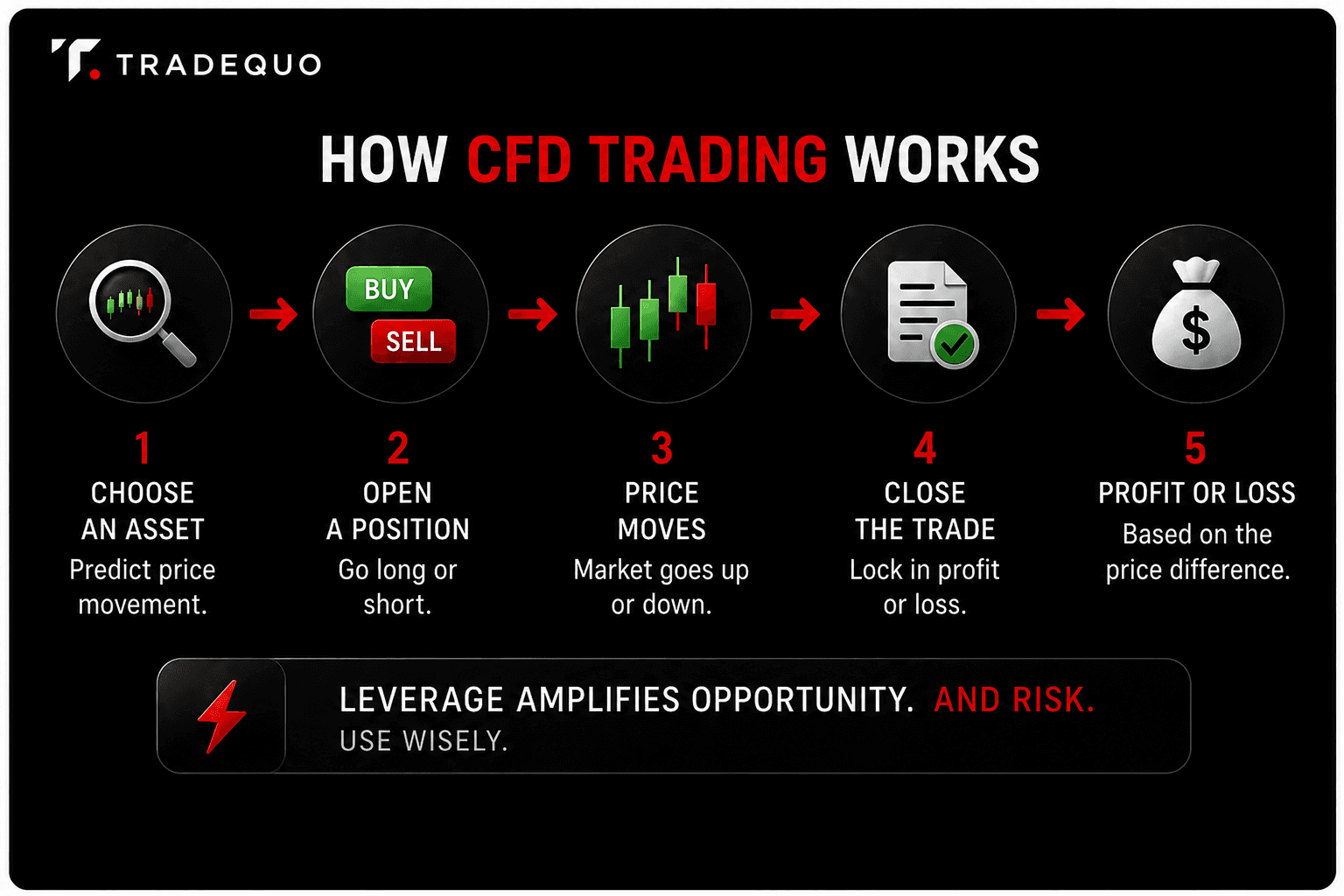
Imagine a trader who believes the asset price of a company listed on the stock market will rise in the coming hours. Instead of purchasing shares through traditional investing, the trader opens a CFD position on that stock using a CFD trading platform.
A contract for difference (CFD) works as a private agreement between the trader and the CFD provider. The trader chooses the number of trading contracts they want to buy or sell. The profit or loss is calculated based on the price difference between the opening and closing market prices.
For example, a trader opens a long CFD position on a stock CFD at a market price of 100. The trader expects the asset price to rise. They buy ten contracts. Later, the market rises, and the CFD prices increase to 110. The trader closes the CFD position. The price difference is 10 points. Ten contracts multiplied by 10 equals a CFD profit of 100. However, if the price fell instead and dropped to 90, the trader would record a losing trade. The price difference would work against them, resulting in a loss of 100.
This example highlights the core principle of trading CFDs. Profits and losses are determined entirely by price movements of the underlying asset.
Another important element is leverage. CFD trading involves leveraged trading, meaning traders only need to deposit a portion of the total trade value as an initial deposit. This is known as margin. The remaining exposure is effectively provided by the broker.
While leverage can increase potential profits, it also amplifies losses. If a leveraged position moves sharply against the trader in volatile markets, the account equity may drop below the maintenance margin. When this happens, a margin call can occur, requiring additional funds to keep the position open. If the trader fails to meet the margin requirement, the position may be automatically closed.
Unlike many traditional financial instruments, CFD contracts typically do not have an expiry date. Traders can hold positions indefinitely as long as margin requirements are met. However, overnight financing costs may apply when positions remain open beyond the trading day.
Markets Available Via CFDs
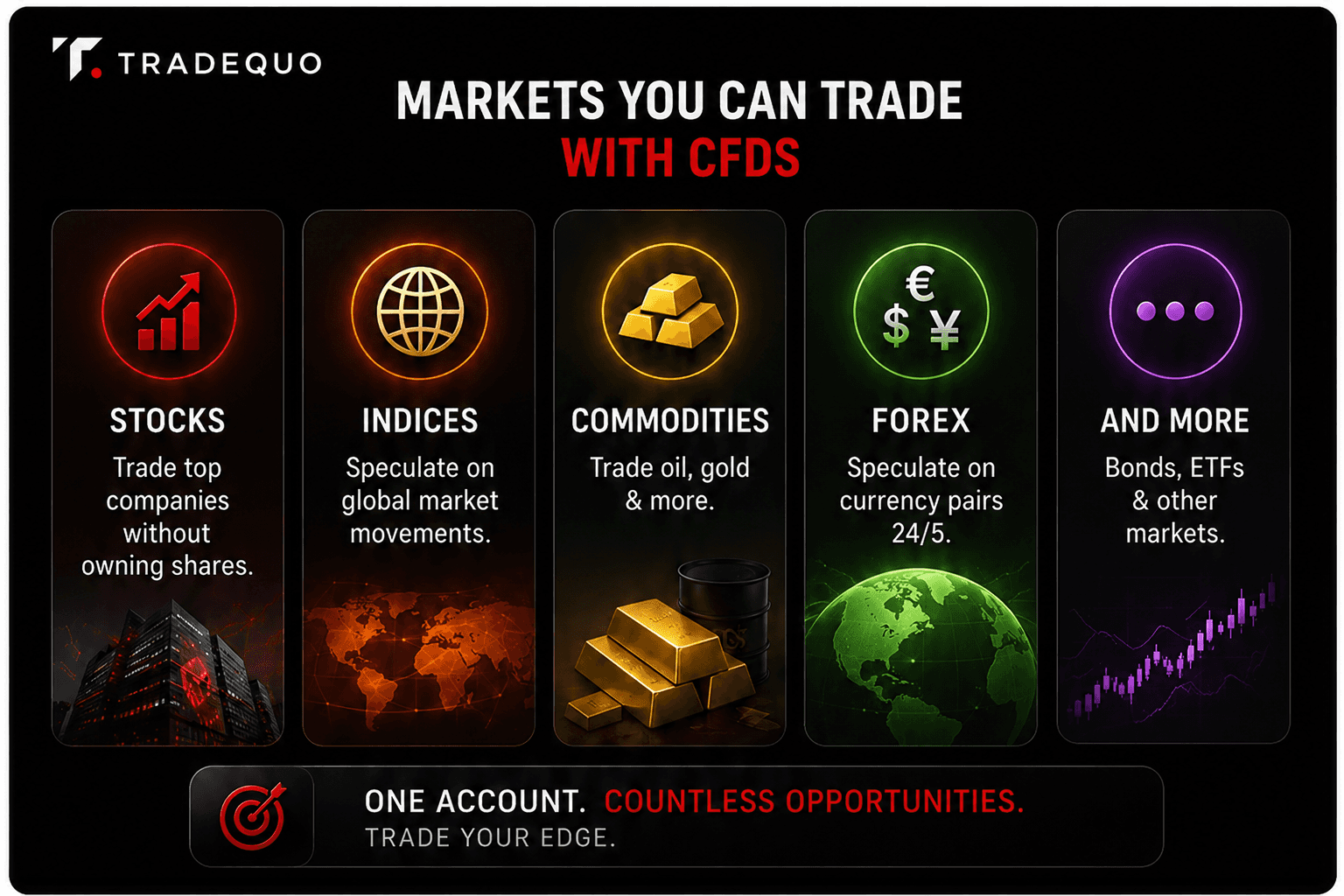
One of the main reasons CFD traders are drawn to this financial instrument is the sheer variety of markets available. Through a single CFD account, traders can speculate on the price movements of multiple asset classes across global financial markets. This access makes CFDs one of the most versatile tools in modern trading.
Stocks
Stock CFDs allow traders to speculate on individual company shares without owning them. Instead of purchasing shares on a stock exchange, traders open CFD positions that follow the underlying asset’s price. This makes trading stocks more flexible, since traders can profit from both asset price rises and asset price falls.
Indices
Indices represent the performance of entire groups of companies. Popular examples include large global stock market indices that track hundreds of businesses. Trading index CFDs allows traders to speculate on overall market moves rather than focusing on a single company.
Commodities
Commodities such as oil, gold, and agricultural products are also widely traded through CFD contracts. Instead of dealing with physical delivery, traders speculate on price changes in the underlying market.
Forex
Currency trading is another major segment of CFD trading. Forex CFDs allow traders to speculate on exchange rates between global currencies, opening long or short positions depending on whether they expect the market to rise or fall.
Across these asset classes, CFDs offer traders a simple way to access markets that might otherwise require different accounts, exchanges, or investment structures.
Benefits Of CFDs
CFDs have gained popularity among experienced traders because they offer several advantages compared to traditional investing.
Ability To Trade Rising And Falling Markets
One of the most important features of CFD trading is the ability to trade both rising and falling markets. If a trader expects the asset price to rise, they open a long position. If they believe the asset price will fall, they can open a short position through short selling. This flexibility allows traders to respond to market volatility rather than waiting for bull markets.
Leverage And Market Exposure
CFDs are leveraged financial instruments. Traders only need to deposit a fraction of the total trade value as an initial investment. Leverage allows traders to control a larger position size than their trading account balance would normally permit. This increased market exposure can amplify potential profits if market moves occur in the expected direction.
However, it is essential to understand that leverage also increases the potential for losses.
Access To Global Financial Markets
CFD trading enables traders to access many financial markets from one trading platform. A trader can move from trading stocks to commodities or forex without opening separate brokerage accounts. For retail traders seeking diversified trading strategies, this flexibility can be particularly appealing.
No Ownership Of The Underlying Asset
Because CFDs track the price of an underlying asset rather than transferring ownership, traders avoid some administrative costs associated with traditional investing. In certain jurisdictions, for example, traders may not pay stamp duty when trading stock CFDs because no shares are actually purchased.
Flexible Trading Structures
CFDs can be used for short-term trade strategies, hedging portfolios, or taking advantage of rapid market moves. With the right risk management strategies, experienced traders can adapt quickly to changing market conditions.
Risks And Drawbacks
Despite their flexibility, CFDs also carry substantial risks. Anyone considering trading CFDs should fully understand these challenges.
Leverage Can Magnify Losses
Leveraged trading means losses can grow quickly if the market moves against the trader. In some situations, losses may exceed the initial investment. A sudden market move can trigger a margin call, forcing traders to deposit additional funds or close their positions.
Overnight Financing Costs
Holding positions beyond a single trading session often results in overnight financing fees. These financing costs can reduce profitability, especially for traders who hold leveraged positions over extended periods.
Spread And Trading Costs
CFD trading costs include the spread between the buy and sell prices. Wider spreads increase the cost of entering and exiting trades, which can affect the profitability of short-term strategies.
Counterparty Risk
CFDs are typically traded over the counter rather than on a centralized stock exchange. This structure means traders face counterparty risk, which is the risk that the CFD broker cannot meet its financial obligations. For this reason, the broker's financial stability and regulatory oversight are critical considerations.
Regulatory Differences Around The World
CFD trading legal status varies across jurisdictions. In the United Kingdom, CFD brokers must comply with regulations set by the Financial Conduct Authority. In Australia, the Australian Securities and Investments Commission imposes leverage limits and requires negative balance protection.
Germany’s regulator BaFin prohibits selling CFDs that expose retail investors to unlimited losses. In Cyprus, CySEC regulates CFD providers and enforces investor protection measures. However, CFDs are banned in the United States due to regulatory concerns raised by the Securities and Exchange Commission about risks for retail investors.
These global differences highlight the importance of understanding local regulations before opening a CFD account.
Who Should Trade CFDs?
Because of the complexity and risks involved, CFD trading is generally better suited to experienced traders who understand financial markets and leverage. CFD traders need to monitor market volatility, manage margin requirements, and apply disciplined risk management. Without these skills, leveraged positions can quickly become dangerous.
Experienced traders often use CFDs as part of broader trading strategies. They may hedge portfolios, speculate on short-term market moves, or gain exposure to multiple asset classes through a single trading platform.
Risk management strategies such as stop-loss orders, position sizing, and diversification can help reduce potential losses.
Beginners and retail investors should approach CFD trading carefully. Before opening a CFD position, it is important to understand how margin works, how financing costs affect profitability, and how quickly market moves can change a trade’s outcome.
Education, market analysis, and disciplined decision-making are essential before starting to trade CFDs.
Conclusion
CFD trading offers a genuinely flexible and powerful way to participate in global financial markets. The ability to go long or short across stocks, indices, commodities, and forex, without the need to own the underlying assets, gives experienced traders a versatility that few other instruments can match.
At the same time, the risks are real and significant. Leverage works in both directions. Financing costs add up. Counterparty risk matters. And the regulatory landscape, including the outright ban on CFDs in the United States, reflects a genuine concern among regulators about the product's suitability for retail investors who are not yet equipped to manage its risks.
For traders who have done the work, understand the mechanics, and approach the market with a clear strategy and disciplined risk management, TradeQuo's CFD offering provides access to a wide range of global markets through a robust trading platform. Explore what is available, take the time to understand the conditions and costs, and trade with the kind of care these instruments genuinely demand.
FAQs
What Is A Contract For Difference In Trading?
A contract for difference is an agreement between a trader and a broker to exchange the price difference of an underlying asset between the opening and closing prices of a trade.
How Does CFD Trading Make Money?
Traders make money when the market moves in the direction they predicted. If they open a long position and the asset price rises, or open a short position and the asset price falls, they can earn a CFD profit.
Is CFD Trading Legal?
CFD trading legal status depends on the country. It is regulated in regions such as the United Kingdom, Australia, Germany, and Cyprus, but it is banned in the United States.
Can Beginners Trade CFDs?
Beginners can open CFD accounts, but CFDs are complex leveraged financial instruments. New traders should first develop a strong understanding of risk management and financial markets.
What Are The Main Risks Of CFD Trading?
Major CFD risks include leverage-related losses, margin calls, overnight financing costs, spread-related trading costs, and counterparty risk from the broker.