CFDは複雑な金融商品であり、レバレッジにより短期間で急速に資金を失う高いリスクがあります。投資する前に、CFDの仕組みを理解しているかどうかをよくご検討ください。

Is CFD Trading Worth the Risk? What You Need to Know

によって

Table of Contents

  • Introduction

  • Why CFD Risk Management Matters

  • Understand Your Leverage Exposure

  • Position Sizing

  • Using Stop Losses

  • Negative Balance Protection, Your Downside Floor

  • Diversification And Correlation Risk

  • A Simple Pre-Trade Risk Checklist

  • Is CFD Trading Safe?

  • What Are The Main CFD Trading Risks?

  • Conclusion

  • FAQs

Introduction

CFDs can give traders access to markets with a relatively small amount of capital because they are leveraged products. That same feature can make losses build quickly when the market moves against a position. Understanding CFD risk management is therefore essential before deciding whether this type of trading fits your goals and risk tolerance.

This guide focuses on the practical side of managing CFD trading risks. If you are still getting familiar with how CFDs work, start with a beginner’s guide to CFD trading before putting the risk management techniques below into practice.

Why CFD Risk Management Matters


CFD Risk Management

One of the biggest differences between CFDs and traditional unleveraged investing is leverage. With a CFD, you generally provide a portion of the position’s total value as margin while gaining exposure to a larger underlying position.

That changes the risk profile considerably. A relatively small price movement in the underlying market can have a much larger effect on the margin committed to the trade. The European Securities and Markets Authority, or ESMA, has highlighted that leverage can multiply both potential gains and losses and can make losses happen quickly.

This is why CFD risk management should start before an order is placed. The important questions are straightforward.

  • How large is the position compared with your account?

  • Where would you exit if the market moves against you?

  • How much of your available capital are you prepared to put at risk?

  • Could several positions lose money at the same time because they are exposed to similar markets?

Having clear answers to these questions can help you approach the benefits and risks of CFD trading with a more realistic view of what is involved.

Understand Your Leverage Exposure

CFD leverage allows you to control a position with a smaller initial margin than would be required to purchase the full underlying exposure.

For example, suppose a trader has $1,000 and opens a leveraged CFD position with exposure of $10,000. A 1% movement in the underlying market represents a $100 change in the position before applicable costs. The same percentage move in the opposite direction would also mean a $100 loss.

The example shows why the amount deposited into an account should not be confused with the size of the market exposure.

Higher leverage does not make a trade inherently better. It increases the sensitivity of the position to price movements. ESMA has also noted that high leverage can make positions more sensitive to relatively small changes in the underlying asset and increase the likelihood of insufficient margin.

Regulatory leverage limits can also vary depending on the jurisdiction, client classification and underlying asset. For example, EU retail CFD measures introduced by ESMA established different limits for different asset classes, ranging from 1:30 for major currency pairs to 1:2 for digital currencies. National regulators may apply their own permanent measures.

The practical lesson is simple. Look at the total market exposure, rather than focusing only on the margin required to open the position.

Position Sizing

Position sizing is one of the most useful parts of CFD risk management because it determines how much exposure you take before the market has a chance to move.

A common approach is to decide how much of your account you are prepared to risk on a particular trade, then calculate the position size based on the distance between the entry price and your planned stop loss.

For example, imagine an account with $5,000. A trader decides that a particular setup should carry a maximum planned loss of $50 if the stop is reached. The position size can then be adjusted so that the distance between the entry and stop corresponds approximately to that $50 risk, subject to the instrument’s contract specifications and trading costs.

The important point is that position size should follow the risk you have chosen. Maximum available leverage should not determine how large the position becomes.

Position sizing also needs to account for the possibility of several trades losing at the same time. Five individually small positions can create a much larger combined exposure if they are all tied to the same market theme.

Using Stop Losses

A stop loss is an order designed to close a position when the market reaches a specified price level. Traders often use stop losses as part of their risk management plan because they establish an intended exit point before a trade moves further against them.

The stop level should have a reason behind it. Depending on the strategy, that might relate to market structure, volatility, or another predefined condition. Simply placing a stop extremely close to the entry can lead to frequent exits from ordinary market fluctuations.

There is also an important limitation to understand.

A standard stop loss does not necessarily guarantee execution at the exact price selected. In fast-moving or gapping markets, there may be insufficient liquidity at the requested level, meaning the position can be closed at a worse price. This is commonly referred to as slippage.

A stop loss can therefore help define an intended risk point, but it should not be presented as a guarantee against losses beyond that level.


manage risk in CFD trading

Negative Balance Protection, Your Downside Floor

Negative balance protection, or NBP, is an important structural safeguard where it applies to a CFD account.

Under the ESMA framework for retail CFDs, negative balance protection limits a retail client’s aggregate liability for CFDs connected to the relevant trading account to the funds in that CFD trading account. In practical terms, the client cannot lose more than the funds specifically dedicated to CFD trading under the applicable protection.

Here is a simplified example.

Imagine a client deposits $100 and opens a CFD position. A sharp market move goes against the position, and the account balance reaches minus $25. The client then deposits another $100.

With applicable negative balance protection, the previous $25 negative balance is not recovered from the client, so the full $100 of the new deposit remains available for trading, subject to the provider’s terms and applicable requirements.

Without negative balance protection, the $25 negative balance would reduce the new funds, leaving $75 available. (The example is intentionally simplified. Actual account treatment depends on the provider, jurisdiction, account type, and applicable terms.)

Negative balance protection does not prevent a trading loss. It addresses the possibility of an account balance falling below zero and establishes a limit on the client’s liability where the protection applies. It should therefore be viewed as one layer of protection within a wider CFD risk management approach.

Diversification And Correlation Risk

Diversification can help reduce concentration, but simply opening several CFD positions does not automatically create a diversified portfolio. The reason is correlation.

Suppose a trader holds positions on several assets that tend to respond to the same economic development. A single market event could then affect several trades at once. The positions may look different on the trading platform while carrying similar underlying risk.

For example, exposure to several equity indices can create substantial concentration in global stock markets. Positions involving currencies that respond to the same central bank decision can also move in the same direction.

Before adding another position, consider how it changes your total exposure. Ask whether the new trade genuinely adds a different source of risk or simply increases an existing one.

This is particularly important when considering the disadvantages of CFD trading, because leverage can make correlated positions affect an account more quickly than a trader may expect.

A Simple Pre-Trade Risk Checklist

A short review before every trade can help turn risk management into a routine rather than something considered only after a loss.

  • Check your current account balance and available margin.

  • Compare the position size with your account and planned risk.

  • Calculate the effect of the proposed stop loss on the position.

  • Review the leverage and total market exposure involved.

  • Check whether the position overlaps with other trades you already hold.

  • Consider whether the market could experience unusually high volatility or a gap.

  • Make sure you understand the costs associated with the position, including applicable spreads, commissions or financing charges.

  • Confirm that you are using capital you can afford to lose.

  • Check whether negative balance protection applies to your account and understand the relevant terms.

Good CFD risk management does not need to be complicated to be useful. What matters is applying the same principles consistently.

So, Is CFD Trading Safe?

CFDs are complex, leveraged financial instruments, and they carry a significant risk of loss. Whether a particular CFD account or provider offers specific investor protection depends on factors including the provider’s regulatory status, the client’s classification, the jurisdiction, and the terms of the account.

Regulatory protections can reduce certain risks, but they do not remove the possibility of losing money through CFD trading. ESMA’s CFD measures include requirements such as leverage restrictions for retail clients, margin close-out and negative balance protection in the relevant regulatory framework.

For a trader, the better question is often whether they understand the risks involved and whether the product is appropriate for their circumstances.

What Are The Main CFD Trading Risks?


Main CFD Trading Risks

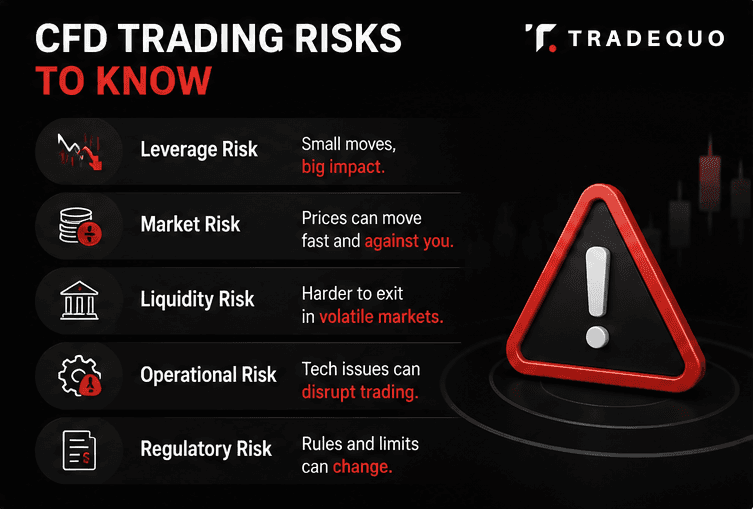
The main CFD trading risks come from the combination of leverage, market volatility and the structure of the product.

A position can lose value quickly when the underlying market moves against you. Leverage means the impact of that move is measured against the full market exposure rather than only the amount initially deposited as margin.

Other risks include slippage during fast market conditions, margin requirements, financing costs, transaction costs, and concentration in correlated positions. Regulatory protections can also differ between jurisdictions and account types.

Understanding these risks is more useful than focusing only on the potential benefits of CFDs. CFDs can provide access to a wide range of markets and allow traders to take positions on rising or falling prices, but those features come with corresponding risks.

Conclusion

CFD trading requires a clear understanding of how much you could lose before you decide how much you want to trade.

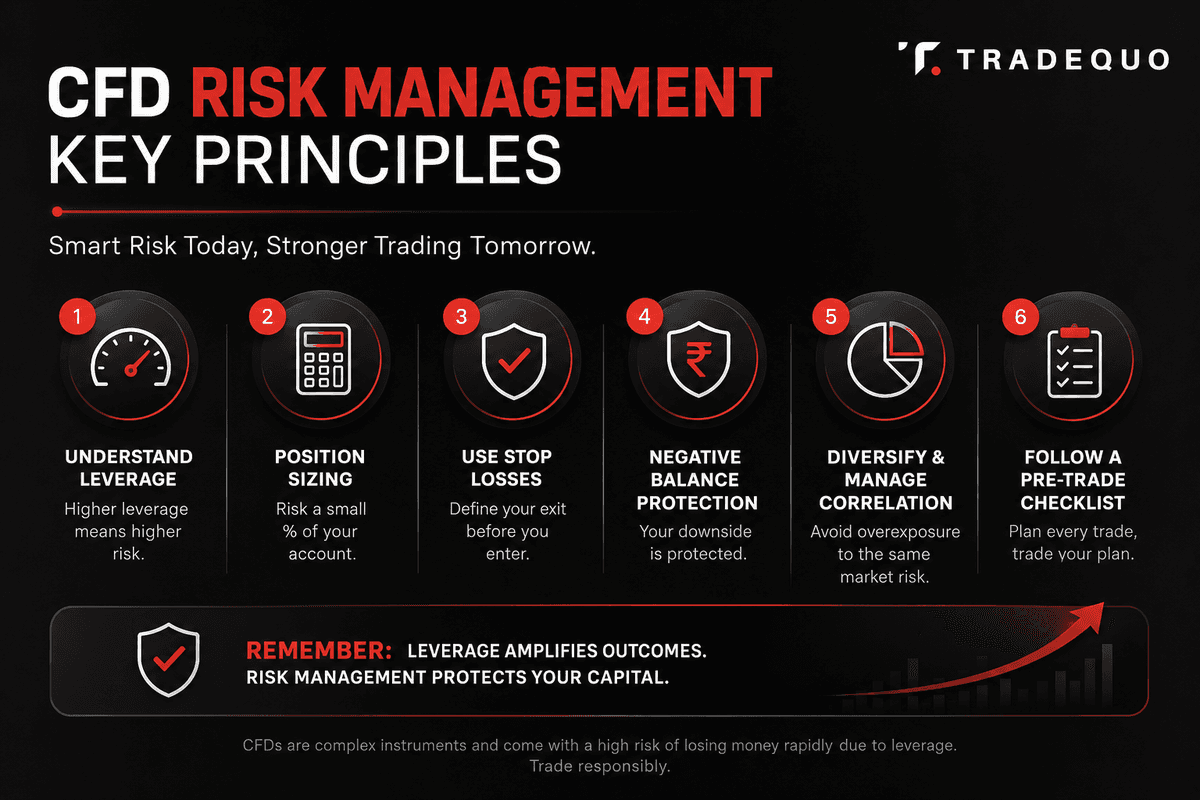
CFD risk management starts with controlling exposure. Position sizing, sensible use of leverage, stop loss planning, awareness of correlation and an understanding of negative balance protection can all form part of that process.

None of these tools guarantees a profitable trade or eliminates market risk. A stop loss can experience slippage, leverage can magnify losses, and even a diversified group of positions can be affected by a broad market event.

The goal of risk management is to make those risks visible and keep them within boundaries you have considered before entering the market.

Risk Disclaimer: CFDs are complex leveraged financial instruments and carry a high risk of losing money rapidly due to leverage. You should consider whether you understand how CFDs work and whether you can afford to take the risk of losing your money. Trading involves significant risk and is not suitable for every investor. 

FAQs

What Is The Risk In CFD Trading?

The main risk is that leverage magnifies the effect of price movements on your position. A relatively small movement in the underlying market can therefore produce a significant gain or loss relative to the margin used. Other CFD trading risks include slippage, margin requirements, financing costs, transaction costs and concentration in correlated positions.

Why Does High Leverage Increase CFD Trading Risk?

High leverage creates greater market exposure relative to the amount of margin committed. As a result, relatively small price movements can have a larger effect on the account. 

How Do You Manage Risk In CFD Trading?

Effective CFD risk management can include controlling position size, understanding total leverage exposure, setting appropriate stop losses, reviewing correlated positions, and keeping sufficient awareness of margin requirements.

How Do Professional Traders Manage Risk In CFD Trading?

Professional risk management generally starts with controlling exposure rather than trying to predict every market move. This can involve predefined risk limits, position sizing, stop loss planning, monitoring overall portfolio exposure, and reviewing how correlated positions could behave during periods of market stress.

What Are The Disadvantages Of CFD Trading?

The main CFD trading disadvantages include leverage-related losses, the possibility of rapid price-driven losses, financing and transaction costs, slippage, and the complexity of managing leveraged positions. 

人々に愛されている

市場から信頼されています

2025年アワード
2025年アワード
2025年アワード

© 2026 Trade Quo. All rights reserved.

This website provides content by group of companies, which include:

Tradequomarkets Financial Services L.L.C is a registered, authorised and regulated company by the Securities and Commodities Authority (SCA) of the United Arab Emirates, with License No. 20200000320 Category 5, to carry out regulated activities of Financial Consultations and Introduction. Its registered office is located at Business Tower, Main Business Village 114499 Dubai, UAE.

Tradequomarkets LTD (2023/C0024). Located at #8 Jepson Lane, St. George, Goodwill, Commonwealth of Dominica

Trade Quo Global Ltd, a securities dealer firm that is authorized and regulated by the Seychelles Financial Services Authority (FSA) with license number SD140.

Tradequo (PTY) Ltd is licensed in South Africa by the Financial Sector Conduct Authority with FSP license number 54827. The registered office: 33rd Floor – 34 Whiteley Road, 2196, Johannesburg, South Africa.

Quo Markets LLC, registered with Financial Services Authority FSA: 3171 LLC 2024. Registered address: Suite 305, Griffith Corporate Centre, Beachmont, Kingstown, SVG.

Tqbg Ltd, registered in Cyprus with registration number HE438084, registered address Archiespiskopou Makariou III 160 1st floor, 3026, Limassol, Cyprus. Is apointed payment agent, and does not engage in any regulated activities.

Risk Warning: CFDs are complex instruments and come with a high risk of losing money rapidly due to leverage. 72.6% of retail investor accounts lose money when trading CFDs with this provider. You should consider whether you understand how CFDs work and whether you can afford to take the high risk of losing your money.

Regional Restrictions: This website including the information and materials contained in it, is not directed at, or intended for distribution to or use by, any person or entity who is a citizen or resident of the following countries: USA, Israel, Iran, Iraq, Russia, Afghanistan, Cuba, Cyprus, Eritrea, Liberia, Libya, Somalia and Syria or any jurisdiction where such distribution, publication, availability or use would be contrary to applicable law or regulation.

TradeQuo and its affiliates do not target EU/EEA/UK clients.

人々に愛されている

市場から信頼されています

2025年アワード
2025年アワード
2025年アワード

© 2026 Trade Quo. All rights reserved.

This website provides content by group of companies, which include:

Tradequomarkets Financial Services L.L.C is a registered, authorised and regulated company by the Securities and Commodities Authority (SCA) of the United Arab Emirates, with License No. 20200000320 Category 5, to carry out regulated activities of Financial Consultations and Introduction. Its registered office is located at Business Tower, Main Business Village 114499 Dubai, UAE.

Tradequomarkets LTD (2023/C0024). Located at #8 Jepson Lane, St. George, Goodwill, Commonwealth of Dominica

Trade Quo Global Ltd, a securities dealer firm that is authorized and regulated by the Seychelles Financial Services Authority (FSA) with license number SD140.

Tradequo (PTY) Ltd is licensed in South Africa by the Financial Sector Conduct Authority with FSP license number 54827. The registered office: 33rd Floor – 34 Whiteley Road, 2196, Johannesburg, South Africa.

Quo Markets LLC, registered with Financial Services Authority FSA: 3171 LLC 2024. Registered address: Suite 305, Griffith Corporate Centre, Beachmont, Kingstown, SVG.

Tqbg Ltd, registered in Cyprus with registration number HE438084, registered address Archiespiskopou Makariou III 160 1st floor, 3026, Limassol, Cyprus. Is apointed payment agent, and does not engage in any regulated activities.

Risk Warning: CFDs are complex instruments and come with a high risk of losing money rapidly due to leverage. 72.6% of retail investor accounts lose money when trading CFDs with this provider. You should consider whether you understand how CFDs work and whether you can afford to take the high risk of losing your money.

Regional Restrictions: This website including the information and materials contained in it, is not directed at, or intended for distribution to or use by, any person or entity who is a citizen or resident of the following countries: USA, Israel, Iran, Iraq, Russia, Afghanistan, Cuba, Cyprus, Eritrea, Liberia, Libya, Somalia and Syria or any jurisdiction where such distribution, publication, availability or use would be contrary to applicable law or regulation.

TradeQuo and its affiliates do not target EU/EEA/UK clients.

人々に愛されている

市場から信頼されています

2025年アワード
2025年アワード
2025年アワード

© 2026 Trade Quo. All rights reserved.

This website provides content by group of companies, which include:

Tradequomarkets Financial Services L.L.C is a registered, authorised and regulated company by the Securities and Commodities Authority (SCA) of the United Arab Emirates, with License No. 20200000320 Category 5, to carry out regulated activities of Financial Consultations and Introduction. Its registered office is located at Business Tower, Main Business Village 114499 Dubai, UAE.

Tradequomarkets LTD (2023/C0024). Located at #8 Jepson Lane, St. George, Goodwill, Commonwealth of Dominica

Trade Quo Global Ltd, a securities dealer firm that is authorized and regulated by the Seychelles Financial Services Authority (FSA) with license number SD140.

Tradequo (PTY) Ltd is licensed in South Africa by the Financial Sector Conduct Authority with FSP license number 54827. The registered office: 33rd Floor – 34 Whiteley Road, 2196, Johannesburg, South Africa.

Quo Markets LLC, registered with Financial Services Authority FSA: 3171 LLC 2024. Registered address: Suite 305, Griffith Corporate Centre, Beachmont, Kingstown, SVG.

Tqbg Ltd, registered in Cyprus with registration number HE438084, registered address Archiespiskopou Makariou III 160 1st floor, 3026, Limassol, Cyprus. Is apointed payment agent, and does not engage in any regulated activities.

Risk Warning: CFDs are complex instruments and come with a high risk of losing money rapidly due to leverage. 72.6% of retail investor accounts lose money when trading CFDs with this provider. You should consider whether you understand how CFDs work and whether you can afford to take the high risk of losing your money.

Regional Restrictions: This website including the information and materials contained in it, is not directed at, or intended for distribution to or use by, any person or entity who is a citizen or resident of the following countries: USA, Israel, Iran, Iraq, Russia, Afghanistan, Cuba, Cyprus, Eritrea, Liberia, Libya, Somalia and Syria or any jurisdiction where such distribution, publication, availability or use would be contrary to applicable law or regulation.

TradeQuo and its affiliates do not target EU/EEA/UK clients.