
Introduction
The forex market does not have a universal entry fee. What you need depends on your trading goals, your preferred trading style, the forex broker you choose, and perhaps most importantly, your approach to risk management.
The good news is that the barrier to entry has dropped dramatically over the past decade. Many forex brokers now allow traders to open a real forex account with as little as $1. That accessibility is genuinely remarkable, but it comes with a catch: starting with too little capital often leads to poor decision-making, excessive risk-taking, and a trading account that barely survives its first few weeks. So while the minimum amount to start forex trading has never been lower, the amount you should start with is a very different conversation.
What Is the Minimum Amount to Start Forex Trading?
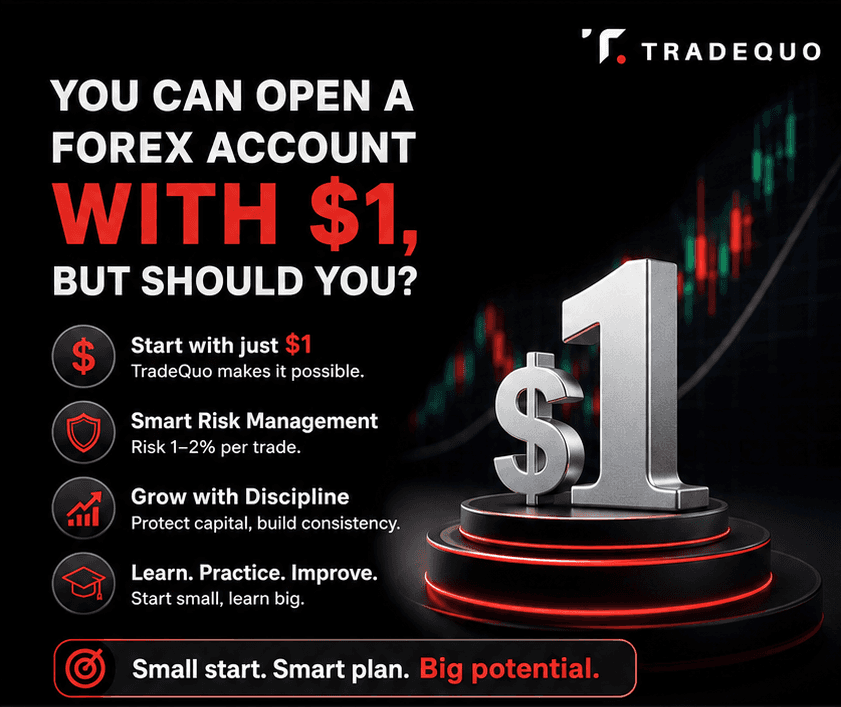
Technically, the forex trading minimum deposit depends entirely on the broker you choose. Some platforms require $200 or $500 to open a standard account. TradeQuo allows you to start forex trading with as little as $1 across all account types.
That $1 entry point sounds almost too good to be true, but it is real, and it serves a purpose. It allows new traders to transition from a demo account to a real forex account without committing significant capital they are not yet comfortable risking. The experience of risking real money, even a small amount, teaches emotional discipline that virtual money simply cannot replicate.
However, opening an account with $1 and actually trading forex productively with $1 are two separate things. At the micro-lot level, your position sizes will be extremely small, and your potential profits will reflect that. The purpose of starting with a very low deposit is to build confidence, develop your trading strategy, and observe how price movements behave in the live foreign exchange market before scaling up your trading capital.
Realistic Expectations With Different Budgets in the Forex Market
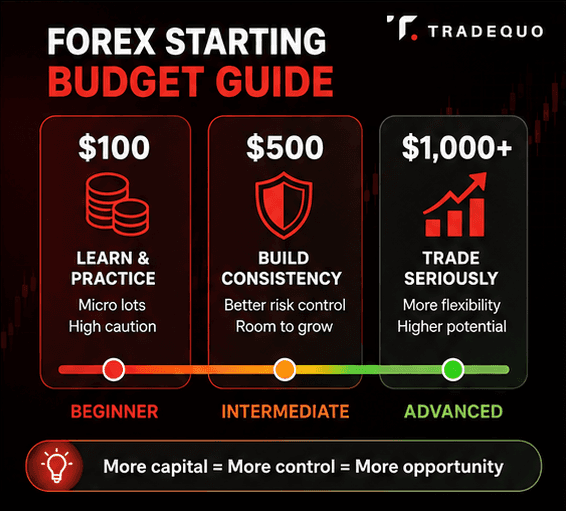
Let me break this down by actual dollar amounts so you can see where you fit.
Start Forex Trading With $100
This is probably the most common budget for new traders, and it comes up constantly in discussions about whether you can trade forex with $100. The short answer is yes, you technically can. The longer answer is that you need to be extremely careful about how you do it.
With $100, you can open a micro account and trade micro lots, which represent 1,000 units of currency. This keeps your risk per trade small enough to survive more than a few losing trades. However, the structural costs of trading eat into your profits much more aggressively when your account is small. Spreads, slippage, and commissions take up a larger percentage of your potential gains, making it mathematically harder to grow your account.
You also face the psychological challenge of wanting to size up too quickly. With only $100, even small losses feel significant. Traders often respond by taking on too much risk, trying to turn that one hundred into something meaningful in a hurry. That desperate mindset is exactly what leads to blown accounts.
If you do start forex trading with $100, treat it as a learning budget rather than an investment. Expect to lose it. Learn from every trade. Keep a trading journal. And do not add more money until you can prove you know what you are doing.
Start Forex Trading With $500
This is where things start to get more realistic. With $500, you can follow proper risk management guidelines much more effectively. The widely accepted rule among forex traders is to risk no more than one to two percent of your account balance on any single trade. At $500, that gives you 5 to 10 dollars of risk per trade.
That might not sound like much, but it is enough to trade micro lots with a reasonable stop loss. You can take twenty to thirty losing trades in a row and still have capital left to keep going. That buffer is crucial because losing streaks happen to everyone. Even the best traders lose often. What separates successful traders from the rest is that they manage those losses well enough to stay in the game.
Most forex trading platforms today will let you open an account with $500. Many brokers also offer cent accounts at this level, which let you trade in smaller increments and practice your strategy with even lower risk.
Start Forex Trading With $1000 to $5000
This is the recommended starting capital range for those who want to take trading seriously. With one thousand to five thousand dollars, you can implement a proper risk management strategy without constantly worrying about a margin call wiping you out. You can also access better account types, tighter spreads, and more trading tools.
At this level, you can start exploring different trading styles. Day trading becomes more viable because you have enough capital to absorb the natural fluctuations of intraday price movements. Swing trading, where you hold positions for several days or weeks, works well too. You can also begin using both technical analysis and fundamental analysis to inform your trading decisions.
Professional traders often start with personal accounts in this range before moving on to prop firm capital or larger funded accounts. It gives you enough breathing room to learn without so much financial pressure that you make emotional decisions.
How Leverage Changes the Equation for Forex Traders
Leverage is one of those topics that confuses a lot of new traders, so let me explain it clearly. Leverage allows you to control a larger position with a smaller amount of capital. If your broker offers 1:100 leverage, your one-hundred-dollar account can control a ten-thousand-dollar position in the market.
That sounds amazing until you realize the same leverage works against you just as hard. A two percent move against your trade could wipe out your entire account in seconds. Leverage amplifies both profits and losses, making it a double-edged sword that cuts deep when you are wrong.
Here is what many new traders do not realize. Higher leverage does not mean you should use all of it. Just because your broker offers 1:1000 leverage does not mean you need to trade at that level. Many successful traders use much lower leverage than their broker allows, precisely because they understand how dangerous high leverage can be for small accounts.
If you are starting with a minimal deposit, high leverage creates an almost irresistible temptation to overtrade. You see how much buying power you have, and you want to use it. That is exactly how accounts get blown up. A few bad trades with excessive leverage can trigger a margin call and close all your positions automatically, leaving you with nothing.
The smart approach is to treat leverage as a tool for flexibility rather than a weapon for aggression. Use just enough to trade reasonable position sizes, and always calculate your position size based on your stop loss distance and your one to two percent risk rule.
Choosing The Right Forex Broker And Trading Platform
Not all forex brokers are created equal, and who you trade with has a real impact on your results. When evaluating a forex broker, look for regulation by a recognized financial authority. Regulated brokers operate under rules designed to protect clients and ensure fair trading conditions.
Beyond regulation, consider the trading costs. Spreads, the difference between the buy and sell price of a currency pair, are effectively the cost of executing each trade. Tighter spreads matter more the more frequently you trade. Fees on deposits and bank transfers are another consideration, particularly for smaller accounts where every dollar counts.
Account type flexibility is also important. Brokers that offer micro lot trading accommodate smaller accounts far better than those that only support standard lot sizes. The ability to control your position size is directly tied to your ability to implement a proper risk management strategy.
TradeQuo offers a minimum deposit of just $1 across its account types, with dynamic leverage, zero commission on Standard accounts, and access to platforms including MetaTrader 4, MetaTrader 5, and TradingView. For traders who want to start small, practice strategies with limited capital, and scale up as their trading skills develop, that combination of low minimum deposits and flexible account structures is genuinely useful.
Risk Management Is Not Optional
Proper risk management is the single most important factor in whether you succeed or fail as a trader. It matters more than your entry strategy, more than your technical analysis skills, more than which currency pairs you choose to trade.
A stop loss order is your best friend. It automatically closes your trade when the price reaches a certain level, protecting you from catastrophic losses. Set your stop loss at a level that respects your one to two percent risk per trade rule. Never move it further away because you hope the market will turn around. That is how small losses become account killers.
Your risk management strategy should also include position sizing based on your stop loss distance. A wider stop loss means a smaller position size. A tighter stop loss allows a larger position size. Either way, your dollar risk stays the same. This takes the emotion out of sizing your trades.
Keep a trading journal. Write down every trade you take, why you took it, where your stop loss was, where your target was, and what happened. Review your journal regularly to see what is working and what is not. This alone will accelerate your learning more than any trading course or indicator.
Trading Strategies for Small Accounts
When you start forex trading with a limited budget, your choice of trading style matters more than you might think.
Swing trading works very well for small accounts. You hold positions for several days or weeks, aiming to catch medium-term price movements. This approach requires less screen time than day trading, and the wider timeframes mean you can set wider stop losses without blowing your risk budget.
Swing trading also exposes you to fewer trading costs because you are not entering and exiting positions constantly. Day trading is possible with a small account, but much harder. You need enough capital to absorb the small losses that inevitably occur throughout a trading day. A minimum of five hundred to one thousand dollars is typically recommended for day trading to manage risks effectively.
Scalping, where you make dozens or hundreds of trades each day for tiny profits, is extremely difficult with a small account. The transaction costs alone can eat up your profits before you even start. Leave scalping to traders with larger accounts and professional-grade infrastructure.
Trend following is another solid option. You simply identify the direction of the dominant trend on a higher timeframe and look for opportunities to trade in that direction. This strategy works well with small accounts because you are not fighting the market. You are going with the flow.
The Psychological Reality of Small Account Trading
Let me be honest with you about something that rarely gets discussed. Trading with a small account is psychologically harder than trading with a large account, not easier.
When you have only one hundred dollars at stake, it feels like play money. You might take risks you would never take with a larger account. You might skip setting a stop loss because you do not care about losing one hundred dollars. That casual attitude leads to bad habits that will destroy you when you eventually trade with real money.
The opposite problem also happens. When one hundred dollars actually matters to you, every loss feels devastating. You might hold losing trades too long, hoping they come back. You might take profits too early because you are afraid of giving back your gains. You might revenge trade after a loss, trying to get your money back immediately. All of these behaviors lead to poor trading decisions.
The healthiest approach is to view your initial trading capital as a tuition payment. You are paying to learn. You will make mistakes. You will lose money. That is fine, as long as you learn from every loss and improve your process. The goal of your first few months is not to get rich. The goal is to learn how to trade without going broke.
Start With a Demo Account Before Trading Real Money
A demo account lets you practice trading with virtual money before you risk a single real dollar. You can test strategies, learn how your trading platform works, and make all your beginner mistakes without paying for them.
Treat your demo account seriously. Use the same position sizes you would use with your real account. Set stop losses. Keep a trading journal. Track your results. If you cannot be profitable on a demo account after a few weeks of consistent trading, you will not be profitable with real money either.
Once you have proven to yourself that you can follow your trading plan on a demo account, you can switch to a live account with a small amount of real money. The transition will still feel different because real money changes your emotions. But at least you will have the mechanical skills in place.

How Much Should You Really Start With
So, what is the ideal answer to how much money do you need to start trading forex? Here is a realistic breakdown.
If your goal is to learn and gain experience, starting with one hundred to five hundred dollars is reasonable. It allows you to trade micro lots, apply risk management strategies, and develop consistency.
If your goal is to trade more actively and pursue higher potential profits, a range between one thousand and five thousand dollars provides a stronger foundation.
Anything below one hundred dollars should be treated as practice capital rather than serious trading capital.
Remember, forex trading is not a shortcut to quick wealth. It is a skill that takes time, patience, and continuous improvement.
Whether you want to test the waters with $1 or start with a more substantial deposit, TradeQuo offers the account types, trading tools, and platform options to match where you are. Not ready to commit real capital yet?
Practice your trading strategy, get comfortable with the platform, and step into the live forex market when you feel genuinely prepared.
FAQs
Is $100 enough to start forex trading?
Yes, you can start trading forex with $100. Many brokers offer micro accounts that allow you to trade small position sizes. However, you must be extremely disciplined with leverage and risk management to avoid losing your capital quickly.
What should I focus on when trading currency pairs as a beginner?
When trading currency pairs, beginners should focus on understanding market price behavior and identifying support and resistance levels. These levels help guide better trading decisions when opening and closing positions. Instead of chasing quick gains, prioritize risk management and build consistency across different financial markets.
Can I lose more than I deposit in forex?
While most modern brokers offer negative balance protection to prevent you from owing more than your invested capital, the use of high leverage means you can lose your entire trading account balance very quickly if the market moves against you.
Is trading CFDs a good way to start in Forex?
Trading CFDs carries both opportunities and risks. It allows you to speculate on price movements without owning the underlying asset, but it also involves risk money. When trading CFDs, especially with small capital, effective risk management is essential to protect your account and avoid unnecessary losses.
What is a margin call?
A margin call happens when your trading account falls below the required amount to keep your open trades active. The forex broker may close your positions automatically to prevent further losses.
Can beginners achieve significant profits in Forex trading?
While significant profits are possible, they are rarely immediate. Trading success comes from discipline, experience, and consistent execution. Most successful traders focus first on managing risk and refining their strategy before aiming for larger returns.