Have you ever looked at a stock chart and felt like you needed a finance degree just to pick one company? You are not alone. That is exactly why so many new traders end up exploring indices trading instead of hunting for the next single winning stock. Index trading gives you a way to take a view on an entire market or sector in one move, without betting everything on a single company's earnings report or CEO tweet.
Let’s explore what indices in trading actually are, how index trading works in practice, the main types of indices you will come across, and the risks worth understanding before you place your first trade. By the end, you will have a clear, honest picture of whether trading indices fits your style, and how to get started if it does.
What Is Index Trading?
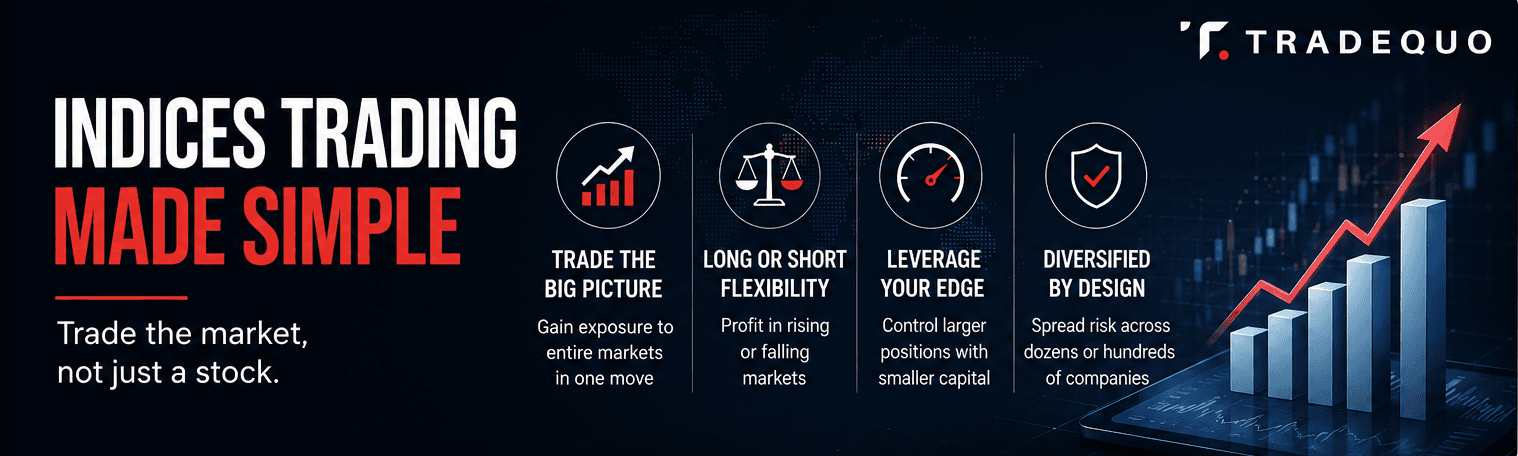
A stock market index is a number that tracks the combined performance of a group of shares. Think of the S&P 500, the FTSE 100, or the Dow Jones Industrial Average. Each one bundles together dozens or hundreds of companies into a single figure that rises and falls based on how those companies are doing collectively.
Index trading means taking a position on the price movement of that number, rather than buying shares in any one of the underlying companies. So when someone asks what is index trading in plain terms, the short answer is this: you are trading the health of a market or sector, not the fortunes of a single business.
This is where indices trading differs sharply from picking individual stocks. Instead of researching one company's balance sheet, you are watching broader economic trends, market sentiment, and how a whole basket of businesses is performing together. It is a different mindset, and for many beginners, a more manageable one.
How Does Index Trading Work?
An index itself cannot be bought or sold directly. It is not a company, and it does not issue shares. An index is simply a calculated value that reflects the prices of its constituent stocks.
So how do people actually trade indices, then? Through financial derivatives, most commonly CFDs (contracts for difference). When you trade indices using CFDs, you are agreeing to exchange the difference in the index's price between when you open and close your position. You never own anything underlying; you are simply speculating on price movements.
This structure gives traders flexibility that stock investing does not always offer. You can go long if you expect an index to rise, or go short if you expect it to fall. That means opportunities exist in both rising and falling markets, which is a meaningful shift in thinking for someone used to a buy-and-hold approach to individual stocks.
Leverage is another core piece of how index trading works. With CFDs, a relatively small margin deposit can control a much larger position size. This magnifies potential gains, but it is worth saying clearly: it magnifies potential losses just as much. Leverage is a tool, not a shortcut, and it deserves respect from day one.
Indices trading hours are tied to the underlying stock exchange. If you are trading an index built from companies listed on the London Stock Exchange, its trading hours will generally mirror that exchange. The same logic applies to indices linked to the Frankfurt Stock Exchange or the Tokyo Stock Exchange. Knowing when your chosen market is actually active matters just as much as knowing what you are trading.
Types of Indices
Not all indices are built the same way, and understanding the differences will help you make more informed decisions once you start trading.
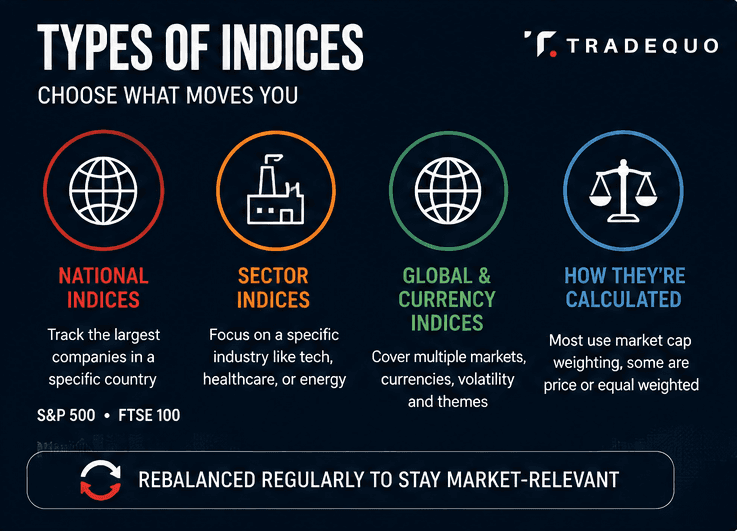
National Indices
These track the largest, most established companies in a specific country. The S&P 500 reflects the performance of 500 prominent US companies, while the FTSE 100 tracks the 100 largest companies listed on the London Stock Exchange. National indices are often the most heavily traded and closely watched, partly because they double as a general barometer for how a country's economy is doing.
Sector Indices
Rather than covering an entire market, sector indices zero in on a specific industry, such as technology, healthcare, or energy. These are useful if you have a view on a particular part of the economy without wanting to pick a single winner within it.
Global and Currency Indices
Some indices span multiple markets or track broader themes, while currency indices measure a currency's value against a basket of others. There are also volatility indices, like the VIX, which measure the market's expectation of volatility itself rather than price direction.
How Indices Are Calculated
Most major indices use market capitalisation weighting, meaning larger companies have more influence over the index's movement. A handful of price-weighted indices exist too, where higher-priced stocks carry more weight regardless of the company's overall size. Less common are equal-weighted indices, which treat every constituent stock the same, no matter how big or small the company is. Indices are also periodically rebalanced or reconstituted, so the list of companies inside them, and their relative weight, shifts over time to stay representative of the market they are meant to reflect.
Why Beginners Trade Indices Instead of Individual Stocks
There is a reason so many new traders gravitate toward indices trading before moving on to individual stocks.
First, it simplifies your research. Instead of digging into one company's quarterly earnings, debt levels, and management decisions, you are watching broader market movements and economic data. That is a lighter mental load for someone just starting out.
Second, indices provide built-in diversification. When you trade an index, you gain exposure to dozens or hundreds of companies in a single position, which naturally spreads risk across multiple businesses rather than concentrating it in one. If a single company inside the index has a bad quarter, it is unlikely to sink the entire index.
Third, major indices like the S&P 500 and FTSE 100 tend to have high liquidity. That generally translates into tighter spreads and more reliable trade execution, both of which matter when you are learning the ropes and do not want unpredictable costs eating into your results.
Finally, indices can be used defensively as well as offensively. Traders sometimes use index positions to hedge existing stock holdings, offsetting potential losses elsewhere in their portfolio. That kind of flexibility is harder to replicate with single stocks alone.
Risks to Understand Before You Start
None of this means indices trading is risk-free. It is not, and anyone telling you otherwise is not being straight with you.
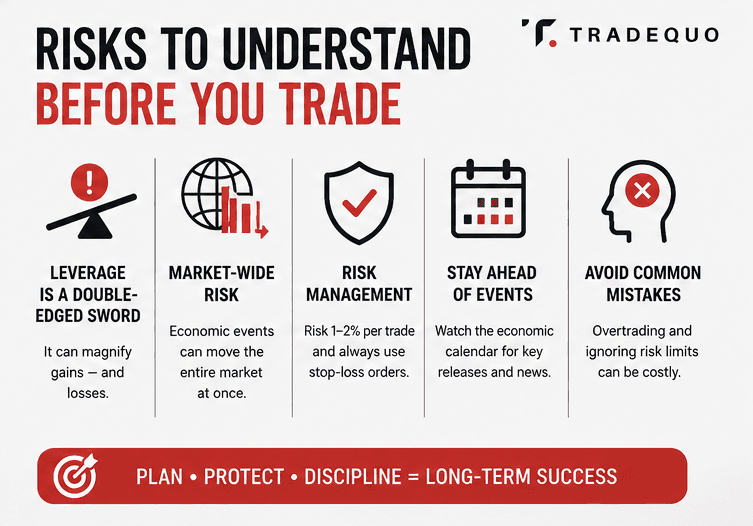
Leverage cuts both ways. The same mechanism that lets a smaller deposit control a larger position can turn a modest market move into a significant loss just as easily as a gain. This is the single most important thing for a beginner to internalize before placing a leveraged trade.
Market-wide risk is also real. Because an index is made up of many companies, it is exposed to broad economic shifts, interest rate decisions, inflation data, and geopolitical events that can move an entire market at once. Diversification within an index spreads company-specific risk, but it does not eliminate market risk altogether. During sharp sell-offs, correlations between assets tend to increase, meaning even a diversified index can drop quickly alongside everything else.
Good risk management is not optional. Most experienced traders recommend risking no more than one to two percent of total capital on any single trade, and using stop-loss orders to cap potential downside automatically. A trading plan with clear entry and exit rules, decided before you place a trade rather than in the heat of the moment, tends to separate disciplined traders from those who let emotion drive decisions. Overtrading and ignoring risk limits are among the most common mistakes beginners make, and they are also among the easiest to avoid once you know to watch for them.
Keep an eye on the economic calendar too. Inflation figures, employment data, and central bank announcements can move indices sharply, sometimes within seconds of release. Understanding what drives price movements is just as important as understanding how to place a trade.
How to Start Trading Indices with TradeQuo
If you have decided that indices trading fits how you want to approach the markets, getting started does not need to be complicated.
Begin with well-known, liquid indices such as the S&P 500 or FTSE 100. Their higher trading volume tends to mean more reliable execution, which is one less variable to worry about while you are still learning.
From there, decide on your trading style. Some traders prefer breakout trading, entering a position when price decisively moves past a clear resistance or support level. Others lean on candlestick chart patterns and broader technical analysis to time entries and exits. There is no single correct approach, but it helps to pick one method, learn it properly, and avoid jumping between strategies before giving any of them a fair test.
TradeQuo offers account types with a minimum deposit starting from $1, which makes it accessible if you want to start small while you build experience. Actual position sizing and margin requirements will still depend on the leverage you choose and the specific index you are trading, so it is worth understanding those mechanics before your first live trade rather than after.
Whichever platform or account you choose, start with a plan, use stop-loss and limit orders from the outset, and treat your first few months as a learning period rather than a sprint toward big returns.
Conclusion
Indices trading offers a genuinely different way to engage with the markets, one built around broad exposure rather than betting on a single company's next move. It simplifies research, spreads risk across many businesses at once, and gives you the flexibility to trade rising and falling markets. None of that removes the real risks that come with leverage and market-wide volatility, but with a clear trading plan, sound risk management, and a willingness to start small, index trading can be one of the more approachable ways for a beginner to step into the markets with confidence.
Disclaimer: CFDs are complex instruments and come with a high risk of losing money rapidly due to leverage. You should consider whether you understand how CFDs work before investing.
FAQ
What is index trading?
Index trading means taking a position on the price movement of a stock market index, a basket of stocks grouped by market, sector, or theme, rather than buying shares in any single company.
How does index trading actually work?
Since an index cannot be bought or sold directly, traders use derivatives like CFDs to speculate on its price. A long position profits if the index rises, and a short position profits if it falls, with leverage determining how much market exposure a given deposit controls.
What are the different types of indices?
Indices generally fall into three broad categories. National indices track a country's largest companies, like the S&P 500 or FTSE 100. Sector indices focus on a specific industry. Global or thematic indices track a broader trend across multiple markets.
Can you trade an index directly?
No. An index is a calculated value, not a physical or tradable asset. Traders gain exposure through derivatives such as CFDs, futures, or index-tracking funds instead.
How much money do I need to start trading indices?
This depends on the broker and account type you choose. TradeQuo's account types have a minimum deposit starting from $1, though your actual position size and margin requirements will depend on the leverage and index you are trading.