What is social trading, exactly, and why does it seem to be everywhere right now? At its core, it is a way of approaching financial markets that trades isolation for community, letting people watch, learn from, and even mirror the moves of traders they trust. Instead of staring at charts alone and second-guessing every decision, you get a window into what other traders are actually doing in real time.
This shift matters because trading has traditionally been a solitary, research-heavy pursuit. Social trading platforms flipped that model by adding a social layer on top of the markets, similar to how a social network works, except the content is trading ideas, strategies, and performance history instead of photos and updates. Before you decide whether it fits your own trading plan, it helps to understand what is actually happening behind the scenes, how it differs from copy trading, and where the real risks sit.
What Is Social Trading?

Social trading is a way of trading financial markets where users can view, follow, and interact with other traders through a shared platform, rather than making every decision in isolation. It blends the technical side of trading with the interactive feel of a social network, so users can browse public profiles, follow trading performance, join discussions, and pick up ideas from people who have been in the markets longer than they have.
Unlike traditional trading, which relies heavily on independent research and self-executed trades, social trading is built around community engagement and open strategy sharing. Traders publish their positions, reasoning, and results, and other users can comment, ask questions, or simply observe. For newer traders especially, this creates a kind of open classroom where lessons come from real, live decisions instead of theory.
Social trading networks typically include tools like leaderboards ranking traders by performance, activity feeds showing recent trades, and profile pages that lay out a trader's history and risk tolerance. Some platforms lean more toward forex social trading, focused specifically on currency pairs, while others cover stocks, commodities, and other asset classes. The exact features vary, but the underlying idea stays the same: trading becomes something you can watch and learn from, not just something you do alone.
Social Trading vs. Copy Trading: What's the Difference?
These two terms get used interchangeably so often that the distinction tends to get lost, but they are not quite the same thing. Social trading is the broader platform experience: the profiles, the leaderboards, the comment sections, the sense of being part of a social trading strategies community. Copy trading is one specific feature that lives inside that experience.
Copy trading automatically replicates the trades of a selected trader into your own account. Once you choose to copy someone, their opening and closing positions are mirrored in your portfolio based on settings you control, like how much capital to allocate per trade. It is a hands-off approach to investing in the sense that you are not manually placing each trade yourself, but you still decide who to follow and how much exposure to take on.
So while all copy trading happens within a social trading environment, not everyone using a social trading platform is copying trades. Plenty of users just browse, read discussions, gauge market sentiment, and build their own trading plan using what they learn, without ever automating a single position. The community interaction is the constant, and copy trading is simply the optional automation layered on top of it.
How Does a Social Trading Platform Actually Work?
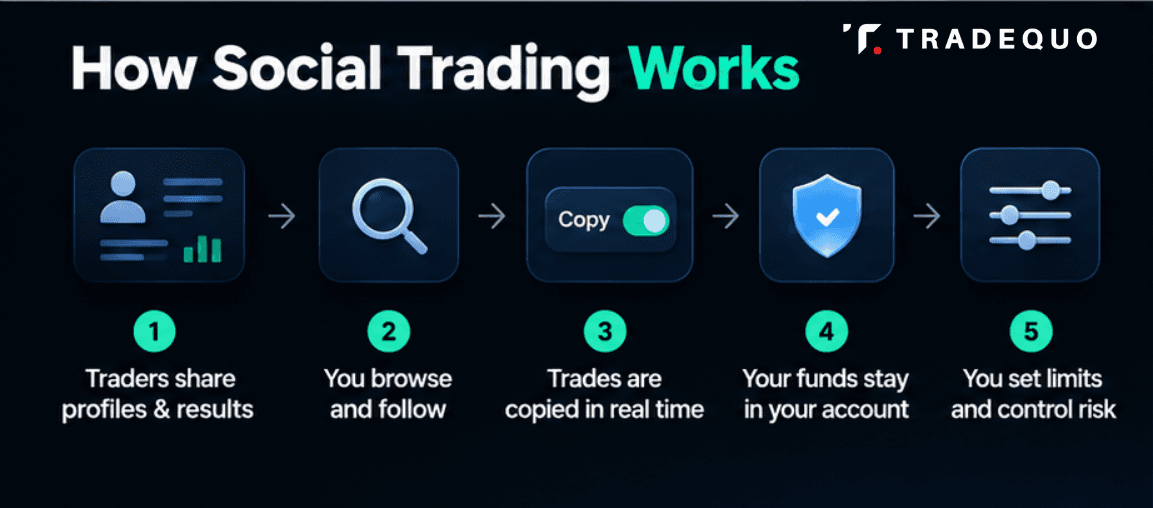
Under the hood, most social trading platforms follow a fairly consistent pattern, even if the interface looks different from one provider to the next. Experienced traders open a public profile that displays their trading history, win rate, drawdown, and other performance metrics. This transparency in performance metrics is what lets other users evaluate a trader before committing any capital to follow them.
Other users then browse a leaderboard of these profiles, filtering by trading style, risk level, or asset classes traded. Once someone decides to follow a trader, that trader's trades automatically get copied into the follower's account in real time, scaled to match the follower's own account size and risk settings. If the leader opens a position, the follower's account opens a proportional version of that same trade within moments.
Importantly, users maintain ownership of their accounts throughout this process. Your funds stay in your own account with your own broker; you are simply granting the platform permission to replicate specific trades based on the parameters you set. You can usually adjust maximum trade sizes, set a stop-loss level, or pause copying at any time. That said, technical failures can delay trade executions in social trading, so there can occasionally be a lag between when a leader trades and when it appears in a follower's account, which matters more in fast-moving markets.
Leaders (Signal Providers) and Followers: The Two Roles
Every social trading platform runs on this basic dynamic between two roles. Leaders, sometimes called trading signal providers, are the professional traders being followed. They build a public trading history, and many are compensated through a share of the fees or spreads generated by their followers. This gives them an incentive to trade consistently and transparently rather than take reckless swings for short-term attention.
Followers are the users who browse these profiles and choose whose trades to copy. A single follower might split their capital across multiple traders with different trading styles, using one for longer-term positions and another for quicker, higher-frequency trades. This lets followers diversify, spreading risk across different strategies instead of tying their entire account to one person's judgment call.
It is worth remembering that leaders are still human traders making decisions under pressure, and past performance does not guarantee future success in trading. A strong 12-month track record says something meaningful about consistency, but it is not a promise of what happens next.
Benefits of Social Trading for Beginners?
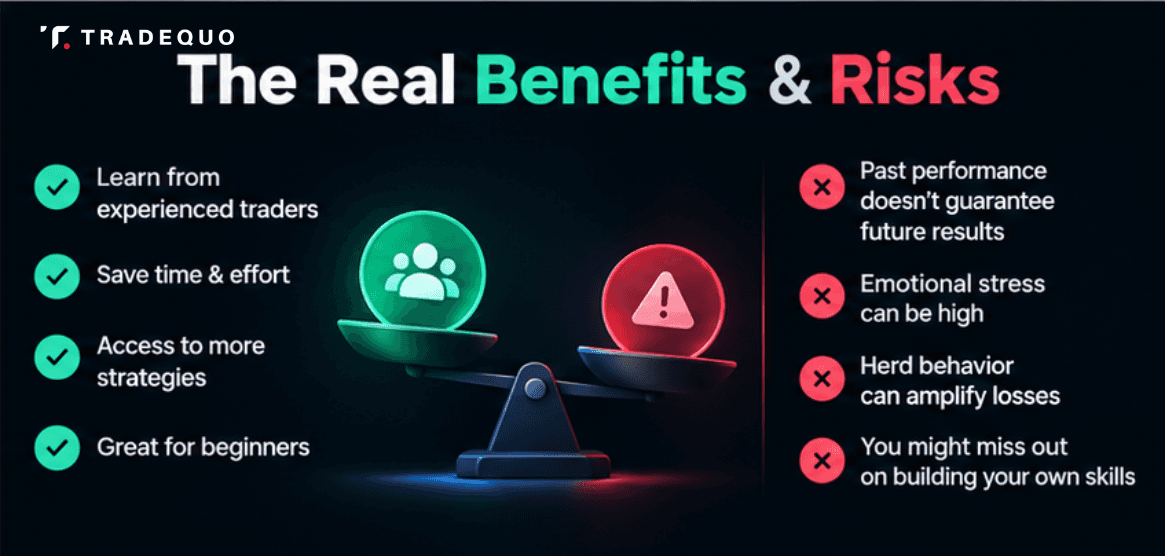
Social trading is often marketed toward beginner traders, and there is a reasonable case for that. It enhances learning through shared insights and discussions, letting new traders see how seasoned traders think through entries, exits, and risk management in real time, rather than learning purely from books or backtested strategies. It can also reduce the need for constant market monitoring, since a follower is not required to watch every tick to stay in the game.
But keep in mind, beginner-friendly does not mean risk-free. Watching others control your money can cause emotional stress, especially the first time a copied trade moves against you and you feel like a passenger rather than the one behind the wheel. There is also a well-documented tendency toward herd behavior in social trading, where large numbers of users pile into the same popular trader, which can amplify losses if that trader's strategy hits a rough patch at the same time for everyone following them.
Over-reliance on others can also hinder your own trading skills development. If every decision is outsourced to a followed trader, it becomes harder to build the judgment, technical analysis, and fundamental analysis skills that make someone a capable trader on their own. The most successful beginners tend to treat social trading as a learning tool alongside their own education, not a total replacement for it.
How to Start Social Trading
If you are considering giving it a try, a measured approach tends to work better than diving in headfirst. A few practical steps can make the difference between a frustrating first few months and a genuinely useful start to your trading journey.
Spend at least one month on a demo account, ideally a forex demo account if currency pairs are your focus, before risking real capital.
Choose traders with at least 12 months of consistent performance rather than someone on a short, flashy winning streak.
Allocate only 10 to 20 percent of your capital to start social trading, keeping the rest in reserve until you are comfortable with how copying behaves in practice.
Set maximum trade sizes and stop-loss levels before copying anyone, so a single bad run does not wipe out a disproportionate share of your account.
Monitor copied trades weekly rather than daily to stay informed without slipping into panic-driven decisions every time the market dips.
Also, make sure any platform you use prioritizes regulatory safety and offers protections like negative balance protection, and be upfront with yourself about hidden fees that can erode profits over time, since spreads, commissions, and performance fees vary significantly between providers.
Conclusion
Social trading did not just add a chat feature to trading platforms; it changed what trading itself looks like for a huge number of retail traders. By combining real trading data with a social network-style experience, it gives people access to the strategies and reasoning of far more experienced investors than they would ever encounter trading alone. Copy trading, as the automated piece inside that experience, makes it possible to act on that access without needing to place every trade by hand.
None of that removes the fundamentals, though. Trading still involves risks, markets still move against even the best traders occasionally, and no leaderboard ranking replaces your own understanding of risk tolerance and market conditions. Used carefully, with a demo account first, a modest allocation, and clear limits set in advance, social trading can be a genuinely useful entry point into the markets. Used carelessly, it is just as capable of amplifying mistakes as it is of sharing wins.
FAQs
What is social trading?
Social trading is a way of trading financial markets where users can view, follow, and automatically replicate the strategies of other traders through a shared platform, rather than trading in isolation.
How does social trading actually work?
Traders create a public profile with a visible track record, other users browse a leaderboard of these profiles, and once someone chooses a trader to follow, that trader's positions are copied into the follower's account in real time based on the follower's own risk settings.
What's the difference between social trading and copy trading?
Social trading is the broader platform experience, covering profiles, leaderboards, and community features, while copy trading is the specific automated mechanism inside it that replicates a chosen trader's positions.
Is social trading suitable for beginners?
It can be, since it removes the need to build a strategy from scratch, but beginners should still check a trader's track record and set their own risk limits rather than copying blindly.
What risks come with social trading?
Past performance of a followed trader does not guarantee future results, and losses are still possible since the follower carries the same market risk as the trader they are copying.