Introduction
Trading is the buying and selling of financial instruments with the aim of profiting from changes in their market prices. For beginners, the trading world can seem full of unfamiliar terms, charts, and numbers, but the basic idea is easier to understand than it first appears.
This guide explains what trading means, how trading works, how trading differs from investing, what markets you can trade, and the main trading styles beginners should know. It also covers how to approach a first trade, why leverage matters, and what risks should be considered before putting real money into the market.
What Is Trading?
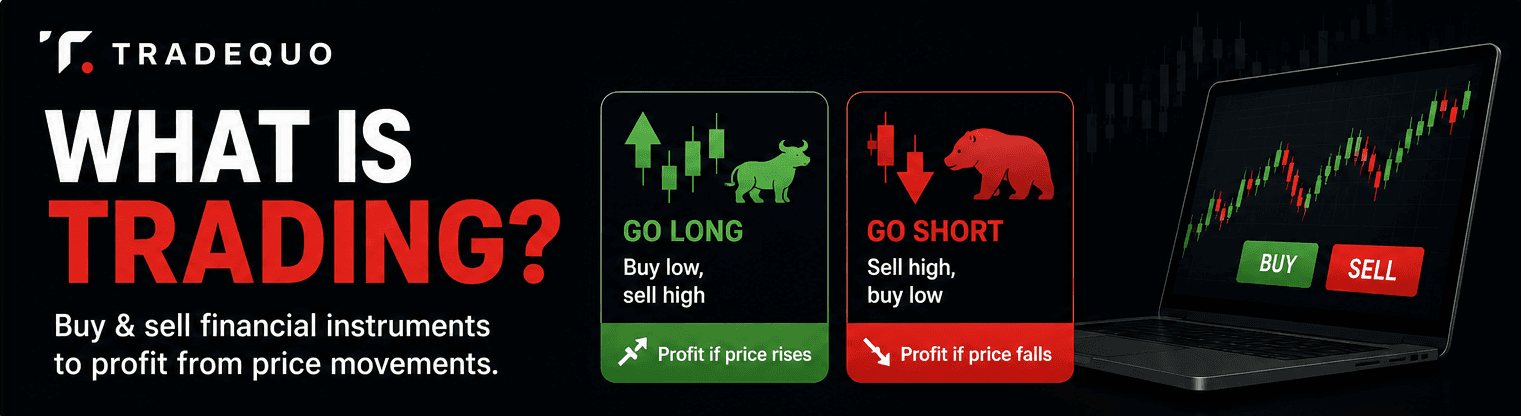
To define trading clearly: it is the process of speculating on the price movements of financial assets to generate a profit. These assets, known as financial instruments, can include everything from currency pairs and company stocks to commodities like gold and oil.
A key characteristic of modern trading, particularly with instruments like Contracts for Difference (CFDs), is that you don't need to own the underlying asset itself. Instead, you are speculating on its price direction.
As a trader, you can choose between two primary positions:
Going Long: This means you "buy" an asset because you believe its price will rise in the future. Your profit is the difference between the lower price at which you bought and the higher price at which you sell.
Going Short: This means you "sell" an asset first, expecting its price to fall. You profit from the difference between the higher price at which you sold and the lower price at which you buy it back later to close the position.
This ability to potentially profit in both rising and falling markets is one of the fundamental distinctions between trading and traditional investing.
Trading vs. Investing: What's the Difference?
While the terms are often used interchangeably, trading and investing are distinct approaches to the financial markets. The core differences lie in the time horizon, ownership, and primary method of profit generation.
Investing typically takes a long-term view. An investor buys assets like stocks or bonds with the expectation that their value will appreciate over years or even decades. They often own the underlying asset and may benefit from dividends or interest payments, focusing on the fundamental health and growth of the company or economy. Investing involves a buy-and-hold strategy, aiming to build wealth gradually over time.
Trading, in contrast, is focused on the short to medium term. A trader's goal is to profit from the price fluctuations of an asset, which can happen within seconds, minutes, days, or weeks. Traders often use derivatives like CFDs, which give them exposure to the price movement of an asset without needing to own the underlying asset itself. The focus is on market sentiment, technical patterns, and short-term catalysts, with profit coming from price changes in either direction.
What Can You Trade?
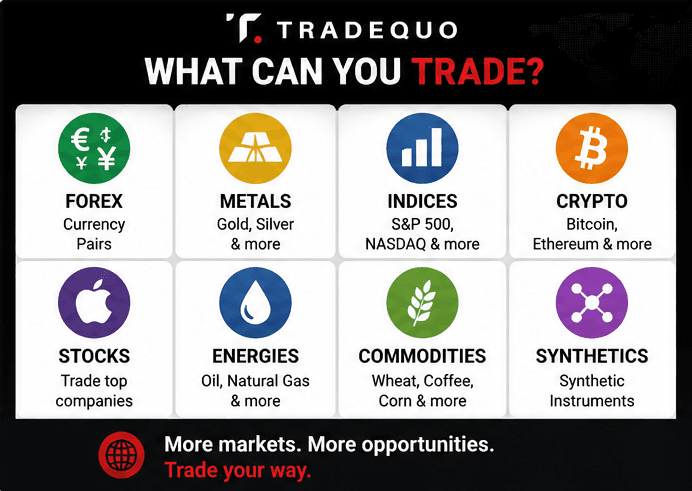
One of the most exciting aspects of trading is the sheer variety of markets available. You are not limited to a single asset class; you can build a diversified portfolio by trading different instruments based on your interests and risk tolerance. Here are some of the most common asset classes:
Forex (Foreign Exchange)
The forex market is where currencies are traded, such as the Euro against the US Dollar (EUR/USD). It's the largest and most liquid financial market in the world, operating 24 hours a day.
Metals
Precious metals such as gold and silver are popular markets because their prices can respond to factors including interest rates, inflation expectations, economic conditions, currency movements, and investor sentiment.
Indices
An index, like the S&P 500 or the NASDAQ, tracks the performance of a group of stocks from a specific sector or region. This allows you to trade on the overall performance of a market without buying each stock.
Stocks (Equities)
This involves trading shares of individual companies, such as Apple or Tesla. When you trade stocks, you are speculating on the performance of a single corporation.
Energies
Energy markets include instruments linked to products such as crude oil and natural gas. Prices can be influenced by supply and demand, production levels, geopolitical developments, inventories, and changes in global economic activity.
Commodities And Soft Commodities
These are raw materials or primary agricultural products, such as Wheat, Coffee, Cotton, and Corn. Their prices can be highly volatile, driven by weather patterns, harvests, and global consumption.
Synthetics
Synthetic instruments are products designed to replicate specific market movements or trading conditions. Their characteristics can differ considerably from traditional financial markets, so traders should understand the product specifications before opening a position.
How Does Trading Work?
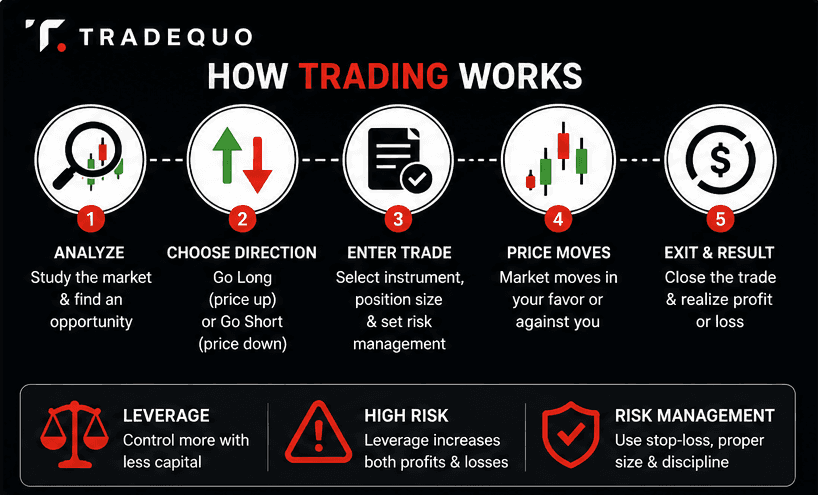
At the most basic level, how trading works comes down to price movement.
Prices in financial markets are influenced by supply and demand. When market participants collectively place more buying interest relative to available selling interest, prices can rise. When selling pressure becomes stronger, prices can fall.
A trader studies the market and decides whether the conditions support a long or short position. The trader then chooses the instrument, position size, entry level, and risk management approach before opening the trade.
The potential profit or loss is generally determined by the difference between the entry price and the exit price, multiplied by the size of the position. Trading costs can also affect the final result.
Consider a simple hypothetical example. A trader opens a position with exposure of $1 per point. If the market moves 50 points in the trader's favor, the position produces a $50 gain before applicable costs. If the market moves 50 points in the opposite direction, the result is a $50 loss before costs.
This example is deliberately simple. Actual trading calculations depend on the instrument, contract size, position size, account currency, trading costs, and other conditions.
Understanding Leverage And Margin
Leverage allows a trader to control a larger position with a smaller amount of capital, known as margin. This can make it possible to gain greater market exposure without providing the full value of the position upfront.
Leverage also increases the size of potential losses. A relatively small market movement can have a significant effect on the account when a highly leveraged position is used.
That is why understanding margin and leverage is a fundamental part of learning how trading works. The amount of capital required to open a position should never be confused with the maximum amount that can be lost.
Types Of Trading
Beyond the asset you trade, the style defines the timeframe you operate in. Choosing a trading style depends largely on your personality, available time, and risk tolerance.
Day Trading
This involves opening and closing all positions within the same trading day. Day traders do not hold positions overnight to avoid the risk of price gaps that can occur after the market closes. It requires intense focus, quick decision-making, and is often treated as a full-time job.
Swing Trading
Swing traders aim to capture short-to-medium-term gains by holding positions for a few days to several weeks. They attempt to profit from "swings" or momentum in the market and may use a combination of technical and fundamental analysis.
Position Trading
This is the longest-term style. Position traders hold positions for weeks, months, or even years. They are less concerned with short-term market noise and focus primarily on fundamental analysis to capture major market trends. This style is often compared to investing but still uses trading tools like leverage.
Getting Started With Trading
Learning how trading works does not require starting with real money. A demo account can give beginners an opportunity to practice using virtual funds and become familiar with market orders, charts, position sizes, and platform features before taking financial risk.
Once the basic mechanics are understood, the next step is to consider the account structure. The account types are designed around different trading conditions rather than representing a universal ranking from best to worst. Traders should review the specifications and consider how the conditions fit their intended approach.
After becoming comfortable with the platform and understanding the account conditions, a beginner can move from a demo environment to a live account if they decide that real money trading is appropriate.
A first trade should be treated as part of the learning process. Before opening a position, it is worth knowing what instrument is being traded, whether the position is long or short, how much exposure is being taken, what the potential loss could be, and which costs apply.
Risk In Trading
It is essential to acknowledge the inherent risks involved in trading. The potential for profit is always accompanied by the potential for loss. Leverage, as discussed, can magnify financial losses just as it can magnify gains. This can lead to losses that exceed your initial deposit.
Furthermore, markets are influenced by a myriad of unpredictable factors, from economic data and geopolitical events to sudden shifts in market sentiment. Because of this, it is critical to only trade with capital you can afford to lose. A robust risk management strategy, including the use of stop-loss orders, proper position sizing, and never risking more than a small percentage of your account on a single trade, is non-negotiable for long-term sustainability.
Conclusion
Trading is the dynamic activity of buying and selling financial instruments, ranging from forex and commodities to indices and stocks, to profit from their price movements. It is fundamentally distinct from investing, differing in its focus on short-term price action rather than long-term value appreciation. By understanding how trading works and the assets available, you can begin to build a strategy that fits your goals. While the journey requires education, discipline, and a clear-eyed view of risk, it offers an accessible entry point to the world's financial markets. To begin, consider opening a demo account - a risk-free way to explore the markets and discover what style suits you best.
FAQs
What Is Trading In Simple Terms?
Trading is buying and selling financial instruments such as forex, stocks, metals, indices, or commodities with the goal of potentially profiting from changes in price. With derivative products such as CFDs, traders can speculate on price movements without necessarily owning the underlying asset.
What Is The Difference Between Trading And Investing?
Trading typically focuses on shorter or medium-term price movements, while investing generally involves holding an owned asset over a longer period. Trading can allow exposure to rising or falling prices, while traditional investing often focuses on long-term appreciation or income from owned assets.
What Can You Trade On?
Common tradable asset classes include forex, stock indices, metals, energies, individual stocks, and commodities. Each market has its own characteristics, trading hours, liquidity, volatility, and risks, so beginners should understand the specific instrument before opening a position.
What Are The Different Ways To Trade?
Traders can go long when expecting prices to rise or go short when expecting prices to fall. Trading styles can also vary by holding period, with day trading generally involving same-day positions, swing trading covering several days or longer, and position trading potentially lasting weeks or months.
How Can Beginners Get Started With Trading?
Beginners can start by learning basic market concepts and practicing with a demo account that uses virtual funds. After becoming familiar with order types, position sizing, leverage, margin, and risk management, a trader can decide whether moving to a live account is appropriate.
Risk Disclaimer: CFDs are complex instruments and come with a high risk of losing money rapidly due to leverage. You should consider whether you understand how CFDs work before investing.