差价合约(CFDs)是复杂的金融工具,并且由于杠杆作用,存在迅速亏损的高风险。投资前,您应考虑自己是否了解差价合约的运作方式。

MT5 vs MT4: Which Trading Platform Is Better?

Table of Contents

  • Introduction

  • MT5 vs MT4: Purpose and Asset Coverage

  • Key Feature Differences Between the MT4 and MT5 Trading Platforms

  • Order Types, Hedging vs Netting, and What It Means for Your Trading

  • Broker Compatibility and Platform Support

  • Which Platform Should You Choose?

  • Conclusion

  • FAQs

Introduction

When traders talk about forex and CFD platforms, two names dominate every conversation: MetaTrader 4 and MetaTrader 5. Both were built by MetaQuotes Software, and both have earned a loyal following for good reasons. But if you've been wondering about the difference between MT4 and MT5, you're not alone. Millions of traders face this exact question when opening a new account or switching brokers. The honest answer is that neither platform is universally superior. The better choice depends entirely on what you trade, how you trade it, and what tools matter most to your strategy. 

This MT4 vs MT5 comparison will walk you through everything you need to know.

MT5 vs MT4: Purpose and Asset Coverage

MT5 vs MT4

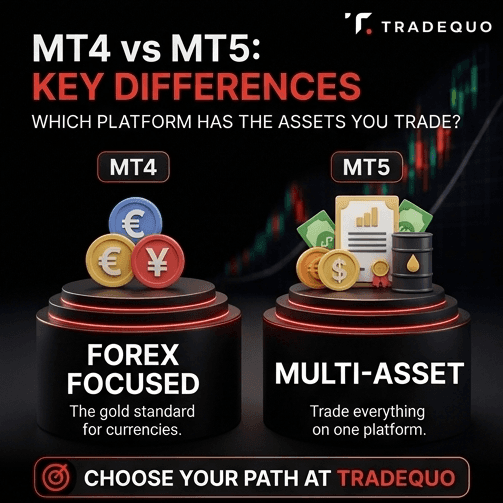
MetaTrader 4 was released in 2005 and quickly became the gold standard for retail forex trading. Its design was intentional and focused. MT4 was built specifically for currency pairs, and that narrow focus turned out to be a massive advantage. Brokers adopted it fast, traders learned it quickly, and the ecosystem around it, including thousands of Expert Advisors, custom indicators, and scripts, grew into something almost unmatched in the retail trading world.

MetaTrader 5 arrived in 2010 with a different vision. MetaQuotes designed MT5 as a multi-asset trading platform, meaning it was built from the ground up to support not just forex, but also stocks, commodities, futures, and exchange-traded instruments. This distinction matters more than most traders initially realize.

If your entire focus is on currency pairs, MT4 gives you everything you need without excess complexity. The platform is lean, fast, and deeply familiar to most forex brokers and their support teams. But if you want to trade equities alongside your forex positions, or if you're interested in futures contracts and broader market exposure, MT5 trading is structurally better suited to handle that kind of diversity.

It's worth noting that MT5 is not simply an upgraded version of MT4. MetaQuotes built it on a different codebase, which is why MT4 Expert Advisors are not directly compatible with MT5 without modification. For algorithmic traders who've spent years developing custom MT4 tools, that incompatibility is a real consideration. For newer traders starting fresh, it's less of a concern.

The bottom line on purpose is straightforward. MT4 excels at forex and CFD trading within a familiar, well-supported environment. MT5 opens the door to multi-asset trading with a broader technical foundation.

Key Feature Differences Between the MT4 and MT5 Trading Platforms


Differences Between the MT4 and MT5

The feature gap between these platforms is larger than many traders expect. Let’s highlight the visible ones. 

Timeframes 

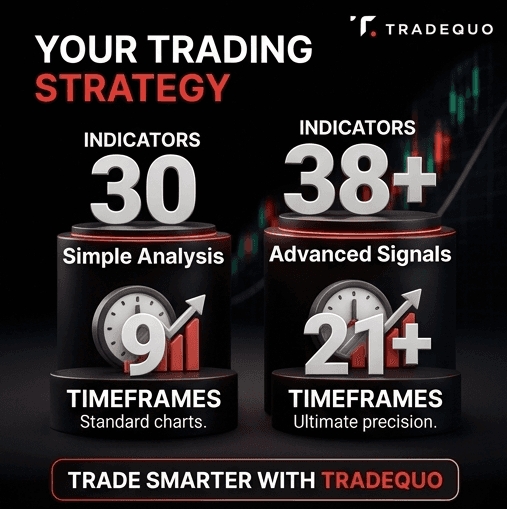
MT4 offers 9 chart timeframes, ranging from one minute to one month. MT5 expands that to 21 timeframes, giving traders far more granularity for technical analysis. If you rely on custom timeframes to refine your entries and exits, MT5 clearly has the advantage here.

Technical Indicators 

MT4 comes with 30 built-in technical indicators. MT5 increases that count to 38, along with a broader selection of graphical objects for chart analysis. Both platforms support custom indicators, but MT5's native library is richer out of the box.

Economic Calendar 

One of the most practical MT5 advantages over MT4 is the integrated economic calendar. MT5 includes the calendar directly into the platform, so traders can track high-impact news events without switching between windows or external tools. MT4 does not include this feature natively, which means traders have to rely on third-party sources or browser tabs to monitor fundamental data.

Depth of Market 

MT5 includes a built-in Depth of Market window, often referred to as the order book or DOM. This feature lets traders see pending buy and sell orders at different price levels, which is particularly valuable for understanding short-term supply and demand dynamics. MT4 does not offer native Depth of Market functionality, which is a meaningful gap for traders who trade with volume context in mind.

Strategy Tester 

MT5's strategy tester supports multi-threaded optimization and multi-currency testing, allowing algorithmic traders to backtest Expert Advisors across multiple symbols simultaneously. MT4's strategy tester runs on a single thread and tests one instrument at a time. For anyone serious about MT5 vs MT4 for algorithmic trading, this difference alone can be a deciding factor.

Programming Language 

MT4 uses MQL4 and MT5 uses MQL5. MQL5 is a more powerful, object-oriented language that offers greater flexibility for building complex trading tools. However, MQL4 still has a larger community library simply because of its longer market presence.

Order Types, Hedging vs Netting, and What It Means for Your Trading

This section addresses one of the most misunderstood differences between the two platforms, and it's one that can genuinely affect how you manage open positions.

MT4 uses a hedging system by default. This means you can open multiple positions on the same instrument in opposite directions simultaneously. If you're long on EUR/USD and you want to open a short on EUR/USD as well, MT4 allows both positions to coexist independently in your account. Many forex traders built their entire risk management strategies around this capability, which is why MT4's hedging support remains such a strong retention factor.

MT5 was originally designed around a netting system, which means the platform aggregates positions on the same instrument into a single net position. If you're long 1 lot and you open a short 1 lot trade on the same pair, MT5 closes the position rather than holding both simultaneously.

However, MetaQuotes later introduced hedging account types in MT5 as well, so depending on your broker's MT5 setup, you may have access to hedging functionality. It's worth confirming the account type before assuming MT5 operates purely on netting logic.

Where MT5 genuinely improves on MT4 is in order variety. MT5 supports six pending order types compared to MT4's four. The additions are Buy Stop Limit and Sell Stop Limit orders, which allow traders to set more precise entry conditions by combining stop and limit logic. MT5 also supports partial order closing natively, giving traders more nuanced control over position sizing as trades develop.

For traders whose strategy depends on simultaneous opposite positions, confirming hedging availability on an MT5 account is essential before switching platforms.

Broker Compatibility and Platform Support

MT4 remains the more widely supported platform across global forex brokers, and that's unlikely to change overnight. Its 21-year presence in the market means the infrastructure around it is deeply embedded, from liquidity provider integrations to back-office systems and customer support training. When you choose an MT4 trading account, you're working with a platform that virtually every broker's support team knows inside and out.

MT5 adoption has grown steadily, and more brokers now offer both platforms simultaneously. Regulatory trends have also played a role, as some jurisdictions have encouraged or required brokers to move toward platforms that support better trade reporting, an area where MT5 has structural advantages.

That said, not every broker that offers MT5 provides access to all asset classes on the platform. Some brokers license MT5 but restrict it to forex and CFDs, which means you may not automatically gain access to stocks or futures simply by choosing MT5. If multi-asset trading is your goal, it's worth confirming what instruments your specific broker offers on the MT5 trading platform before making a decision.

TradeQuo supports both MT4 and MT5, giving traders the flexibility to choose based on their individual needs rather than platform availability.

Which Platform Should You Choose?


 MT4 or MT5

The right answer depends on three things: what you trade, how you trade, and whether your existing tools are tied to one platform.

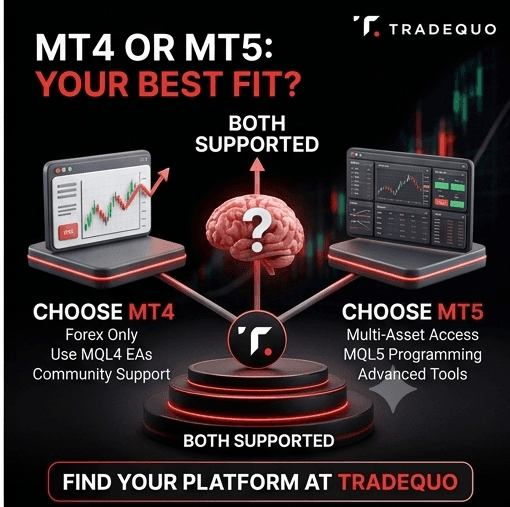
Choose MT4 if: You trade forex and major CFDs exclusively, your strategy relies on hedging with simultaneous opposite positions, and your broker doesn't offer MT5 hedging accounts; you've already built or purchased Expert Advisors coded in MQL4, or you prefer a simpler interface with a well-established support community.

Choose MT5 if: You want access to stocks, futures, or commodities alongside forex, you value advanced features like Depth of Market, a built-in economic calendar, and extended timeframes, you're building new algorithmic strategies and want the more powerful MQL5 language, or you're a newer trader without legacy tools tying you to MT4.

For beginners specifically, both platforms have approachable learning curves, but slightly favor MT4 for pure forex trading because of the abundance of tutorials, community resources, and broker support available. MT5 is equally learnable, but its feature depth can feel overwhelming before you've established a clear trading direction.

Regulatory considerations may also influence your choice. In some markets, regulators prefer or mandate certain platform configurations that affect hedging account availability. This is another reason to confirm account type details with your broker directly.

Conclusion

The MT4 vs MT5 debate doesn't have a single correct answer, and that's actually reassuring. MT4 remains a world-class forex trading platform with unmatched broker support and a growing community. MT5 is the more technically advanced option, built for traders who need multi-asset access, deeper charting tools, and more sophisticated order management. Understanding the difference between MT4 and MT5 means you can make a decision based on your actual trading goals rather than hype. TradeQuo offers both platforms so you can explore each one and choose the environment where you trade best.

FAQs

What is the difference between MT4 and MT5? 

MT4 is a forex-focused platform that supports hedging and has been the industry standard since 2005. MT5 is a multi-asset platform offering more timeframes, additional order types, a built-in economic calendar, and Depth of Market functionality. They run on different codebases, so indicators and Expert Advisors are not directly interchangeable between them.

Is MT5 better than MT4? 

MT5 offers more features and broader asset coverage, but it depends on your needs. For pure forex trading with hedging strategies, MT4 may suit you more effectively. For multi-asset trading and advanced analytical tools, MT5 has clear advantages.

Can MT4 accounts be used on MT5? 

No. MT4 and MT5 are separate platforms with different codebases. You need a specific account for each platform. Your broker will set up either an MT4 trading account or an MT5 trading account, and the two are not interchangeable.

Should beginners choose MT4 or MT5? 

Beginners focused on forex trading often find MT4 easier to start with due to the volume of available tutorials and community support. MT5 is equally learnable and offers more tools, but newer traders benefit from confirming their primary trading goals before choosing.

Why do brokers offer both MT4 and MT5? 

Because different traders have different needs. MT4 retains a massive user base and broker infrastructure built over two decades. MT5 attracts traders who need multi-asset access and more advanced features. Offering both allows brokers to serve a wider range of trading styles and experience levels.

深受人们喜爱

深受市场信赖

2025奖项
2025奖项
2025奖项

© 2026 Trade Quo. All rights reserved.

This website provides content by group of companies, which include:

Tradequomarkets Financial Services L.L.C is a registered, authorised and regulated company by the Securities and Commodities Authority (SCA) of the United Arab Emirates, with License No. 20200000320 Category 5, to carry out regulated activities of Financial Consultations and Introduction. Its registered office is located at Business Tower, Main Business Village 114499 Dubai, UAE.

Tradequomarkets LTD (2023/C0024). Located at #8 Jepson Lane, St. George, Goodwill, Commonwealth of Dominica

Trade Quo Global Ltd, a securities dealer firm that is authorized and regulated by the Seychelles Financial Services Authority (FSA) with license number SD140.

Tradequo (PTY) Ltd is licensed in South Africa by the Financial Sector Conduct Authority with FSP license number 54827. The registered office: 33rd Floor – 34 Whiteley Road, 2196, Johannesburg, South Africa.

Quo Markets LLC, registered with Financial Services Authority FSA: 3171 LLC 2024. Registered address: Suite 305, Griffith Corporate Centre, Beachmont, Kingstown, SVG.

Tqbg Ltd, registered in Cyprus with registration number HE438084, registered address Archiespiskopou Makariou III 160 1st floor, 3026, Limassol, Cyprus. Is apointed payment agent, and does not engage in any regulated activities.

Risk Warning: CFDs are complex instruments and come with a high risk of losing money rapidly due to leverage. 72.6% of retail investor accounts lose money when trading CFDs with this provider. You should consider whether you understand how CFDs work and whether you can afford to take the high risk of losing your money.

Regional Restrictions: This website including the information and materials contained in it, is not directed at, or intended for distribution to or use by, any person or entity who is a citizen or resident of the following countries: USA, Israel, Iran, Iraq, Russia, Afghanistan, Cuba, Cyprus, Eritrea, Liberia, Libya, Somalia and Syria or any jurisdiction where such distribution, publication, availability or use would be contrary to applicable law or regulation.

TradeQuo and its affiliates do not target EU/EEA/UK clients.

深受人们喜爱

深受市场信赖

2025奖项
2025奖项
2025奖项

© 2026 Trade Quo. All rights reserved.

This website provides content by group of companies, which include:

Tradequomarkets Financial Services L.L.C is a registered, authorised and regulated company by the Securities and Commodities Authority (SCA) of the United Arab Emirates, with License No. 20200000320 Category 5, to carry out regulated activities of Financial Consultations and Introduction. Its registered office is located at Business Tower, Main Business Village 114499 Dubai, UAE.

Tradequomarkets LTD (2023/C0024). Located at #8 Jepson Lane, St. George, Goodwill, Commonwealth of Dominica

Trade Quo Global Ltd, a securities dealer firm that is authorized and regulated by the Seychelles Financial Services Authority (FSA) with license number SD140.

Tradequo (PTY) Ltd is licensed in South Africa by the Financial Sector Conduct Authority with FSP license number 54827. The registered office: 33rd Floor – 34 Whiteley Road, 2196, Johannesburg, South Africa.

Quo Markets LLC, registered with Financial Services Authority FSA: 3171 LLC 2024. Registered address: Suite 305, Griffith Corporate Centre, Beachmont, Kingstown, SVG.

Tqbg Ltd, registered in Cyprus with registration number HE438084, registered address Archiespiskopou Makariou III 160 1st floor, 3026, Limassol, Cyprus. Is apointed payment agent, and does not engage in any regulated activities.

Risk Warning: CFDs are complex instruments and come with a high risk of losing money rapidly due to leverage. 72.6% of retail investor accounts lose money when trading CFDs with this provider. You should consider whether you understand how CFDs work and whether you can afford to take the high risk of losing your money.

Regional Restrictions: This website including the information and materials contained in it, is not directed at, or intended for distribution to or use by, any person or entity who is a citizen or resident of the following countries: USA, Israel, Iran, Iraq, Russia, Afghanistan, Cuba, Cyprus, Eritrea, Liberia, Libya, Somalia and Syria or any jurisdiction where such distribution, publication, availability or use would be contrary to applicable law or regulation.

TradeQuo and its affiliates do not target EU/EEA/UK clients.

深受人们喜爱

深受市场信赖

2025奖项
2025奖项
2025奖项

© 2026 Trade Quo. All rights reserved.

This website provides content by group of companies, which include:

Tradequomarkets Financial Services L.L.C is a registered, authorised and regulated company by the Securities and Commodities Authority (SCA) of the United Arab Emirates, with License No. 20200000320 Category 5, to carry out regulated activities of Financial Consultations and Introduction. Its registered office is located at Business Tower, Main Business Village 114499 Dubai, UAE.

Tradequomarkets LTD (2023/C0024). Located at #8 Jepson Lane, St. George, Goodwill, Commonwealth of Dominica

Trade Quo Global Ltd, a securities dealer firm that is authorized and regulated by the Seychelles Financial Services Authority (FSA) with license number SD140.

Tradequo (PTY) Ltd is licensed in South Africa by the Financial Sector Conduct Authority with FSP license number 54827. The registered office: 33rd Floor – 34 Whiteley Road, 2196, Johannesburg, South Africa.

Quo Markets LLC, registered with Financial Services Authority FSA: 3171 LLC 2024. Registered address: Suite 305, Griffith Corporate Centre, Beachmont, Kingstown, SVG.

Tqbg Ltd, registered in Cyprus with registration number HE438084, registered address Archiespiskopou Makariou III 160 1st floor, 3026, Limassol, Cyprus. Is apointed payment agent, and does not engage in any regulated activities.

Risk Warning: CFDs are complex instruments and come with a high risk of losing money rapidly due to leverage. 72.6% of retail investor accounts lose money when trading CFDs with this provider. You should consider whether you understand how CFDs work and whether you can afford to take the high risk of losing your money.

Regional Restrictions: This website including the information and materials contained in it, is not directed at, or intended for distribution to or use by, any person or entity who is a citizen or resident of the following countries: USA, Israel, Iran, Iraq, Russia, Afghanistan, Cuba, Cyprus, Eritrea, Liberia, Libya, Somalia and Syria or any jurisdiction where such distribution, publication, availability or use would be contrary to applicable law or regulation.

TradeQuo and its affiliates do not target EU/EEA/UK clients.