

Table of Contents
Introduction
How to Choose a Trader to Copy
Why Diversifying Across Multiple Traders Reduces Risk
Setting Risk Limits on Copy Trading Relationships
Common Mistakes to Avoid in Copy Trading
Monitoring and Adjusting Your Copy Trading Strategy Over Time
Testing Strategies with a Demo Account First
Conclusion
Frequently Asked Questions
Introduction
Turning on copy trading is the easy part. What actually determines whether you make money or lose it is the strategy behind who you follow and how well you manage that relationship over time. This article assumes you already understand the mechanics of how copy trading works - subscribing to a trader, allocating capital, and having their trades mirrored in your account. If you need that foundation first, start with this article. Here, we're focused on the best copy trading strategies that separate consistent results from costly guesswork.
How to Choose a Trader to Copy
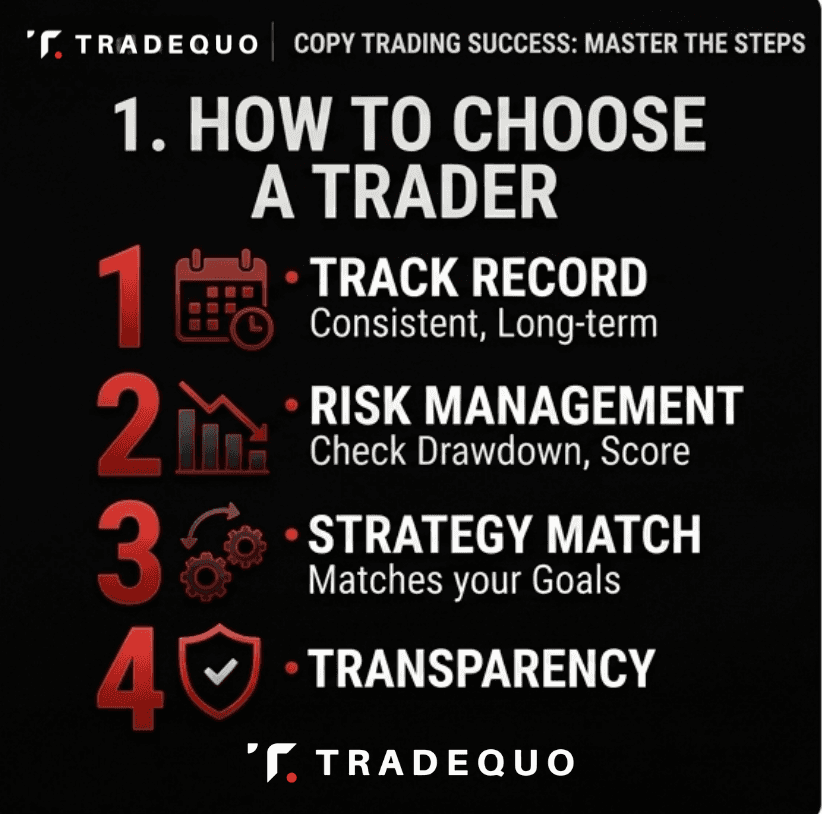
This is the decision that shapes everything else, so it deserves more scrutiny than most beginners give it.
Look at the full performance history, not just the highlights. A trader who's up 40% over the last month might look irresistible, but that snapshot tells you almost nothing about how they perform across different market conditions. Pull up their track record over six months, a year, or longer if it's available. You're looking for consistency and a strategy that holds up over multiple market cycles, not a lucky streak.
Check maximum drawdown and risk scores before you check returns. Maximum drawdown shows the largest peak-to-trough loss a trader has experienced, which is a far more honest picture of downside risk than headline profit figures. A trader with a 25% average annual return and a 60% maximum drawdown is a very different proposition than one with an 18% return and a 12% drawdown. Most platforms also assign a risk score - use it as a filter, not a footnote.
Match strategy compatibility to your own goals. A scalper who opens and closes dozens of positions a day trades on a completely different timeline and risk profile than a swing trader holding positions for weeks. Similarly, a trader focused exclusively on forex majors behaves nothing like one concentrated in volatile altcoins or indices. Before copying anyone, ask whether their asset focus, holding periods, and typical position sizing actually fit what you're trying to achieve and how much volatility you can tolerate.
Favor transparency and longevity over short-term gains. Traders who openly share their strategy logic, risk parameters, and historical losses (not just wins) are giving you the information you need to make an informed decision. A trader who's been active and profitable for two years through varying market conditions is generally a safer bet than one riding a three-week winning streak, even if the newer trader's numbers currently look flashier.
Why Diversifying Across Multiple Traders Reduces Risk
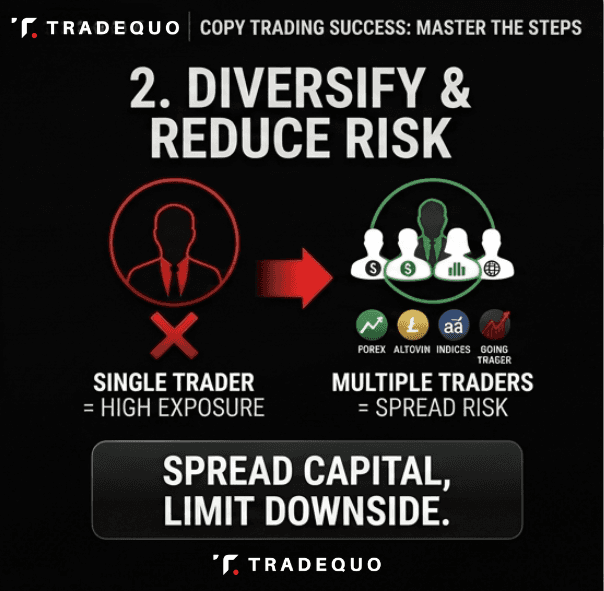
Following a single trader means your entire copy-trading portfolio lives or dies with that person's decisions. If their strategy stops working because market conditions shift, they take on more risk than usual, or they simply have a bad run, your whole allocation feels it.
Diversifying across traders with different strategies and risk profiles spreads that exposure. For example, instead of allocating 100% of your copy trading capital to one aggressive short-term trader, you might split it across three or four: a conservative long-term trader, a moderate swing trader, and one or two higher-risk, higher-reward specialists in a different asset class. If one underperforms or is paused, the others continue operating independently, and the impact on your overall portfolio is contained rather than total.
This isn't a nice-to-have - it's a core risk-management technique, the same principle that underpins diversification in any investment portfolio.
Setting Risk Limits on Copy Trading Relationships
Diversification protects you at the portfolio level. Risk limits protect you within each individual copy relationship.
Set a stop-loss on every trader you copy. Most platforms let you define a stop-loss threshold for each copy relationship independently, so a losing streak from one trader doesn't quietly erode your entire balance before you notice.
Cap how much capital any single trader can control. Even a trader with a strong track record shouldn't receive an outsized share of your allocation. Deciding in advance what percentage of your copy trading capital any one trader can hold, and sticking to it, prevents a single relationship from becoming a concentration risk you didn't intend to take on.
Treat your initial allocation as a starting point, not a permanent decision. Many beginners set their allocations once and never revisit them. Risk limits work best when they're adjusted as performance data comes in - tightening exposure to traders who are underperforming or showing increased volatility, and reallocating toward those who continue to perform within your risk tolerance.
Common Mistakes to Avoid in Copy Trading
Even experienced investors fall into these patterns. Avoiding them is often what separates a sustainable copy trading strategy from a frustrating one.
Over-reliance on a single trader. Concentrating your capital with one trader means their bad month is your bad month. Diversify and understand the strategy behind every trade you copy.
Ignoring broader market trends. A strategy that worked in a trending market can fall apart in a choppy or reversing one. Stay aware of overall market conditions rather than assuming a copied strategy will perform the same way regardless of context.
Neglecting risk management. Skipping stop-losses and allocation caps leaves you exposed to losses you could have limited. Set risk parameters before you start copying, not after a loss makes you wish you had.
Not engaging with trader performance data. Copying a trader and then never checking in on their results is a passive approach that invites unpleasant surprises. Review performance regularly, not just at the start.
Copying without understanding the underlying strategy. If you don't know why a trader makes the moves they make, you won't know when their approach has stopped fitting your goals or your risk tolerance.
Monitoring and Adjusting Your Copy Trading Strategy Over Time
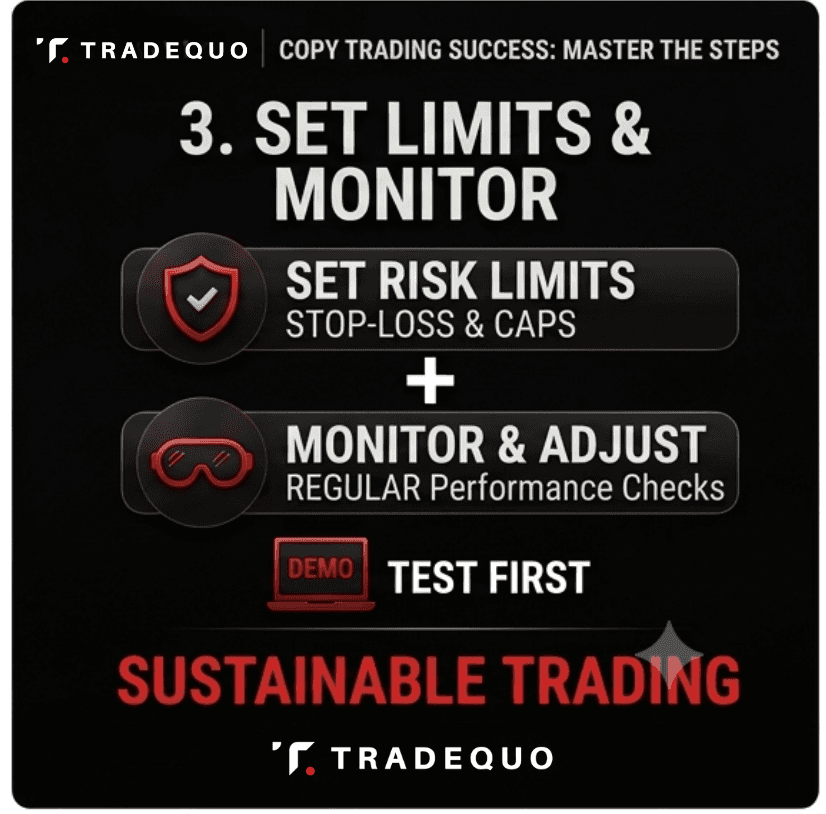
Copy trading isn't a "set it and forget it" activity. A trader's results and approach can change, sometimes gradually, sometimes overnight, and your strategy needs to keep pace.
Make it a habit to check performance metrics on a regular schedule, not just when something looks obviously wrong. Look for changes in drawdown, shifts in trading frequency or asset focus, and whether returns are still consistent with what attracted you to that trader in the first place.
Be willing to stop copying a trader whose strategy or results have shifted, even if they were a strong performer previously. Past performance earned them a spot in your portfolio; it doesn't guarantee they keep it. At the same time, treat your allocation amounts as adjustable, increasing exposure to traders who continue to perform within your risk tolerance, and scaling back on those who don't, rather than leaving your initial setup untouched indefinitely.
Testing Strategies with a Demo Account First
Before committing real capital to a new trader or an unfamiliar strategy, test it in a demo account. This lets you observe how a trader's approach plays out and how you feel about the volatility involved, without any financial risk attached.
A demo period of a few weeks to a few months is generally enough to see how a strategy behaves across different market conditions before you decide whether it deserves real allocation. This step is especially useful when you're considering a trader whose style is new to you, since it gives you a low-stakes way to confirm the strategy actually fits your goals before your own money is on the line.
Conclusion
Copy trading strategies aren't a one-time setup decision; they're an ongoing discipline of choosing carefully, diversifying deliberately, setting real risk limits, and staying engaged with performance over time. The traders who succeed at this aren't the ones who picked well once; they're the ones who keep evaluating and adjusting.
Frequently Asked Questions
How do I choose a reliable trader to copy?
Evaluate a trader's full performance history rather than recent results alone, check their maximum drawdown to understand realistic loss exposure, and confirm their trading style matches your own risk tolerance and goals.
What are the most common copy trading mistakes?
The most common mistakes are relying on a single trader instead of diversifying, ignoring how broader market conditions affect a copied strategy, and failing to set risk limits on individual copy trading relationships.
Should I diversify across multiple traders when trading copy?
Yes, following several traders with different strategies and risk profiles reduces dependence on any single trader's performance and limits the impact if one strategy underperforms.
How often should I review the traders I'm copying?
Performance and strategy should be reviewed regularly, since a trader's results and approach can change over time, and a strategy that worked previously may stop performing under different market conditions.
Disclaimer: CFDs are complex instruments and come with a high risk of losing money rapidly due to leverage. You should consider whether you understand how CFDs work before investing.